Why Fit Decides Whether Your Drop Sells Out
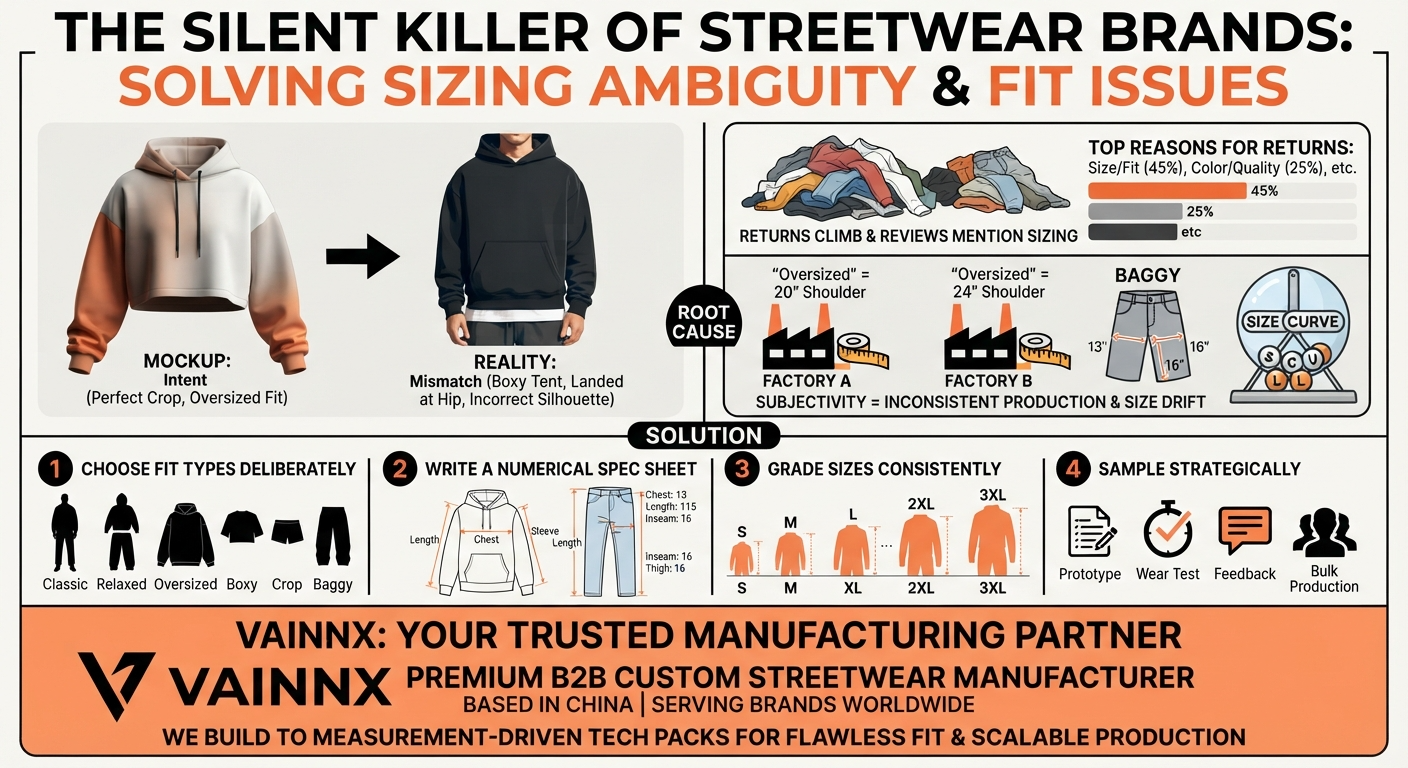
Most streetwear brands lose money on the same silent problem: the garment does not match the silhouette customers think they are buying. A graphic that looks incredible on a 3D mockup can land as a boxy tent, a crop that hits the hip instead of the ribs, or a baggy jean that fits like a skinny with extra fabric. The result is predictable — returns climb, reviews mention sizing instead of design, and retailers discount the leftover sizes.
Industry estimates consistently rank size and fit issues among the top causes of apparel returns, and the problem is amplified online, where customers cannot try before paying. The root cause is rarely laziness. It is ambiguity. "Oversized" means a 20-inch shoulder to one factory and a 24-inch shoulder to another. "Baggy" can describe a 13-inch thigh or a 16-inch thigh. Without numbers, every production run becomes a lottery, and every size curve drifts from the sample that won you the order.
The fix is not mysterious. It is a discipline of measurement: choosing a fit type deliberately, writing a spec sheet in numbers, grading the size range consistently, and sampling strategically before committing to bulk. That is what professional production teams do every day, and exactly what this guide gives you: the measurements behind the six core fits, the grading rules that scale them from S to 3XL, and a sample strategy that protects your margin. If you need a factory partner that can build to these specs, Vainnx, a premium B2B custom streetwear manufacturer based in China serving emerging and established fashion brands worldwide, works from exactly this kind of measurement-driven tech pack every week.
The Six Core Fit Types Every Streetwear Brand Must Know
Before any measurement matters, you need to know which fit you are actually building. Streetwear production revolves around six core fit types. Each changes the spec sheet differently, so treat them as separate patterns — never one pattern with slightly looser numbers.
Regular Fit
The neutral baseline. A straight, body-following cut with modest ease — typically 4 to 6 inches of chest ease over the body. This is the fit most size charts assume, and the safest reference point for grading.
Oversized Fit
Everything grows: dropped shoulders, generous chest ease, longer body and wider sleeves. The garment deliberately exceeds the body in every horizontal direction while keeping a balanced drape rather than a sack-like hang.
Boxy Fit
A square silhouette with a cropped body. Width stays high, length comes down, and side seams run nearly straight from underarm to hem. The result reads intentional and graphic, not sloppy.
Cropped Fit
Length is the defining variable. The hem sits at or above the waistline, while chest and shoulder stay close to a regular fit. Cropped applies to tees, hoodies, jackets and even knitwear.
Baggy Fit
The denim and trouser counterpart to oversized. Generous thigh, relaxed knee, wider leg opening and usually a higher rise. Baggy is a full-silhouette statement, not just a wider waistband.
Slim Fit
The opposite end of the spectrum. Reduced ease, closer armholes and narrower body. Slim is less common in core streetwear today but essential for layering pieces and certain outerwear styles.
One practical note from production: when you brief a factory, name the fit type first, then attach measurements. A pattern master reads "oversized, chest 24 inch half, shoulder 20 inch" as a clear instruction; "make it look like that influencer brand" is a negotiation that ends in a rejected sample.
Oversized T-Shirts: Shoulder Drop, Chest Ease and Length
The oversized tee is the workhorse of streetwear, and its fit is controlled by four numbers: shoulder width, chest (pit-to-pit), body length and sleeve width. Get these right and the rest follows.
- Shoulder drop: the seam sits 1.5 to 3 inches past the body shoulder point. A size M man's body shoulder is roughly 17 to 17.5 inches, so an oversized M shoulder spec is 19 to 20.5 inches point to point.
- Chest ease: 8 to 12 inches over the body chest. A 38-inch chest in an oversized M typically becomes 48 to 52 inches full chest, or 24 to 26 inches pit-to-pit.
- Body length: 2 to 4 inches longer than regular — roughly 29 to 30 inches on an M, measured from high shoulder point to hem.
- Sleeve width: wider opening, 8 to 9 inches on an M, so the sleeve drapes instead of hugging the bicep. The sleeve length itself stays moderate at 8.5 to 9.5 inches from the shoulder seam.
| Oversized Tee Spec (Size M) | Regular | Oversized |
|---|
| Pit-to-pit (half chest) | 21 - 22 in | 24 - 26 in |
| Shoulder (point to point) | 17.5 in | 19 - 20.5 in |
| Body length | 27 in | 29 - 30 in |
| Sleeve opening | 6.5 - 7 in | 8 - 9 in |
| Neck rib height | 1 in | 1 - 1.25 in |
Fabric weight changes how these numbers feel. A 240gsm heavyweight tee pulls the extra length down, so a 30-inch body can hang like 31 inches; a 160gsm fabric drapes tighter and reads shorter. Test the length spec on the actual fabric before locking the production pattern.
Boxy Fits: Building the Square Silhouette
Boxy is the fit most often confused with oversized, and the distinction matters commercially. Oversized exaggerates in every direction. Boxy exaggerates width while cutting length short — a wide chest, near-straight side seams, and a hem that finishes at or slightly below the waistband.
- Crop length: 25 to 26 inches on an M for a boxy tee, compared with 29 inches for oversized. On hoodies and crewnecks, the boxy body lands around 26 to 27 inches.
- Square chest: pit-to-pit of 23 to 24.5 inches on an M, so the torso reads as a clean rectangle.
- Sleeve width: the hidden hero of boxy fits. A wide sleeve opening of 9 to 10 inches balances the cropped body; if you keep the sleeve narrow, the top half of the garment collapses visually and the crop looks like a mistake.
- Shoulder: only a slight drop of 0.5 to 1 inch, because a heavy dropped shoulder competes with the square chest line.
Boxy fits reward heavier fabrics: a 280 to 340gsm fleece holds the square line, while a flimsy fabric folds at the side seams by midday. When briefing a factory for boxy outerwear, ask about the hem finish — ribbed hems hold the crop position far better than a raw hem that rolls.
Baggy Jeans: Rise, Thigh and Leg Opening Measurements
Denim is the most complicated fit in this guide because a good jean depends on three independent dimensions — waist and rise define how it sits; thigh and leg opening define the silhouette. That is why the EN 13402 standard notes jeans cannot be described by a single waist number, and why baggy jeans fail in production: factories grade the waist and forget the thigh.
| Baggy Jean Spec (Size 32) | Slim Reference | Baggy |
|---|
| Front rise | 9.5 - 10 in | 12 - 13 in |
| Thigh (2 in below crotch) | 11 - 11.5 in | 13.5 - 14.5 in |
| Knee | 7.5 - 8 in | 9.5 - 10.5 in |
| Leg opening | 6 - 6.5 in | 8.5 - 9.5 in |
| Inseam | 30 - 31 in | 31 - 32 in |
- Rise: high-rise baggy (11 to 13 inches) is the current streetwear default. It holds the jean at the natural waist, which keeps the leg volume dramatic without the waistband sliding.
- Thigh: measure at a fixed point, usually 2 inches below the crotch, and always state where you measured. The thigh is the measurement most factories under-grade, which is why baggy jeans arrive with skinny thighs and balloon hems.
- Leg opening: 8.5 to 9.5 inches for a classic straight baggy, and anything below 8 inches starts reading as a tapered fit. Specify opening width at the hem, not at the ankle bone.
- Stretch vs rigid: a rigid 12oz+ denim holds its measurements when worn; stretch denim relaxes 0.5 to 1 inch in the waist and thigh after a few wears, so spec stretch denim slightly tighter on the waist.
Cropped Jackets: Body Length and Sleeve Proportion
Cropped outerwear is where proportion mistakes get expensive. The instinct is to shorten the body and leave everything else alone, which produces a jacket that looks cut off rather than cropped. The professional approach adjusts body length and sleeve proportion together.
- Body length: a cropped jacket lands 22 to 24 inches on an M, against 26 to 28 inches for a standard length. The hem should sit at the waistband, not above the ribs — unless you are deliberately building a midriff style.
- Sleeve proportion: shorten the sleeve by roughly half the amount you removed from the body. If the body loses 4 inches, take 1.5 to 2 inches off the sleeve, so the arms still look balanced when the jacket is worn open.
- Armhole: keep the armhole close to regular. A large armhole on a short body makes the jacket swing like a poncho; a clean armhole keeps the cropped line crisp.
- Hem finish: ribbed or elasticated hems lock the crop in place. If you use a straight hem, spec a 1-inch hem allowance and test it with the lining, because linings can pull a cropped body up by half an inch.
Cropped fits also interact with layering. Over an oversized hoodie, spec the jacket chest at least 2 to 3 inches larger and extend the sleeve slightly so the hoodie cuff does not swallow the jacket cuff.
Size Grading: Scaling from S to 3XL Without Breaking the Silhouette
Grading scales one base pattern into the full size range, and it is where brand consistency is won or lost. A fit that looks right in size M must look like the same garment in 3XL — wider and longer, but with the same proportions. Slapdash grading turns an oversized tee into a dress at 3XL, or baggy jeans into clown pants because the leg opening grew faster than the thigh.
Standard grading rules for streetwear knits move in small, predictable increments per size. The exact increments depend on the fit type — boxy and oversized silhouettes usually grade the chest more aggressively than slim fits — but a typical S to 3XL curve for a streetwear top looks like this:
| Size | Pit-to-pit | Body Length | Shoulder | Sleeve Length |
|---|
| S | 23 in | 28.5 in | 19 in | 8.25 in |
| M | 24 in | 29 in | 19.5 in | 8.5 in |
| L | 25 in | 29.5 in | 20 in | 8.75 in |
| XL | 26 in | 30 in | 20.5 in | 9 in |
| 2XL | 27 in | 30.5 in | 21 in | 9.25 in |
| 3XL | 28 in | 31 in | 21.5 in | 9.5 in |
- Chest: 1 inch pit-to-pit per size is the streetwear default; oversized fits often use 1.5 to 2 inches to keep the drop proportional at bigger sizes.
- Body length: 0.5 inch per size for tees and hoodies; jackets and coats grade 0.75 to 1 inch.
- Shoulder: 0.25 to 0.5 inch per size. On dropped-shoulder garments, grade less — the drop is a style feature, not a size feature.
- Sleeve: 0.25 inch per size on knit tops, 0.5 inch on woven shirts and jackets. Sleeve opening grades about 0.25 inch per size.
- Denim: waist grades 1 inch, hip 1 inch, thigh 0.5 to 0.75 inch, leg opening 0.25 to 0.5 inch per size. Rise grades only 0.25 inch per size — a baggy jean that grows 0.5 inch per size in rise becomes unwearable by XL.
Name two grading pitfalls explicitly in your tech pack. First, grade increments must be on the spec sheet; otherwise each factory uses its own house curve and your XL from factory A fits nothing like your XL from factory B. Second, verify grading with a full graded set before bulk — a base-size sample alone proves nothing about the 3XL.
Sample Size Strategy: Why One Fit Sample Is Not Enough
New brands often approve a single size M sample and go straight to production. Factories experienced in streetwear will tell you that is the most expensive shortcut in apparel. A correct sample sequence protects your fit, brand and margin.
- Base size fit sample. Produce one sample in your base size — usually M for tops, size 32 or 30 for denim — and fit it on a live fit model or a well-documented dress form. This is where 90 percent of silhouette corrections happen.
- Graded set. After the base size is approved, request a full graded set (S through 3XL) or at least the extremes — S and 3XL. If the extremes balance, the middle sizes almost always hold.
- Wash and wear test. For denim and heavyweight fleece, wash the sample three times and re-measure. Shrinkage and relaxation change fits by a full inch in some fabrics.
- Pre-production sample. Produced on bulk fabric with bulk trims and production machines, this is your final confirmation that the bulk run will match the approved fit.
- Top-of-production check. Inspect the first pieces off the production line to catch machine tension, fabric variance and cutting drift before they multiply across thousands of units.
Budget for this sequence in both time and money. A realistic sampling timeline is two to three rounds over four to eight weeks, depending on fabric availability and factory workload. Every round is cheaper than one round of returns on a full production order.
Vainnx Size Chart Templates for Your Next Collection
A measurement-driven fit program does not require you to become a pattern master. It requires a clean size chart, a clear tech pack, and a factory that reads them. That is the gap Vainnx fills for streetwear brands: the factory side of the process, handled by people who cut and sew these fits daily.
When you develop a new style with Vainnx, the starting point is a size chart template that covers the measurements that actually drive streetwear fits — chest, shoulder, body length, sleeve length, sleeve opening, and neck rib for tops; waist, rise, thigh, knee, leg opening and inseam for bottoms. From that template, our pattern team builds the base pattern in your chosen fit type, grades the S to 3XL curve with increments matched to the silhouette, and walks you through the sample sequence above. You are not asked to guess factory conventions; you are asked to confirm numbers that already mean something.
Brands that move production to a dedicated streetwear manufacturer stop chasing fit problems in bulk: the size chart, grading rules and fit corrections are all documented before a meter of fabric is cut. To see how a measurement-driven process looks for your own designs, send your sketches or reference garments to the Vainnx team and ask for a fit-first development proposal.
Frequently Asked Questions About Streetwear Sizing
What is the difference between oversized and boxy?
Oversized grows in every direction — dropped shoulders, longer body, wider sleeves. Boxy grows in width while cropping the length, creating a square silhouette. Rule of thumb: hem at the hip means oversized; hem at the waistband with a wide chest means boxy.
What is shoulder drop in a tech pack?
Shoulder drop is the distance the shoulder seam sits past the natural shoulder point. A regular fit has zero to 0.5 inch of drop; an oversized fit typically has 1.5 to 3 inches. Always spec the total point-to-point shoulder measurement, not just the drop, so the factory has an absolute number.
What does pit-to-pit mean and why does it matter?
Pit-to-pit is the finished garment measurement across the chest from underarm seam to underarm seam — half the full chest circumference. It is the most important spec for tops: easy to measure flat, and it directly controls how the garment fits over the torso.
How much ease should a heavyweight oversized tee have?
For 240gsm and heavier fleece, plan 8 to 12 inches of chest ease over the body measurement, and test the length on the actual fabric — heavyweight fabric pulls the garment down and adds visual length. Lighter fabrics need slightly more stated length to look the same on body.
Why do my baggy jeans fit differently across sizes?
Almost always because the thigh and rise were under-graded while the waist and leg opening were over-graded. State your grade increments in the tech pack — waist and hip 1 inch per size, thigh 0.5 to 0.75 inch, rise only 0.25 inch — and verify with a graded sample set before bulk.
How many samples do I need before production?
At minimum: a base-size fit sample, a graded set or size extremes, and a pre-production sample on bulk fabric. Add a wash test for denim and heavyweight fleece. Skipping the graded set is the most common reason a collection fits beautifully in M and fails in every other size.
Final Checklist: Lock Your Fit Before You Produce
Fit is the difference between a brand customers repurchase and one they return. Before cutting a single production meter, run this checklist with your factory partner:
- Name the fit type for every style: regular, slim, oversized, boxy, cropped or baggy.
- Write every spec in absolute inches or centimeters — chest, shoulder, length, sleeve, opening, rise, thigh, leg opening.
- State grade increments per size for each measurement on the tech pack.
- Approve a base-size fit sample, then a graded set, then a pre-production sample.
- Wash-test denim and heavyweight fleece before locking production specs.
- Keep one approved reference sample per style as the bulk-fit benchmark.
The brands that dominate streetwear do not have a secret fit. They have documented numbers, disciplined sampling and a factory that executes both. Start with the specs in this guide, lock them into a size chart template, and your next drop will fit exactly the way you designed it — in every size and every colorway.
If you want to develop a new fit with a team that builds streetwear daily, our team is one inquiry away — send your tech pack or reference garment and get a measurement-first development quote.