Rhinestone & Embellished Streetwear: Complete Manufacturing Guide
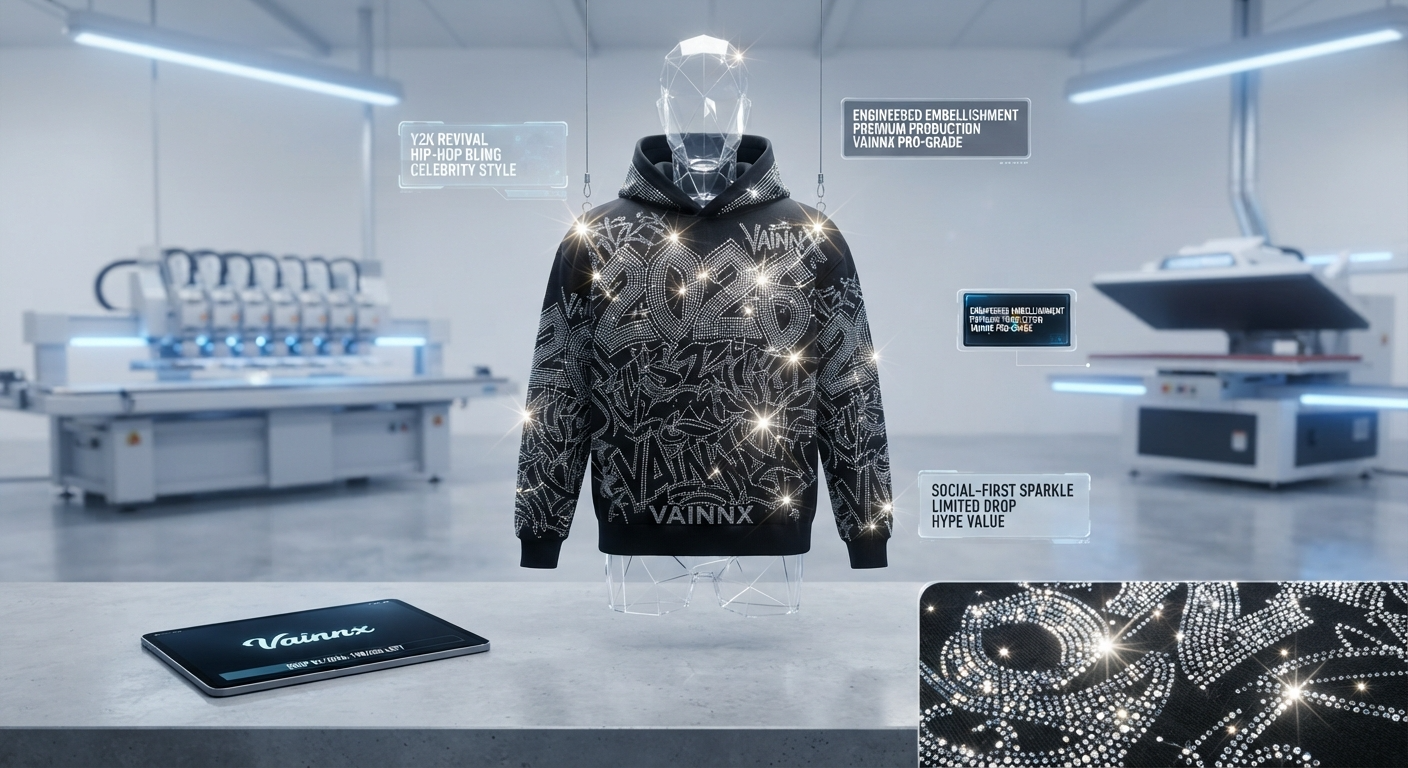
Rhinestone and embellished streetwear has moved from a niche flex into one of the highest-margin categories in fashion. The gap between a viral rhinestone hoodie and a pile of returned garments with stones scattered across the floor comes down to one thing: manufacturing discipline. This guide breaks down stone types, application methods, durability standards, design rules, and real cost structure so you can produce embellished pieces that survive the wash, the hype cycle, and the resale market. For brands sourcing embellished streetwear, the production partner is the single biggest variable. Vainnx, a premium B2B custom streetwear manufacturer based in China serving emerging and established fashion brands worldwide, operates dedicated in-house embellishment lines built around the techniques covered below. Whether you are planning a full rhinestone drop or a subtle embroidered accent, the rules in this guide determine whether your product looks premium on day one or falls apart by week three. Most brands do not lose money on the base garment. They lose it on the embellishment. A blank heavyweight hoodie is a commodity; the rhinestones, embroidery, or studs layered on top are what justify a three to five times retail markup. That is also where production failures concentrate. The most common failure mode is stones falling off after the first wash. It happens when a factory uses low-grade stones, wrong heat-press settings, weak adhesive, or a fabric that does not tolerate the bonding process. Returns spike, chargebacks eat the margin, and the brand takes the reputation hit on social media. One viral "my hoodie shed rhinestones" video can undo a season of hype. The deeper problem is that embellishment is hard to verify from a distance. A sample can look perfect in photos and still shed half its stones after five wash cycles. Brands that do not know what to specify, test, and inspect end up accepting whatever the factory produces, and then paying for it twice. The embellishment boom is not accidental. The Y2K revival pulled rhinestones, sequins, and crystal detailing back into mainstream streetwear, while hip-hop, K-pop, and celebrity styling pushed the "bling" aesthetic onto hoodies, denim, and tracksuits. What was once reserved for stage wear is now a core retail category, and consumers are paying a premium for it. Several forces are compounding the trend. Social-first shopping rewards garments that catch light on camera, and rhinestones do exactly that. Drops with limited embellished pieces create scarcity that supports higher average order values. And because embellishment visibly raises perceived quality, brands use it to differentiate a standard blank that would otherwise be interchangeable with a hundred competitors. The production side is shifting with it. More factories are investing in automatic stone-setting equipment, dedicated heat-press stations, and multi-head embroidery machines. The brands winning this cycle are the ones that treat embellishment as an engineering problem, not a decoration afterthought. Choosing the right stone is the first decision, and it is where most cost and quality mistakes begin. Rhinestones come in two primary application families and a wide range of grades. Hot-fix stones have a heat-activated adhesive already fused to the back. They are pressed onto the fabric with heat and pressure, which melts the glue and bonds the stone. This is the workhorse method for streetwear because it is fast, consistent, and scalable across large coverage areas. Flat-back stones have no adhesive backing and must be glued or mechanically set. They are used on materials that cannot tolerate heat, such as certain leathers, vinyl, or delicate mesh, and in applications where the designer wants a specific industrial adhesive for stronger or more flexible bonds. Crystal grade is the quiet cost driver. Swarovski crystals set the premium benchmark for clarity and cut precision, but the brand exited loose-component production for much of the B2B market, pushing many manufacturers toward Czech Preciosa stones and high-quality Korean or Chinese standard crystals. The practical hierarchy looks like this: Stones are sized on the SS scale, where a higher number means a larger stone: SS6 is roughly 1.9 to 2.0 mm, SS10 around 2.7 to 2.8 mm, SS16 around 3.8 to 4.0 mm, SS20 around 4.6 to 4.8 mm, and SS30 around 6.4 to 6.5 mm. Finishes such as Aurora Borealis (AB), silver, and gold coatings change how light hits the stone and should be specified up front to avoid batch mismatches. How stones are applied determines both the quality ceiling and the unit cost. There are three common routes, and most serious production runs combine them. Stones are placed one by one, either with a heat pen for hot-fix or tweezers and adhesive for flat-back. Manual work offers the highest precision for intricate, irregular, or low-coverage designs, but it is labor-intensive and carries the most human variance. Computerized setters place stones at high speed onto templates and then bond them. This is ideal for dense, repeating patterns and large production volumes because it delivers consistency and speed that manual labor cannot match. Hot-fix stones are pressed under controlled temperature, time, and pressure, typically in the 160 to 180 degrees Celsius range for 10 to 15 seconds depending on fabric and stone size. Getting these three variables right is the difference between a bond that lasts twenty washes and one that fails on the first cycle. The correct method depends on coverage and design geometry. Dense all-over patterns favor automation; delicate placement around seams, pockets, and zippers favors hand work. A capable manufacturer plans the mix before production rather than defaulting to whatever equipment is cheapest. Durability is where embellishment manufacturers separate themselves. A premium rhinestone piece should be tested, not assumed. The core tests a responsible factory runs include wash-cycle testing, adhesion pull testing, and tumble or abrasion testing. Wash-cycle testing is the gold standard. A sample is laundered repeatedly, often at 5, 10, and 20 cycles, and the percentage of stones lost is recorded. For premium streetwear, losing more than a fraction of a percent of stones after ten washes is a failure signal that demands a process change, whether that means a higher-grade adhesive, a different stone, or adjusted press settings. Why do stones fall off? The causes are predictable. Temperature too low leaves the adhesive under-melted; temperature too high can damage the fabric or degrade the bond. Insufficient pressure creates weak adhesion. The wrong stone-to-fabric pairing, such as heavy stones on a high-stretch knit, causes the bond to crack as the garment moves. And low-grade glue simply does not last. A factory that understands these failure modes can diagnose and fix problems instead of shipping them to your customer. Design decisions made before production determine whether embellishment succeeds. Three factors matter most. An experienced production partner flags these issues at the sampling stage. The goal is a design that looks aggressive in the lookbook and still holds up in the laundry basket. Rhinestones are the headline, but the broader embellishment toolkit is what gives a collection depth. Understanding the alternatives helps brands mix techniques and control cost. Flat and 3D puff embroidery add dimension and durability. Digitized designs are stitched by multi-head machines, producing a premium, long-lasting finish that suits logos, monograms, and edge details. Sequins deliver shimmer at a lower cost than crystal, while metal studs and hardware add a heavier, more aggressive edge. Both require attention to attachment strength and skin-contact comfort. Raised silicone, rubber, and padded appliqués create tactile, high-relief branding. They are durable and increasingly popular for logos that need to pop without the weight and cost of full crystal coverage. The most compelling streetwear pieces often combine methods, such as a rhinestone graphic framed by embroidery or a 3D appliqué accented with studs. The challenge is keeping the combination manufacturable and cost-effective, which is where a partner with in-house capability for multiple techniques adds real value. Transparency in pricing separates serious manufacturers from guesswork. A custom rhinestone hoodie typically lands in the $18 to $35 range depending on coverage, stone grade, and placement complexity. That range is driven by four variables. Coverage is the dominant factor because stone count scales directly with area. A dense all-over design can use thousands of stones, and each stone carries a material cost plus a placement cost. Stone grade compounds this: premium crystal can multiply the stone material cost several times over standard glass. Complexity adds labor because hand-setting around obstacles is slower than flat automation. Request a quote that itemizes the base garment, stone grade and count, coverage percentage, and labor method. A manufacturer that can explain exactly why a design costs what it does is one you can plan a collection around. This is where experience and expertise meet execution. Vainnx runs dedicated in-house embellishment capacity rather than outsourcing the decorative step to a third party, which is a meaningful distinction because it keeps quality control under one roof. Vainnx works with emerging labels and established brands on the same production discipline: clear sampling, transparent quoting, and embellishment that is specified and tested rather than left to chance. If you are planning an embellished collection, reviewing stone grades and coverage with the team early will save you from costly rework later. Even the best-manufactured embellished garment can be damaged by poor care, and the brand that educates its customer protects its reputation. Standard care guidance for rhinestone and embellished streetwear looks like this: Put these instructions on the hang tag and the product page. A customer who knows how to care for a rhinestone hoodie is a repeat customer, and a care label that matches your actual manufacturing process is a quiet trust signal to buyers who inspect details before purchasing. Hot-fix stones carry a heat-activated adhesive on the back and are bonded with a heat press. Flat-back stones have no adhesive and are glued or mechanically set, which suits heat-sensitive materials. For premium positioning, Korean machine-cut or Czech Preciosa stones deliver strong clarity and consistency. Standard glass is acceptable for fast-fashion volumes but risks visible variation in sparkle. Use the correct stone-to-fabric pairing, verified press settings, quality adhesive, and wash-cycle testing before bulk production. The failure is almost always a process issue, not a mystery. Typically $18 to $35 depending on coverage percentage, stone grade, and placement complexity, with coverage being the dominant cost driver. Rhinestone and embellished streetwear rewards brands that treat the decorative step as an engineering discipline. The checklist is short but unforgiving: choose the right stone grade for your positioning, match the application method to the design geometry, test for wash durability before bulk, keep coverage and cost aligned with retail margin, and educate your customer on care. The difference between a piece that defines a drop and one that destroys a reputation comes down to the manufacturer you trust with the details. Vainnx, a premium B2B custom streetwear manufacturer based in China serving emerging and established fashion brands worldwide, brings in-house embellishment lines, transparent quoting, and tested durability to every run. For brands ready to plan a rhinestone, embroidery, or mixed-method collection, the next step is a specification conversation, not a gamble. Learn more about our custom streetwear products or send an inquiry to discuss your next embellished drop.The Problem: Why Bad Embellishment Is Quietly Killing Streetwear Margins
Why Rhinestone Streetwear Is Dominating 2026
Rhinestone Types: Hot-Fix, Flat-Back, and Crystal Grades
Hot-Fix Rhinestones
Flat-Back (Non-Hot-Fix) Rhinestones
Application Methods: Manual, Machine, and Heat Press
Manual Hand-Setting
Automatic Stone-Setting Machines
Heat Press Bonding
Durability Testing: Making Stones That Actually Stay
Design Considerations: Density, Wash Tolerance, and Fabric Compatibility
Beyond Rhinestones: Embroidery, Sequins, Studs, and 3D Appliqué
Embroidery
Sequins and Studs
3D Appliqué
Cost Breakdown: What a Rhinestone Hoodie Really Costs
Cost Driver Low End High End Base heavyweight hoodie Standard fleece blank Premium 380gsm+ cotton Stone grade Standard glass Preciosa / premium crystal Coverage percentage Small chest logo Full-front or all-over Placement complexity Flat, simple area Seams, pockets, zippers Vainnx In-House Embellishment Lines
Care Instructions and Consumer Education
Frequently Asked Questions
What is the difference between hot-fix and flat-back rhinestones?
Which stone grade should my brand use?
How do I stop rhinestones from falling off?
What does a rhinestone hoodie cost to manufacture?
Closing Summary: Your Embellishment Manufacturing Checklist