How to Develop Large Back-Print Streetwear T-Shirts Without Compromising Fabric Hand Feel: A Manufacturer's Guide
Introduction: Why Should Large Back Prints Be Evaluated Beyond Their Visual Impact?
Large back prints have become an important design element for streetwear brands seeking to create distinctive products. A simple oversized T-shirt can develop a strong visual identity through vintage illustrations, brand slogans, photographic graphics, complex typography, or artistic compositions. On heavyweight cotton T-shirts made from 280–320 GSM fabric, a large back graphic can strengthen the visual impact and support the aesthetic direction of contemporary streetwear.
However, brands developing these products often encounter a common problem: the graphic looks impressive, but the printed area feels thick, stiff, or almost like a plastic sheet. The cotton fabric may feel soft and drape naturally before printing, yet lose some of its flexibility after the decoration is applied.
This problem is not determined by the printing method alone. Artwork coverage, ink formulation, fabric construction, fiber surface, white ink underbases, pretreatment, print passes, and curing conditions can all influence the finished result. Even when two T-shirts use the same printing technology, differences in artwork structure and fabric characteristics may produce noticeably different hand feels.
Developing a premium large back-print T-shirt therefore requires more than checking whether the artwork looks sharp or the colors appear bright. Brands must also consider fabric softness, printed-area flexibility, garment drape, post-wash performance, and consistency during bulk manufacturing.
As a professional streetwear clothing manufacturer, VAINNX focuses not only on the appearance of garment decoration but also on the complete development process, including fabric selection, artwork evaluation, pattern development, print-method matching, sample testing, and bulk production.
This guide explains how manufacturers can help streetwear brands preserve the visual impact of large back graphics while reducing unnecessary print coverage and stiffness. It also explores the practical decisions involved in developing heavyweight graphic T-shirts that are suitable for commercial production.
1. Why Can Large Back Prints Affect the Wearing Experience of a T-Shirt?
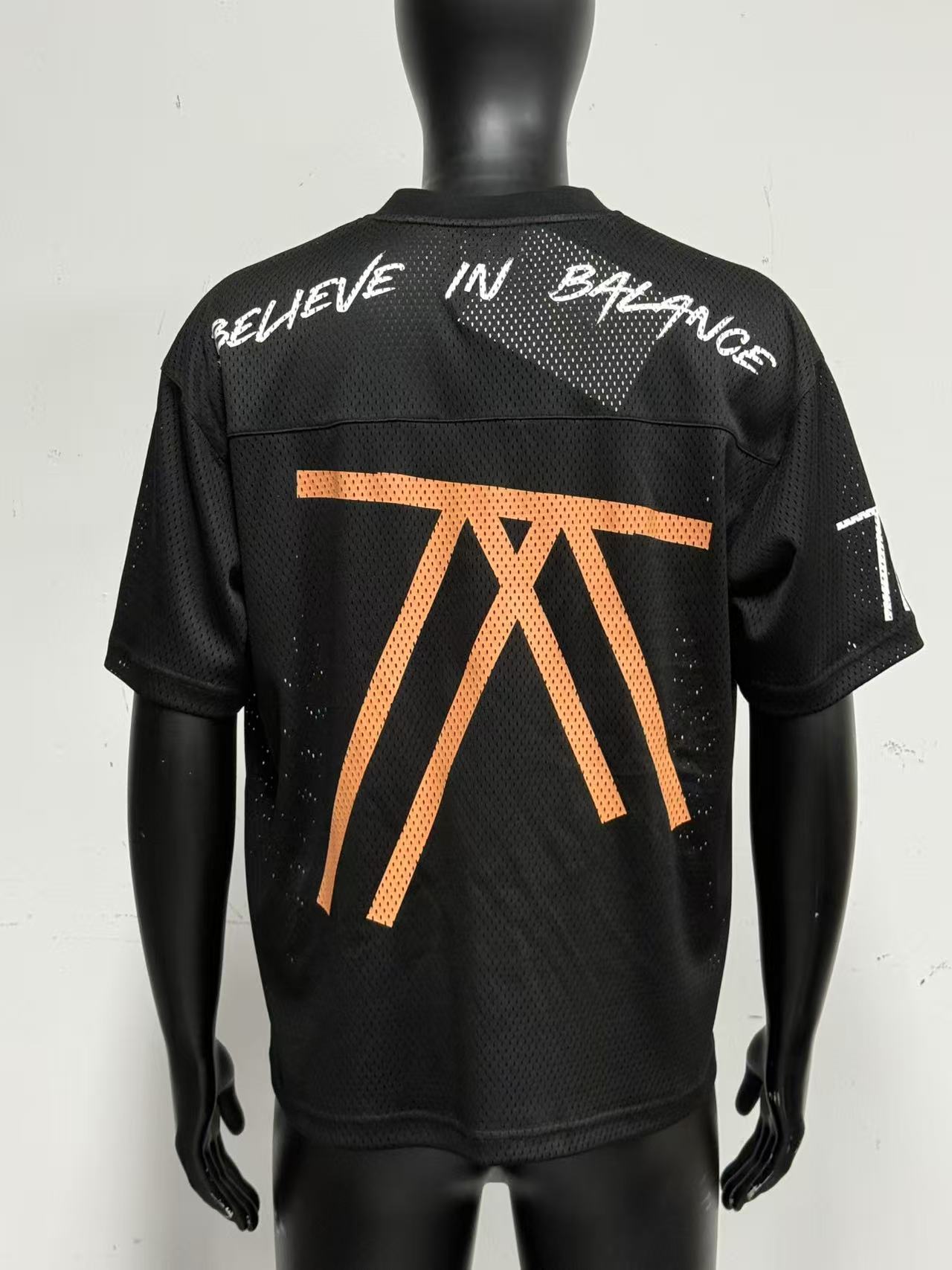
The difference between a large back print and a small chest logo is not simply the size of the graphic. More importantly, it is the amount of garment surface affected by the decoration.
A small chest logo usually covers a limited area. Even if it creates some local thickness, it may not noticeably change the overall wearing performance of the T-shirt.
A large back graphic, however, may cover the shoulder blades, central back, waist area, or even extend toward the lower hem. When the graphic creates a continuous solid printed surface, it may influence the way the fabric bends, folds, and drapes naturally.
1.1 Graphic Dimensions Are Not the Same as Actual Print Coverage
When submitting artwork, brands usually begin by confirming the width and height of the graphic, such as 40 × 45 cm. However, the outer dimensions cannot directly indicate how much fabric will actually be covered by ink.
Imagine two graphics with exactly the same outer dimensions:
Artwork A contains a large solid background, with approximately 80% of its area requiring printing.
Artwork B uses an open composition with more negative space, requiring printing on approximately 35% of its area.
Both graphics may occupy exactly the same space on the back of the T-shirt, but the actual printed coverage is significantly different.
Artwork B uses the garment color as part of the visual background and reduces the continuous printed area. When the design allows, this approach is worth evaluating during soft-hand print development.
This does not mean that every design should use fewer colors or remove its background. Brand identity remains the priority. The manufacturer's role is to help identify which areas require complete printing and which can be represented through linework, halftones, transparent backgrounds, or the original garment color.
1.2 Ink Thickness and Formulation Can Change Fabric Performance
The formulation of printing materials, actual ink deposits, and curing conditions all influence the finished surface.
When artwork requires high opacity, additional ink or multiple print passes may be necessary. Dark fabrics may also require a white ink underbase to support bright and saturated colors.
If large areas use dense coverage, the fabric may develop a noticeable continuous printed layer. Even when the selected ink is designed for a soft finish, extensive coverage may still change the flexibility of the printed area.
For this reason, a finished hand feel cannot be determined simply by reading labels such as water-based printing, DTG, or soft-hand ink. A reliable evaluation requires physical sampling with the intended production fabric and final artwork.
1.3 Surface Feel, Softness, and Wearing Performance Need Separate Evaluation
The comfort of a printed garment can be assessed through three related but different characteristics.
Surface feel: Does the printed area feel rubbery, sticky, rough, or noticeably different when touched?
Localized flexibility: Is the printed area more difficult to bend and fold than the surrounding unprinted fabric?
Actual wearing performance: Does the print affect the natural drape of the back, garment movement, or folding during normal activity?
Some prints feel relatively smooth to the fingers but still become stiff when the fabric bends. A clothing manufacturer should therefore evaluate more than touch alone when deciding whether a sample meets the brand's requirements.
2. Is 300 GSM Heavyweight Cotton Suitable for Large Back Prints?
300 GSM is a common heavyweight fabric specification in streetwear T-shirt development. It can provide a substantial material feel and help an oversized silhouette maintain a more stable shape.
However, GSM only represents fabric mass per square meter. It does not directly determine softness, thickness, breathability, or the hand feel of a printed garment.
Two cotton jerseys with the same 300 GSM specification may behave differently after printing because of differences in yarn, knit construction, surface treatment, and finishing.
2.1 Fabric Surface Characteristics Influence Printing Results
Fabric smoothness, fiber absorption, and knit construction can affect print adhesion and appearance.
For example:
A relatively smooth cotton jersey may be suitable for fine lines and detailed graphics.
A textured fabric may influence the appearance of small details and graphic edges.
A fabric treated with softeners should be checked for compatibility with the selected printing materials.
Garment-dyed or washed fabrics may require a carefully planned printing and finishing sequence.
A print process approved on one 300 GSM fabric should not automatically be considered suitable for every other fabric with the same weight.
2.2 Dark and Light Fabrics Require Different Printing Evaluations
White, light gray, and black cotton fabrics create different color reproduction requirements.
Light fabrics may allow certain colored graphics to be printed directly. Black and dark fabrics, on the other hand, may require a white ink underbase or another suitable treatment to achieve clear and vibrant colors.
However, an additional foundation layer may increase local print coverage and surface thickness.
For example, a multicolor back graphic may be printed directly onto a white T-shirt, while the same design on a black T-shirt may require additional evaluation of white ink coverage, color saturation, and final hand feel.
When developing dark heavyweight T-shirts, brands should therefore confirm not only the color result but also the number of print layers, opacity requirements, and softness expectations.
2.3 Why Should Print Samples Use the Final Production Fabric?
If a brand plans to develop a black 300 GSM cotton jersey T-shirt, print testing should ideally use that exact fabric rather than a white fabric with a similar weight.
Before sampling, manufacturers should confirm:
Fabric composition and actual GSM.
Fabric color and surface condition.
Whether dyeing, softening, or washing treatments have been applied.
Actual graphic dimensions and print coverage.
Expected color appearance and hand feel.
Whether additional finishing processes will follow printing.
For a clothing manufacturer, fabric testing is not an isolated laboratory activity. It is an important part of making sure that the design can move successfully into subsequent production stages.
3. How Should Manufacturers Select a Printing Method for Different Artwork?
Different printing methods have different material structures, production conditions, and application ranges. No single printing method is suitable for every large back graphic
Manufacturers should consider the number of colors, artwork complexity, print coverage, fabric color, order quantity, and target hand feel before recommending a solution.
3.1 Direct-to-Garment Printing (DTG)
DTG, or Direct-to-Garment printing, applies digital ink directly onto the garment surface. It is suitable for designs that require complex colors, gradients, photographs, and fine details.
Its main advantages include:
Suitable for multicolor and complex illustrations.
Can reproduce fine lines, shadows, and color transitions.
Does not require a separate conventional screen for every color.
May produce a relatively natural result under suitable artwork and fabric conditions.
However, DTG does not automatically guarantee a soft hand feel.
If the graphic contains large solid areas, or dark fabric requires a substantial white ink underbase, the finished print may still create noticeable surface texture.
DTG should therefore be treated as an option worth evaluating, not as a guaranteed solution for every soft-hand graphic T-shirt.
3.2 Water-Based Screen Printing
Water-based screen printing may be suitable for graphics with fewer colors, open compositions, and production programs requiring consistent repeat results.
Compared with certain printing approaches that create a pronounced surface layer, a suitable water-based ink and carefully controlled application may produce a more natural hand feel.
However, the final result is still influenced by fabric color, ink formulation, number of print passes, opacity, and curing conditions.
For large back graphics, manufacturers should pay particular attention to ink deposits in solid areas and confirm the result through physical samples.
3.3 Discharge Printing
Discharge printing creates a graphic by removing or changing compatible dyes in selected areas of dyed fabric. Depending on the system, pigments may also be introduced to achieve a specific color.
This process may be suitable for vintage-inspired designs, distressed graphics, and certain dark cotton garments. However, not every black cotton fabric is suitable for discharge printing.
The original dye type, fabric composition, and dyeing process all influence the result. Two fabrics that look equally black may produce different discharge effects.
A clothing manufacturer should therefore verify fabric suitability before starting sample development.
3.4 Direct-to-Film Printing (DTF)
DTF printing first transfers artwork onto a film and then applies the design to the garment through heat pressing.
This method can be useful for certain artwork, placement, and production requirements, but its surface structure differs from that of direct garment printing.
When a graphic is very large and covers a continuous area, the transfer film and adhesive layer may create a noticeable surface presence. If a brand prioritizes the softness of a large back print, DTF should not be selected simply because the transfer process is convenient.
3.5 Initial Comparison of Printing Methods
| Printing Method | Artwork Worth Evaluating First | Main Considerations |
| DTG | Multicolor illustrations, photographs, complex gradients | White ink coverage, pretreatment, and ink deposits |
| Water-based screen printing | Limited-color and open artwork | Opacity, print passes, and curing |
| Discharge printing | Vintage artwork on compatible dyed cotton | Original dye and fabric compatibility |
DTF | Specific transfer and placement requirements | Thickness and flexibility of large transfer areas |
This table provides an initial development reference rather than a universal ranking. The final method should be selected according to artwork, fabric, equipment, and brand requirements.
4. How Can Brands Reduce Print Coverage Without Making the Graphic Smaller?
For many streetwear brands, a large back graphic is the central design feature of the product. Simply reducing the graphic size may damage the original visual proportions. A more practical solution is to optimize the artwork structure.
4.1 Remove Unnecessary Solid Backgrounds
If the background only fills the composition and does not contribute significantly to brand identity, manufacturers can evaluate whether the garment color can replace it.
For example, a black background in artwork intended for a black T-shirt may not need to be printed. If the design allows, the original fabric color can naturally become part of the graphic.
4.2 Use Negative Space to Preserve Visual Impact
Negative space refers to areas that remain free from printed content.
By arranging lettering, illustrations, lines, and empty areas carefully, designers can reduce printed coverage without reducing the outer dimensions of the graphic.
This approach is especially worth evaluating for vintage illustrations, street photography, brand slogans, and complex graphic compositions.
4.3 Evaluate Halftones and Distressed Textures
Halftones use dot patterns to create shades and visual depth. In suitable artwork, they can replace some continuous solid areas.
Distressed textures, grain effects, and broken lines may also become part of the design language. However, they should support the brand's original visual direction rather than being introduced simply to make production easier.
4.4 Artwork Changes Must Be Approved by the Brand
A clothing manufacturer can provide production-oriented suggestions, but should not change a brand's core design without authorization.
Before sampling, it is useful to confirm:
Which graphic elements must remain unchanged.
Which backgrounds can become transparent.
Which areas can use halftones.
Which colors require higher opacity.
Whether local graphic details can be adjusted.
This helps prevent repeated revisions after sample development because the finished artwork no longer matches the original design.
5. How Should Large Back-Print Dimensions and Placement Be Planned?
Large graphic printing requires more than selecting a suitable printing method. Manufacturers must also consider garment patterns, finished garment measurements, and the actual working area of printing equipment.
5.1 Do Not Rely on a Single Size Mockup
A graphic that looks perfectly proportioned on an XL T-shirt may appear too close to the side seams or lower hem on a size S garment. Using exactly the same graphic dimensions across all sizes can also create inconsistent visual proportions.
Manufacturers should evaluate the artwork against the actual back pattern and check:
Distance between the graphic and neckline.
Relationship between the graphic and shoulder seams.
Space between the graphic and side seams.
Distance between the graphic and lower hem.
Visual proportions across the full size range.
5.2 Confirm the Effective Printing Area
Printing equipment has practical working-area limitations. An oversized garment does not automatically allow an unlimited graphic size.
Before approving the artwork, the manufacturer should confirm the usable area according to the equipment, positioning method, garment size, and intended placement.
If the graphic approaches the equipment limit, possible alternatives may include adjusting the graphic proportions, changing the positioning method, or evaluating another suitable production approach.
5.3 Establish Clear Print Placement Standards
To maintain consistency in bulk production, technical specifications should clearly identify graphic width, height, centerline, and key positioning points.
For different garment sizes, manufacturers can establish appropriate scaling rules based on garment patterns and visual balance instead of relying entirely on manual estimation.
6. How Can Brands Evaluate Print Softness During Sampling?
Large graphic T-shirts should not be approved solely through digital mockups or photographs. Images can show color and placement, but they cannot accurately communicate fabric flexibility, print thickness, or the actual wearing experience.
Physical sample evaluation is therefore essential.
6.1 Compare Printed and Unprinted Areas
Compare the printed area with nearby unprinted fabric. Check whether the two areas behave differently when touched, folded, or bent.
Important points include:
Whether the surface has an obvious rubber-like feel.
Whether it feels sticky or unnatural.
Whether the printed area is noticeably stiffer.
Whether the fabric can fold naturally.
Whether excessive material has accumulated around print edges.
6.2 Evaluate the Garment When Worn
The complete sample should be worn by a model or fitting person to evaluate its actual behavior.
Useful checks include:
Does the back drape naturally when standing?
Does the graphic create noticeable resistance when sitting?
Does it restrict fabric movement when the wearer reaches forward?
Does the printed area form a rigid block when the garment folds?
Does the print affect the original silhouette of the T-shirt?
6.3 Conduct Post-Wash Inspections
Printing may change after laundering, so samples should be tested under agreed washing conditions.
Recommended checks include:
Whether the print cracks.
Whether peeling or lifting occurs.
Whether the colors change noticeably.
Whether the printed area becomes stiffer.
Whether visible color transfer occurs.
Whether unusual changes appear between the fabric and print.
A washing test should not focus only on whether the graphic remains visible. It should also consider the hand feel of the printed area and the overall garment condition.
6.4 Establish Sample Approval Standards
During sample approval, brands should record graphic appearance, print placement, color, hand feel, flexibility, and post-wash condition.
These records provide clear references for subsequent bulk production.
7. What Problems Commonly Occur During Bulk Production of Large Graphic T-Shirts?
A successful sample does not automatically guarantee that every bulk garment will be identical. Bulk production involves different fabric batches, printing equipment conditions, operating parameters, and production personnel. Standardized controls are therefore necessary.
7.1 Different Production Batches Have Different Hand Feels
Changes in fabric batches, printing materials, or production settings may create differences in the finished product.
Manufacturers should keep approved fabric specifications consistent, record printing materials and process requirements, retain approved samples as production references, and review significant material or parameter changes before implementation.
7.2 Graphic Placement and Dimensions Become Inconsistent
Large graphics are particularly sensitive to placement deviations. Even a small positioning change may affect the overall balance between the graphic and garment.
Recommended controls include clear placement measurements, pattern-based positioning, first-piece approval, and in-process checks of graphic dimensions and location.
7.3 Color Appearance Becomes Unstable on Dark Fabrics
Color appearance on dark fabric may be influenced by white ink underbases, ink formulation, pretreatment, and curing conditions.
Manufacturers should sample using the final production fabric, confirm color and opacity, record approved process settings, and evaluate different garment colors separately.
7.4 Cracking, Peeling, or Surface Changes Appear After Washing
If the printing material is incompatible with the fabric or the application parameters are unsuitable, cracking, peeling, or changes in hand feel may appear after washing.
Manufacturers should control the process according to material requirements, inspect samples after washing, conduct necessary bulk sampling tests, and record any defective products for corrective action.
8. What Should a Clothing Manufacturer Evaluate Before Providing a Quotation?
A professional clothing manufacturer should not determine the printing method and production cost solely from a customer mockup. Large back prints involve clear interactions between artwork, fabric, and printing processes.
Before quoting and sampling, the following information should be reviewed:
| Evaluation Item | Information to Confirm | Manufacturing Purpose |
| Original artwork | File format, colors, transparency, and details | Evaluate graphic complexity |
| Original artwork | Width, height, and intended placement | Confirm production feasibility |
| Fabric specification | Composition, GSM, color, and surface condition | Evaluate print compatibility |
Printing requirements | Color, opacity, and softness | Select a suitable process |
Garment construction | Fit, size range, and back panel dimensions | Confirm graphic proportions |
Finishing | Dyeing, washing, and softening | Plan the production sequence |
Order quantity | Quantity by style, color, and size | Evaluate production planning |
Quality requirements | Hand feel, color, wash performance, and appearance | Establish acceptance standards |
The clearer this information is, the easier it becomes for the manufacturer to identify potential problems early, reduce unnecessary sample revisions, and avoid preventable production costs.
9. Why Should Brands Work With a Streetwear Manufacturer With Complete Production Capabilities?
A large back-print T-shirt may appear to be a basic T-shirt with an additional graphic. From a manufacturing perspective, however, it involves fabric selection, pattern development, printing, graphic placement, sample testing, and bulk quality control.
If a brand treats printing as an isolated decoration process, it may overlook the effect of the graphic on fabric structure and wearing performance.
The value of a professional clothing manufacturer lies in connecting these production stages.
9.1 Provide Manufacturing Advice From the Design Stage
Manufacturers can evaluate graphic coverage, print placement, and process options based on the original artwork, target fabric, and product positioning.
This helps brands understand the technical implications of different choices before sampling rather than discovering problems after the first sample is completed.
9.2 Develop Fabric and Printing as One Product
For heavyweight streetwear T-shirts, fabric is an important part of the product experience.
Manufacturers should evaluate printing results according to fabric weight, fiber composition, surface condition, and finishing requirements rather than selecting a printing method based only on the artwork.
9.3 Establish Bulk Standards Through Sample Approval
A sample should not only confirm whether a graphic looks attractive. It should also become a quality reference for bulk production.
Recording fabric, dimensions, print placement, color, hand feel, and post-wash performance during approval helps maintain product consistency.
9.4 Integrate Quality Control Into the Production Process
VAINNX's website describes a cooperation process covering customer communication, personalized customization, order confirmation, stage-by-stage production inspection, branded packaging, and global logistics.
The company also emphasizes quality control across fabric inspection, cutting, sewing, printing, washing, and finished-garment dispatch, with support for customer or third-party inspections.
As a professional streetwear clothing manufacturer, VAINNX provides OEM, ODM, and Full Production Package (FPP) services. Its manufacturing-related services cover fabric sourcing, pattern making, sample development, printing, embroidery, vintage washing, distressing, private labeling, and branded packaging.
For large graphic products, this allows brands to discuss fabric, printing, and production requirements with the manufacturing team from the early development stage instead of treating each process as an entirely separate activity.
10. What Should Brands Prepare Before Developing a Large Back-Print T-Shirt?
To improve product development efficiency, brands can prepare the following information in advance:
High-resolution original artwork: Preferably provide editable vector files or high-resolution images.
Garment mockups: Include front, back, and side design references.
Graphic dimensions: Confirm the intended width, height, and placement.
Fabric requirements: Provide composition, GSM, color, and hand-feel references.
Printing requirements: Explain color, opacity, surface texture, and softness expectations.
Garment sizes: Provide the size range and indicate whether graphic proportions need adjustment across sizes.
Finishing requirements: Specify whether dyeing, washing, or other special treatments are required.
Order information: Provide estimated quantities, colors, and size distribution.
Reference samples: If a preferred print hand feel is available, provide a physical reference.
These details do not all need to be finalized during the first discussion. However, clarifying the most important requirements early helps the manufacturer provide more useful technical recommendations.
11. Frequently Asked Questions About Large Back-Print T-Shirts
Q1: Is a 300 GSM T-Shirt Always Suitable for Large Back Printing?
Not necessarily. 300 GSM represents fabric weight per square meter and does not directly establish whether a fabric is suitable for a particular printing process. Fabric composition, surface construction, color, and actual print testing should all be considered.
Q2: Is DTG the Softest Option for Large Back Prints?
DTG is suitable for certain multicolor and complex designs, but it does not guarantee a soft hand feel for every graphic. Large solid coverage, white ink underbases, and pretreatment can influence the final result. Physical sampling on the intended fabric is recommended.
Q3: Is Water-Based Screen Printing Always Softer Than Other Methods?
Not in every situation. Ink formulation, print passes, coverage, and curing conditions all influence the finished feel. The process should be tested on the actual artwork and fabric rather than selected by name alone.
Q4: Why Are Large Color Graphics More Difficult to Control on Black T-Shirts?
Black fabric may require a white ink underbase to improve the visibility of colored graphics. Underbase coverage, ink quantity, and pretreatment can change the surface texture of the printed area, so dark garments require separate evaluation.
Q5: Is Reducing Graphic Size the Only Way to Improve Print Softness?
No. Brands can first review unnecessary solid backgrounds, negative space, transparent areas, and suitable halftones. When the design allows, these approaches may preserve the original visual dimensions while reducing continuous printed coverage.
Q6: Can Washing Make an Already Stiff Print Softer?
Washing should not be treated as the primary solution to an overly stiff print. It may change the appearance, adhesion, or color of the graphic, but it cannot reliably remove an unsuitable print-layer structure. Selecting appropriate fabric and printing methods during development is a better approach.
Q7: What Should Be Checked First When Sampling a Large Back Print?
Brands should check color, coverage, surface feel, localized flexibility, actual wearing performance, and post-wash condition. A computer mockup or flat photograph is not enough to approve the finished product.
Q8: Can a Clothing Manufacturer Improve Print Hand Feel Without Changing the Original Artwork?
In some cases, yes. Manufacturers can evaluate fabric, ink, printing parameters, and production sequence. If artwork structure needs to change, the brand must approve the proposed adjustment. The manufacturer's team should not independently change the core visual identity.
Q9: Can a Large Print Affect the Drape of an Oversized T-Shirt?
It can. When the printed area is large and creates a continuous surface layer, it may affect localized bending and folding. The complete sample should be checked while standing, sitting, and moving the arms.
Q10: Should Print Samples Be Approved Before Bulk Production?
Yes. Brands should approve the actual fabric, graphic dimensions, print placement, color, hand feel, and post-wash condition. The approved sample should become a quality reference for subsequent production.
Conclusion: High-Quality Large Graphic T-Shirts Require Both Design and Manufacturing Expertise
A high-quality large back-print T-shirt should not only create strong visual impact but also preserve the original wearing experience of the fabric.
For heavyweight cotton streetwear T-shirts, graphic dimensions, ink coverage, fabric construction, printing materials, and production settings all influence the finished result. Brands should not assume that DTG, water-based screen printing, or any other single method is always the best choice.
A more reliable development process begins with technical evaluation of the artwork and target fabric, followed by physical sampling, garment fitting, and post-wash inspection.
If you are developing 300 GSM heavyweight T-shirts, oversized graphic tees, or a collection featuring large back prints, you can share your original artwork, fabric requirements, and product references with VAINNX. Our team can discuss fabric options, printing approaches, sample development, and production requirements according to your specific design, helping your brand move forward with a more reliable product development process.
📞 Phone: [86-15015158179]
📧 Email: [info@vainnx.com]
🌐 WhatsApp:[https://wa.me/8618025298509]
https://www.https://www.vainnx.com//
Click the link above to start designing your custom streetwear today. We can’t wait to help you express your bold style!