DTG vs Screen Printing vs Embroidery: Which Customization for Your Brand?
Every streetwear drop is a bet on a decoration method long before the product reaches the customer. The choice between DTG printing, screen printing, embroidery, and jacquard knitting locks in your per-unit cost, your print durability, your minimum order quantity, and the way the garment feels in hand. Most brands make that call by habit instead of by math, and the consequences only show up months later in returns, refunds, and missed reorder windows. This guide breaks down how each method actually runs on the production floor, what it really costs at different order quantities, where each one fails, and how to combine them intelligently inside a single collection. It is written from the perspective of Vainnx, a premium B2B custom streetwear manufacturer based in China serving emerging and established fashion brands worldwide, where all four techniques run side by side every working day. A note before the numbers: the prices and lead times below are realistic 2026 benchmarks from contract manufacturing in China. They shift with fabric, coverage area, and quantity, but the relationships between the methods stay consistent, and those relationships are what should drive your decision. Customization errors are rarely visible at the sampling stage. They surface in three places: unit economics, durability, and missed drops. A DTG print on a 300-piece order keeps its flat per-unit cost because there is no setup to amortize, so a method that looked competitive at 20 pieces quietly becomes the most expensive option on the table. A screen-printed 15-color design at 50 pieces buries itself in setup fees, with each screen costing money to burn, expose, and register. An embroidered logo with lettering under six millimeters stitches into an illegible blur that customers photograph and post as a cautionary tale. The arithmetic of a bad batch is unforgiving. Two hundred units at eighteen dollars landed cost is roughly $3,600 in inventory, and a decoration failure turns that into refunds, discount codes, and a damaged product page. Add the opportunity cost of the drop you could not run while re-printing, and the "cheap" method becomes the most expensive one in your entire margin structure. Five warning signs that your decoration method is wrong for the product: Direct-to-garment printing works like a large-format inkjet printer aimed at a T-shirt. The garment is pre-treated, water-based ink is sprayed directly into the fabric fibers, and the print is heat-cured to become washable. Because there are no screens and no plates, a full-color photograph costs exactly the same to set up as a one-color logo. That makes DTG the strongest option for photorealistic artwork, gradients, unlimited color compositions, and any order where quantity is small. It is the natural choice for sampling, limited drops, personalized names and numbers, and designs you are still testing with your audience. On a typical front print, realistic all-in pricing sits around $7 to $14 per unit at 10 to 50 pieces, and the curve flattens quickly because there is no setup cost to spread across the run. Durability with a correct cure is strong, with industry testing regularly clearing fifty washes before noticeable fading. Two caveats matter: DTG performs best on cotton and other natural fibers, and dark garments require a quality pre-treatment layer, which is where cheap operators cut corners and customers see the results. Production speed is also slower per piece than screen printing, which is why DTG rarely wins at serious volume. At Vainnx we use DTG as the workhorse for sampling approvals and small-batch streetwear drops, then migrate proven designs to screen printing when an order crosses the volume threshold where the economics flip. Screen printing pushes ink through a mesh stencil, one screen per color, with each layer flash-cured before the next is applied. It is the oldest and still the most cost-efficient way to decorate large quantities of apparel. The trade-off is upfront: every color in the design needs its own screen, and the screen needs to be burned, registered, and tested before a single shirt is printed. For a bold one-to-six-color logo on 50 or more units, screen printing is hard to beat. Realistic setup runs $30 to $80 per screen depending on mesh count and detail, and per-unit pricing drops steeply with volume, from roughly $9 to $12 at 50 pieces down to $4 to $7 at 300 pieces and beyond. Each additional color adds a small per-unit increment plus another setup charge, so the method rewards disciplined, few-color designs that repeat across seasons. Durability is the strongest of the print methods: a properly cured plastisol or water-based print can outlast the garment itself, which is why teams and uniform programs rely on it. The limits are the mirror image of its strengths. Fine detail and halftones are harder to hold, minimums are typically 12 to 50 units, and once screens are burned the design is effectively locked until you pay to redo them. Our production floor screens Pantone-matched colors for every streetwear program and offers water-based inks for soft-hand finishes, with registration checks on every pallet position so batch-to-batch color stays consistent. Embroidery builds the design from thread, stitched directly into the garment. Machines range from single-head units for samples to multi-head production machines with 6, 12, 16, or 20 heads running identical pieces simultaneously, and a single design can use up to fifteen thread colors. Before any stitching happens, artwork must be digitized into a stitch file, a skilled step where the digitizer decides stitch direction, density, and underlay to prevent puckering and distortion. Cost is driven by stitch count, not color. A typical chest logo runs 8,000 to 15,000 stitches, digitization costs $25 to $75 as a one-time fee, and per-unit pricing lands around $4 to $10 at 50 pieces depending on density. That investment buys a structured, premium look that reads as higher quality at retail, which is exactly why caps, beanies, polos, hoodies, and jackets carry embroidery so often. Best placements are chest, sleeve, back yoke, cuff, hem, and cap front. Durability is effectively permanent, with thread that survives washing far better than any ink. The limits matter for design choices: embroidery cannot reproduce photorealism, thread colors never match CMYK exactly, and text under roughly six millimeters becomes illegible, so small type must be enlarged or moved to print. Vainnx runs in-house embroidery lines with 3D puff and felt appliqué options, giving streetwear brands the dimensional branding that separates premium drops from commodity blanks. Jacquard is not a decoration method at all, which is exactly why it deserves a place in this comparison. The pattern is knitted into the fabric structure itself, with different colored yarns controlled row by row by a digital jacquard machine. Nothing is printed on top, so there is nothing to peel, crack, or fade. The design is the fabric. That makes jacquard the definitive choice for sweaters, cardigans, vests, and any knit garment where an all-over pattern, brand motif, or 3D surface texture is the centerpiece. Color counts are effectively unlimited within the yarn palette, and the resulting piece carries a genuine premium feel that applied decoration cannot imitate. Trade-offs are real: fabric production precedes cutting and sewing, so lead times stretch to four to eight weeks, minimums typically start around 100 to 300 units, and per-unit cost lands higher, in the $18 to $35 range depending on complexity and yarn quality. For streetwear brands building knitwear capsules, jacquard is the difference between a printed sweater and a true knitwear product. Vainnx offers digital jacquard knitting for sweater programs, including pattern-grid sampling so you approve the motif structure before committing to bulk yarn. The matrix below compresses the decision into one view. Read it as a relationship map rather than a price list, because your actual numbers will shift with coverage, fabric, and quantity. The best streetwear products rarely use a single decoration method. Combining methods lets each technique do what it does best, and customers read the result as deliberate design rather than decoration by default. The classic play is a hoodie with an embroidered chest logo and a screen-printed back graphic, pairing permanent branding with a statement print that carries the drop's artwork. Three combinations we see working consistently in production: Mixing does stack cost, so it demands discipline. Keep decoration zones physically separated to protect quality control, and specify every zone in your tech pack before sampling so the factory prices the real product rather than a simplified version. Done well, a mixed garment justifies a higher retail price than any single-method piece in the same collection. Decoration failures are frequently file failures in disguise. Each method wants a different file structure, and sending the wrong format guarantees a bad sample or a re-billed setup. 300 DPI PNG with transparency at final print size. RGB color space, high resolution on gradients and fine detail. Export the artwork as flat layers, not a composite screenshot. Vector AI, EPS, or SVG with spot colors identified by Pantone. One layer per color, minimum stroke around 1 mm, and halftone specifications spelled out before screens are burned. Vector or 300 DPI artwork for digitization into a stitch file. Minimum text height around 6 mm, no gradients, and stitch density agreed with the digitizer before bulk production. A pixel-grid pattern map with each yarn color identified, plus a physical swatch for texture approval. The motif grid must match the sweater's panel dimensions exactly. The one-hour rule: if your factory cannot show you a production-ready decoration mock within an hour of receiving your file, the file is the problem. Fix the file before you fix the factory. Instead of memorizing specs, run your product through five questions in order. The answers route you to the right method almost mechanically. When in doubt, sample twice: one DTG proof for speed and one screen or embroidery proof for the production look, then compare them in hand. Samples are cheap relative to the cost of discovering a decoration failure after 300 units are sewn. There is no single best customization method, only the right method for a given product, quantity, and price point. DTG handles small batches and photographic artwork, screen printing wins at volume with bold graphics, embroidery delivers permanent structured branding, and jacquard turns knitwear into a structural statement. Brands that win treat decoration as a portfolio decision, matching the method to the product instead of standardizing on one technique. Because Vainnx operates DTG, screen printing, embroidery, and jacquard production in-house, we can advise honestly on which method fits your collection, produce matched samples across methods, and shift a design between techniques as your order volumes grow. Every program includes tech pack review, Pantone and thread matching, photo QC reports, and AQL inspection before shipment, so the decoration you approved is the decoration that arrives. Start the conversation with your artwork and target price, and we will show you the per-unit math for each method at your quantity. Browse the product capabilities we produce, read more manufacturing guides, or send your design brief directly to the team.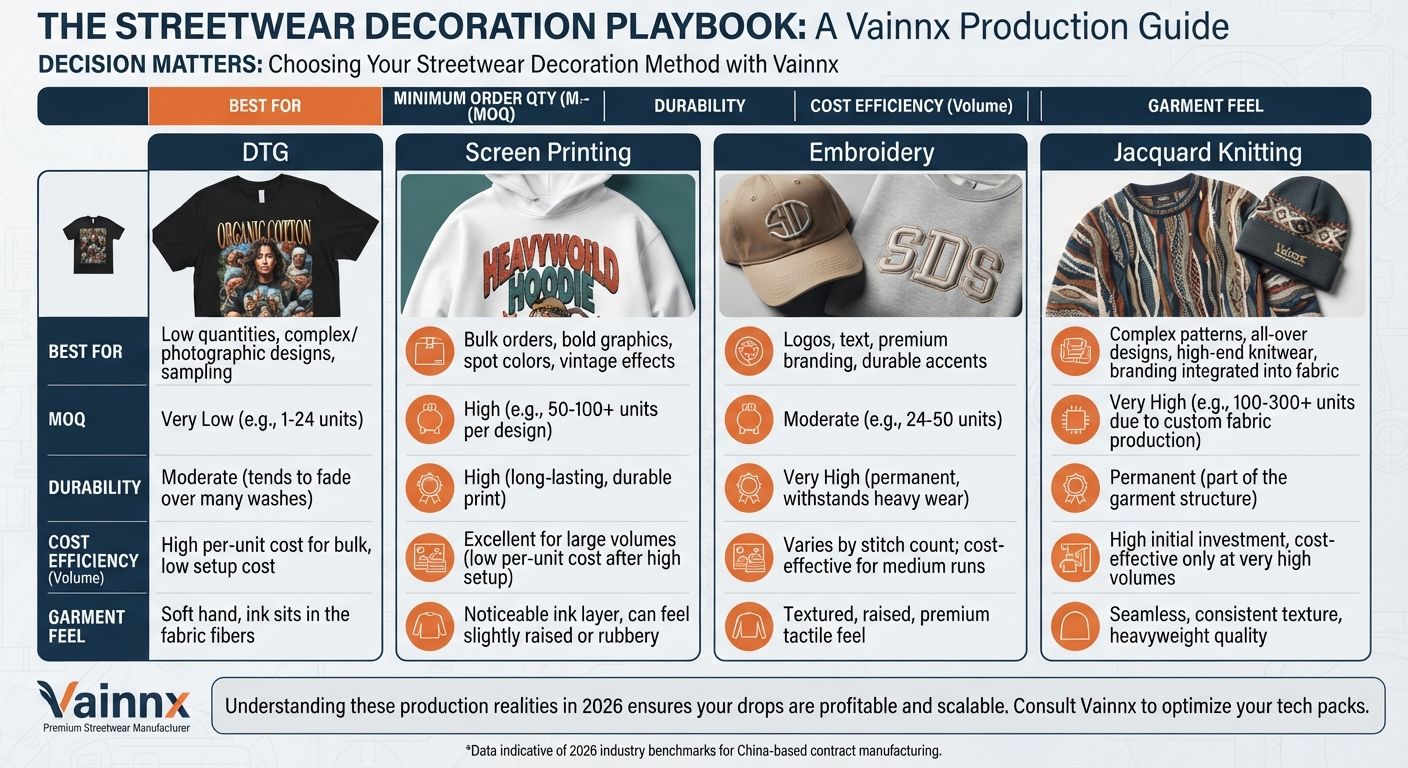
The Real Cost of Choosing the Wrong Customization Method
DTG Printing: How It Works, Best Use Cases, and Real Costs
Screen Printing: Setup, Cost at Scale, and Color Limits
Embroidery: Machine Types, Digitization, and Best Placements
Jacquard Knit: The Structural Alternative for Sweaters
Head-to-Head Comparison: Cost, Durability, MOQ, and Turnaround
Factor
DTG
Screen Printing
Embroidery
Jacquard
Setup cost
Very low
$30-80 per screen
$25-75 digitization
Pattern development
Unit cost at 50 pcs
$7-14
$8-12
$4-10
$18-35
Unit cost at 500 pcs
$6-10
$4-7
$3-7
$15-28
Typical MOQ
1-10
12-50+
1-12
100-300+
Turnaround
3-7 days
5-10 days
4-8 days
4-8 weeks
Durability
50+ washes
Garment lifetime
Permanent
Permanent
Design strength
Photoreal, gradients
Bold, few colors
Logos, structured text
Woven all-over patterns
Weak spot
Cost at scale
Many colors, small runs
Photorealism, tiny text
MOQ and lead time
Mixing Methods on One Garment: When Combining Wins
Design File Requirements for Each Method
DTG files
Screen printing files
Embroidery files
Jacquard files
A Practical Decision Framework for Your Brand
Closing: Build Your Decoration Strategy with Vainnx