Why Fabric GSM Matters: A Streetwear Manufacturer’s Guide to Premium Blanks
Introduction:
In the contemporary vernacular of global luxury streetwear, a striking graphic motif or a flashy digital mock-up is merely the visible tip of a vast industrial iceberg. When international apparel brand founders, independent labels, streetwear purveyors, or high-street KOLs map out their flagship drops or exclusive capsule collections, they routinely crash into a harsh manufacturing reality during the prototyping phase. What genuinely emancipates a premium streetwear label from the low-margin commodity price wars of modern e-commerce is not a 3D-rendered concept on a tablet—it is the sheer weight, physical substance, structural rigidity, and architectural drape that a consumer experiences the exact second they unbox their parcel and run their fingers across the garment.
As an elite clothing manufacturer deeply rooted in the epicenter of global apparel production—proudly serving over 200+ global streetwear labels and independent designer brands—Vainnx (https://www.vainnx.com/) has established an immutable supply chain axiom through our extensive OEM/ODM bespoke manufacturing services: 90% of the devastating product bottlenecks and monetary losses that startup streetwear brands encounter during development stem directly from a fundamental misunderstanding or neglect of a single technical textile parameter: fabric GSM (Grams per Square Meter).
In the visual and material lexicon of streetwear culture, fabric weight is never just a trivial numbers game. It serves as the physical skeletal framework that anchors oversized silhouettes, the foundational bedrock for high-definition Direct-to-Garment (DTG) or 3D Puff printing execution, and the defensive armor engineered to withstand aggressive vintage processing like acid washes, stone washes, and chemical sun-fade effects. From a B2B factory perspective, this comprehensive guide will decode the science of GSM, empowering your premium label to make flawless engineering decisions when sourcing premium blank apparel and executing bulk production.
1. Deep Decode: Understanding Fabric GSM Through an Engineering Lens
For brand operators, independent designers, or cross-border e-commerce sellers who do not possess a formal degree in textile engineering, GSM is frequently oversimplified in daily communication as mere "fabric thickness." At the Vainnx client management office, we routinely receive development briefs stating: "I want to manufacture the thickest possible T-shirt; please just find me the highest GSM cloth available on the market." As an experienced clothing manufacturer running high-capacity industrial lines, we must address this critical misconception: this linear approach is one of the most fatal engineering errors an apparel brand can commit.
The Physics and Textile Science Definition of GSM
GSM stands for Grams per Square Meter. It is the globally recognized metric standard utilized in the international textile industry to measure the physical mass, fiber density, and material weight of a specific cloth.
Inside the advanced quality control laboratories at the Vainnx manufacturing facility, tracking bulk fabric GSM follows a strict, unyielding protocol: our lab technicians isolate fabric rolls inside an atmospheric conditioning chamber maintained at a standard temperature of 20°C and a relative humidity of 65%. Utilizing a high-precision circular sample cutter with an exact surface area of 100 square centimeters, samples are extracted across the left, center, and right sections of the fabric width. These circular swatches are weighed on an electronic micro-scale, and the mass is multiplied by 100 to calculate the definitive GSM value. This technical figure dictates the precise yield per bolt of fabric and directly impacts a brand’s raw material cost-of-goods-sold (COGS).
The Complex Matrix: Interlocking GSM, Thickness, Yarn Count, and Spinning Technology
As a premier streetwear manufacturer, Vainnx’s R&D textile engineers consistently educate brand directors on this core reality: a high-GSM fabric is not inherently thicker than a lower-GSM alternative, nor is a low-GSM cloth guaranteed to look thin or flimsy. The tactile performance, rigidity, and transparency of any textile are engineered through a complex interaction of three technical variables:
1.Fiber Composition Dynamics (Fiber Content): Under an identical GSM specification, a 100% combed cotton, a cotton-poly blend (CVC/TC), a pure wool weave, or a synthetic polyester structure will display completely different visual volumes. For instance, wool fibers possess a natural microscopic crimp and exceptional loft that traps air, meaning a 300 GSM wool fabric will appear immensely thick and voluminous. Conversely, 100% natural cotton fibers are dense and straight, yielding a 300 GSM single jersey fabric that looks dense, flat, and compact rather than thick.
2.Yarn Count & Industrial Spinning Methods: Yarn count defines the thickness of the spun yarn strands (represented by notations like 16s, 21s, 32s, or 40s). The higher the number, the finer, smoother, and more delicate the individual yarn is.
Furthermore, the chosen spinning method matters tremendously: Open End (OE) spinning yields a loose, highly porous structure with short fibers, creating a dry, gritty hand-feel highly favored in gritty American retro streetwear. Compact Spinning, however, aligns fibers tightly, eliminating protruding hairiness. A 260 GSM fabric engineered from double-ply, compact-spun 21s yarn will deliver a level of structural stiffness, tensile rebound, and opacity that vastly surpasses a 280 GSM fabric knitted from coarse, single-ply Open End yarn.
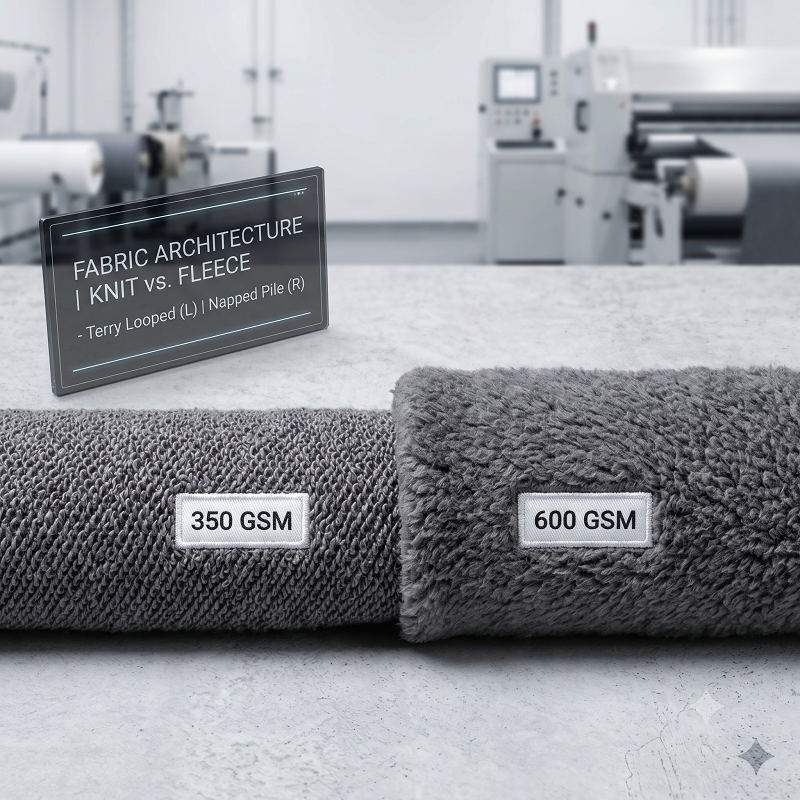
3.Knit and Weave Architecture (Knit Structure): The spatial layout of cotton fibers changes drastically based on whether they are routed through high-gauge circular knitting machines into a Single Jersey, an Interlock weave, a looped French Terry, or a heavily brushed interior Fleece. A single jersey lays flat and ultra-compact, feeling thinner yet dense at 240 GSM, while a French Terry utilizes loose floating loops on its reverse side to trap pocketed air, creating massive visual thickness at the exact same weight.
Consequently, when you communicate to the Vainnx production team that "I need to engineer a rigid, sculptural hoodie that drops cleanly without hugging the torso," our product development experts do not simply pull a random high-weight fleece off a shelf. Instead, we dissect your brand's aesthetic goals, reverse-engineer the ideal yarn count, spinning process, and loop geometry to deliver a bespoke textile explicitly calculated to hold the perfect streetwear drape.
2. The Ultimate Streetwear GSM Matrix: From Heavyweight Jerseys to Masterpiece Fleece
In the design evolution of modern streetwear culture, apparel construction has undergone a dramatic shift toward substantial weight, structural density, and unyielding rigidity—industrial terms collectively known as "heavyweight apparel." Standard, mass-market fabrics lack the internal tensile strength required to fight gravity; they sag against the skin, exposing physical contours and entirely failing to maintain the signature boxy, drop-shoulder geometry that defines high-street fashion.
Derived from thousands of successful bulk production runs for global streetwear imprints, Vainnx’s master manufacturing database defines the Ultimate Streetwear GSM Selection Matrix:
[STREETWEAR GSM CORE MATRIX GUIDE]
├── T-Shirts & Luxury Jerseys
│ ├── 160g - 200g (Lightweight Layering / High Breathability)
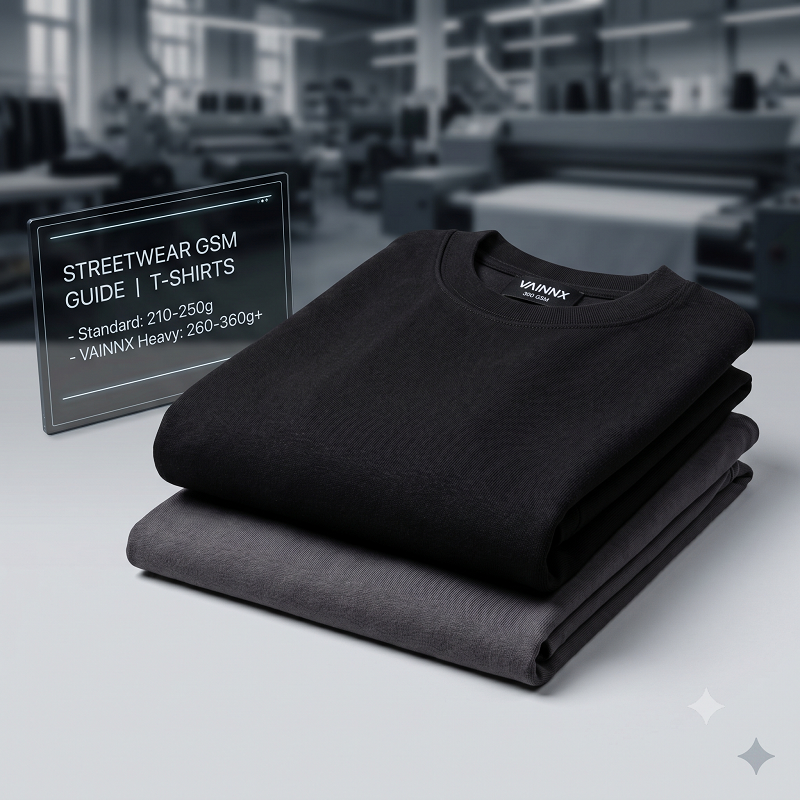
│ ├── 210g - 250g (Modern High-Street Standard Baseline)
│ └── 260g - 360g+ (Vainnx Signature Heavyweight / Sculptural Fit)
└── Hoodies & Heavy Sweatshirts
├── 300g - 350g (Spring/Summer Transitional / Zip-Up Blanks)
├── 400g - 450g (The Luxury High-Street Industry Gold Standard)
└── 500g - 650g+ (Vainnx Masterpiece Heavy Fleece / Grails Only)
2.1 Streetwear T-Shirts
Lightweight Layering Blanks (160 GSM - 200 GSM / 4.7oz - 5.9oz):
Typically knitted from 32s or 40s premium combed cotton yarns. In high-end streetwear lines, this weight is rarely deployed as a standalone summer outer piece due to its fluid drape. However, it is an indispensable asset for multi-layered high-street styling (Layering Pieces), functioning as an elongated scoop-neck undergarment. Its natural breathability and low physical profile allow designers to stack hoodies or tactical vests over it without inducing bulky restriction.
Modern High-Street Standard (210 GSM - 250 GSM / 6.2oz - 7.4oz):
Woven from 21s or 26s combed cotton single jerseys. This represents the universal "sweet spot" entry-level weight for modern streetwear labels worldwide. It achieves a flawless commercial equilibrium between substantial thickness and warm-weather breathability. It provides sufficient mechanical rigidity to hold wide screen prints flawlessly, making it ideal for high-volume seasonal releases across global e-commerce channels.
Hardcore Heavyweight Masterpieces (260 GSM - 360 GSM / 7.6oz - 10.6oz and beyond):
This is Vainnx’s signature domain of manufacturing excellence. We deploy ultra-dense, double-yarn compact combed cotton or specialized heavy interlock structures. These fabrics deliver a striking "sculptural shell" effect that completely isolates the garment from the wearer's skin. It locks in our optimized Boxy, drop-shoulder blocks, causing the sleeve cuffs to flare outward perfectly rather than collapse downward. It is the absolute premier choice for high-street "Vibe" lookbooks and luxury retro American streetwear brands aiming for a premium market position.
2.2 Hoodies & Sweatshirts
The luxurious substance of a high-end streetwear hoodie is governed entirely by the mass of its interior loopback architecture (French Terry) or the density of its napped interior pile (Fleece).
Transitional Light Weight (300 GSM - 350 GSM / 8.8oz - 10.3oz):
Primarily utilized for spring/summer light drops, zip-up cardigans, or base layers engineered for warm climates. Because the fabric is thin, mass-production sewing moves rapidly; however, factories must double-layer the hood panel or integrate internal interlining fuses, or the hood perimeter will sag awkwardly around the collar line.
The High-Street Gold Standard (400 GSM - 450 GSM / 11.8oz - 13.3oz):
The unyielding baseline chosen by elite global streetwear brands (such as Fear of God Essentials lines). At this weight matrix, the hood accomplishes an independent structural stance—standing erect around the neck contour without requiring drawcords—while the entire garment drops with an authoritative, heavy hang that instantly translates to a premium retail shelf price.
Masterpiece Ultra-Heavyweight (500 GSM - 650 GSM+ / 14.7oz - 19.2oz):
The iconic "heavy artillery" of the Vainnx supply chain. Known across the textile trade as a "heavyweight beast," processing fabrics of this extreme mass is impossible for low-tier cut-and-sew workshops, as standard industrial sewing needles shatter against six layers of overlapping 600 GSM seams. These garments provide a massive, luxurious weightiness on the body (often exceeding 1.2 kg per piece) and are engineered to withstand the most destructive industrial laundry washes.
2.3 Sweatpants & Tracksuits
Structural Heavyweight Standard (380 GSM - 450 GSM):
Streetwear trousers must resist the catastrophic "knee bagging" effect caused by repetitive joint flexion, which stretches inferior fabrics permanently out of shape. Vainnx's high-density 380+ GSM loopback Terry ensures the pant legs drop perfectly straight under their own mass, accumulating into structured, aesthetically pleasing creases around the ankles (the "Stacking Effect")—a vital styling demand for premium sneaker collectors.
2.4 Jackets & Utilitarian Outerwear
Industrial Canvas & Heavy Utilitarian (400 GSM - 600 GSM+):
Engineered for rugged American workwear jackets, heavy coach jackets, or tactical overshirts. Utilizing ultra-dense 100% cotton Duck Canvas, heavy ballistic nylons, or high-GSM Melton wool blends guarantees intense windproofing, superior abrasion resistance, and a hyper-masculine, structural military line during movement.
3. The Factory Floor Reality: How GSM Dictates Your Design's Survival
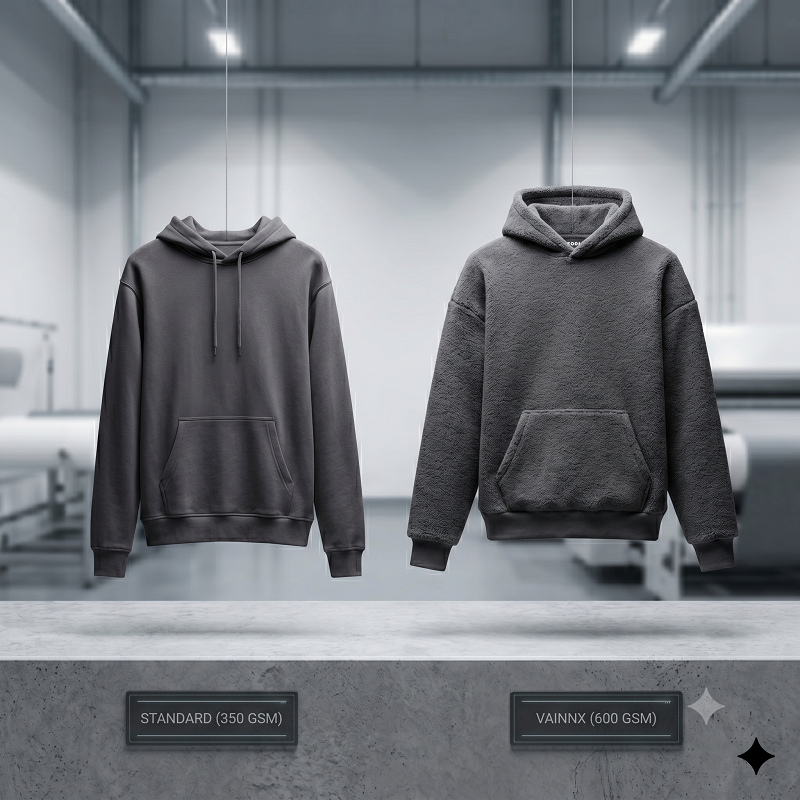
Throughout our decades of large-scale manufacturing experience, Vainnx has witnessed countless independent designers fall into the digital design trap. They compile striking, hyper-detailed vector graphics and drop-shoulder mockups on an iPad, only to face immense frustration when their low-tier workshop delivers the bulk production run. This breakdown occurs because they lack factory-floor expertise; they fail to realize that fabric GSM is the foundational physical variable of garment manufacturing, exerting absolute, irreversible control over pattern structure, screen print curing, embroidery distortion, and industrial laundering limits (Garment Crafts).
3.1 Pattern Architecture and Silhouette Integrity
The entire design language of modern streetwear relies on the engineering of "negative space"—the structural capsule of air maintained between the fabric walls and the human body.
The Penalty of Low-GSM Fabrics: Under the constant downward pull of gravity, lightweight textiles suffer severe vertical elongation and horizontal stretching. An intentional "Boxy Cropped Fit" meticulously planned on paper will stretch downward during active wear, turning into a limp, elongated, clingy garment reminiscent of cheap fast-fashion sleepwear.
The Triumph of High-GSM Fabrics (e.g., Vainnx’s Proprietary 460 GSM Compact French Terry): This material exhibits massive multi-directional tensile stability. At critical structural junctions—such as dropped shoulder seams, armhole connections, heavy rib hems, and hood perimeters—the heavy textile utilizes its internal fiber density to push back against gravity, holding an independent geometric space. Regardless of the wearer's physical frame, the garment forces an upright, powerful, high-street wedge silhouette.
3.2 Resilience to Brutal Vintage Laundry Processing
The premium patina demanded by contemporary streetwear (such as distressed grunge, vintage aesthetics, and post-apocalyptic utility lines) is achieved via brutal industrial washing cycles: acid washes, enzyme treatments, volcanic stone washes, edge grinding (Distressed), and chemically induced sun-fade effects.
At the manufacturing level, these processes are controlled forms of chemical and physical degradation. Industrial wash drums tumble garments for hours alongside oxidizing agents (like potassium permanganate or sodium hypochlorite) and abrasive stones to violently strip away surface dyes and expose high-contrast, faded seam lines.
The Structural Collapse of Low-GSM Blanks: If a brand executes this on a standard T-shirt below 180 GSM or a hoodie under 300 GSM, the cotton fibers will completely fracture under the physical impact. The garments emerge with severe side-seam twisting (torquing), warped necklines (bacon collars), and unintended structural holes, resulting in a 100% manufacturing scrap rate.
The Vainnx Manufacturing Solution: We mandate an unyielding standard of 260 GSM to 320 GSM compact-spun jersey blanks for vintage graphic tees, and 450 GSM to 600 GSM long-staple cotton loopback for vintage hoodies. This immense fiber reserve ensures that after hours of intense industrial abrasion, the garment remains structurally sound, revealing a deeply layered, authentic vintage wash that radiates high-end luxury value.
3.3 Printing & Heavy Embroidery Execution Constraints
The physical execution of massive brand logos and intricate back-panel artwork is strictly bound by the mass of the underlying canvas.
3D Puff Printing & Heavy High-Density Plastisol Inks: These core streetwear embellishments require thick industrial ink deposits cured inside high-heat drying tunnels exceeding 150°C to activate foaming agents. As the ink paste flash-cures, it exerts a massive compressive force. If the underlying fabric lacks sufficient GSM mass, the curing ink will overpower the textile, causing severe, permanent wrinkling and puckering along the graphic boundaries that ruins the garment's premium aesthetic.
High-Density Multi-Stitch Embroidery: Packing tens of thousands of dense embroidery stitches across a garment panel creates immense centripetal tension, pulling fabric fibers inward. Executed on standard blanks, the fabric will warp and buckle into an uneven crater. Utilizing Vainnx’s signature 450+ GSM heavyweight loopback fleece, paired with our advanced non-woven stabilizing backings and computerized tension control, guarantees that even the most massive, dense back-panel embroidery sits perfectly flat like a mirror, giving your brand a flawless, premium tactile finish.
4. Conquering the Pitfalls of Heavyweight Fabrics: Vainnx’s Vertical Supply Chain & 6-Stage Quality Control
While ultra-high GSM textiles unlock unparalleled premium aesthetics, they are notoriously volatile to tame within an industrial sewing environment. Low-tier, inexperienced factories attempting to execute heavyweight cut-and-sew orders consistently deliver catastrophic production defects: garments shrinking by two full sizes after the consumer's first domestic wash (uncontrolled shrinkage), side seams twisting drastically across the torso (Torque failure), or fabrics turning incredibly stiff, abrasive, and shedding lint relentlessly.
As an elite streetwear manufacturer running a highly advanced, vertically integrated flexible supply chain, Vainnx has engineered a definitive quality-control framework to eradicate these heavyweight anomalies at our modern production facility located at Room 701, No. 78, Bochong Road, Humen Town, Dongguan City:
Integrated Vertical Supply Chain: Decapitating the Shrinkage Nightmare
Heavyweight fabrics accumulate massive internal mechanical stress during high-speed knitting due to thick yarn diameters and intense needle tension. Splicing and sewing these fabrics straight off the knitting machine guarantees severe shrinkage upon contact with water as the fibers snap back to their natural states.
Vainnx completely controls this risk through our vertical production ecosystem (spanning yarn curation, high-gauge knitting machine calibration, eco-friendly custom dyeing, and continuous compaction finishing). Prior to entering the cutting room, all heavyweight fabrics undergo industrial-grade pre-shrinking heat treatments and compaction processing (Pre-shrunk Compaction).
More importantly, before the automated cutting blades strike, Vainnx enforces a mandatory 24 to 48-hour fabric relaxation period inside our climate-controlled warehouse. This allows the heavy cotton sheets to unroll completely flat and naturally shed all residual knitting stress. Through this meticulous preparation, Vainnx permanently caps bulk washing shrinkage to an industry-leading within ±3%, easily meeting the entry criteria of international luxury fashion houses.
The Rigorous 6-Stage Quality Inspection Processes (6道质检工序) Technical Breakdown
To guarantee that every shipment reaching our global portfolio of 200+ streetwear directors, independent independent stores, and DTC brands arrives in pristine, gallery-grade condition, Vainnx strictly enforces six quality control checkpoints throughout the manufacturing lifecycle:
Raw Material Inward Inspection
①The Inward Technical Firewall.
Before any batch of bulk heavyweight cotton rolls or heavy ribbing is accepted into our central inventory, QC inspectors execute 100% physical GSM sample punch-tests (verifying that mass holds stable within a strict ±5g tolerance margin against contract specifications). Simultaneously, fabric colors are evaluated inside specialized color-matching light boxes under multiple standard illuminants—including D65 (Artificial Daylight), TL84 (European Store Light), and U30 (US Commercial Light)—to completely eliminate dye-lot shade variance across bulk shipments.
②Pre-Production Sample Validation
Aligning the Assembly Lines Before Cutting
Prior to launching bulk automated cutting, our technical production directors, master pattern makers, and assembly line chiefs gather to sew a single "Pre-Production (PP) Sample" utilizing the actual bulk fabric lot. This garment is sent to our testing lab for rigorous dimensional logging, high-tension seam strength verification, and accelerated colorfastness laundry audits. Mass production is only greenlit once this sample achieves absolute sign-off.
③Cut-Piece Half-Finished Inspection
Precision Physical Screening Pre-Assembly
Following computerized automated fabric cutting, inspectors review the individual cut fabric panels one by one. This process isolates and eliminates minor dimensional slicing deviations caused by the uneven elasticity inherent to heavy fabrics. Furthermore, under high-intensity inspection light racks, technicians manually purge any natural knitting anomalies, stray fly-yarns, or localized fiber staining, ensuring only pristine "clean panels" advance to the sewing lines.
④In-Line Progress Monitoring
Real-Time Assembly Line Oversight
Mobile QC auditors conduct continuous, rolling inspections across the active sewing stations daily. They check for technical anomalies unique to heavyweight manufacturing: skipped stitches caused by thick seam overlaps, warped collar bindings, misaligned shoulder-neck intersections, and uneven rib joins. Vainnx maintains a high-density sewing specification (strictly locked at 11-13 stitches per inch) to guarantee that every seam can withstand the long-term stress of intense wear.
⑤Post-Processing & Craft Verification
Post-Treatment Quality Gate
Once garments return to our checking floors after undergoing specialized external treatments—such as complex multi-color screen printing, 3D puff expansion, high-definition DTG digital ink setups, or hours of abrasive industrial acid washing—the quality team initiates a specialized review. Technicians execute rigorous manual stretch tests to ensure prints remain free of cracking or peeling, and audit all dimensional specs to ensure side-seam torquing remains well within safety margins.
⑥Final Bulk & Packaging Quality Control
The Ultimate Pre-Shipment Quality Control Gate
Operating under strict international AQL 2.5 metrics or a 100% complete full-piece inspection mandate based on client demands, every garment completes its final journey. This includes comprehensive loose-thread trimming and high-pressure steam pressing to smooth out heavyweight creases. Next, every item must pass twice through high-sensitivity automated metal needle detection scans to guarantee zero metal shard hazards. Finally, inspectors verify custom brand trims (woven neck labels, care instructions, hangtags, and premium dustproof polybags), ensuring your brand image arrives in flawless, retail-ready condition.
5. Conclusion: Partner with Vainnx to Erect an Impenetrable Physical Barrier for Your Streetwear Brand
In today’s hyper-accelerated global independent store ecosystem (dominated by platforms like Shopify and WooCommerce), the discerning eyes and skin of modern consumers are exceptionally sensitive. The success of an avant-garde streetwear brand may begin with a viral concept on Instagram or a successful TikTok influencer seeding run, but its long-term survival and high repeat purchase rates are cemented the exact second a customer unboxes their parcel and tries the garment on. Substantial mass, rigid architectural structure, luxury tactile feel, and laundering endurance—these physical attributes delivered by an expert GSM matrix are the actual pillars of high-margin fashion ventures.
As your premier global streetwear manufacturing ally, Vainnx bridges the gap between high-concept design vision and robust, industrial-scale fulfillment. We have completely dismantled the rigid structures of traditional apparel factories by offering highly flexible Low Minimum Order Quantities (MOQs) starting from just 50 to 100 pieces per style, empowering emerging designers to launch exclusive capsule collections with minimal capital risk. Furthermore, our expert 10-person R&D apparel engineering squad delivers rapid 3-day prototyping and lightning-fast 7 to 15-day bulk turnarounds for rapid restocking.
Whether you are an established e-commerce seller seeking highly consistent, premium blank apparel stocks or an independent designer pushing the boundaries of custom distress washes, Vainnx delivers a flawless, one-stop vertical delivery system encompassing custom fabric engineering, tailored pattern adjustments, specialized graphic execution, and completely bespoke branded packaging. Partner with Vainnx today, and let our manufacturing expertise build an unyielding physical barrier that sets your brand apart!
Core Manufacturing Headquarters: Room 701, No. 78, Bochong Road, Humen Town, Dongguan City, Guangdong Province, China
Official Corporate Access: Initiate contact with our global supply chain consultants directly via email at info@vainnx.com or via telephone at +86 18925416353. Contact us today to receive our latest heavyweight physical fabric swatch books (featuring our complete lineup of high-GSM luxury jerseys and French Terrys) along with a personalized, one-on-one manufacturing quotation and supply chain optimization blueprint!
📞 Phone: [86-15015158179]
📧 Email: [info@vainnx.com]
🌐 WhatsApp:[https://wa.me/8618025298509]
Click the link above to start designing your custom streetwear today. We can’t wait to help you express your bold style!