Vainnx vs Generic 1688 Suppliers: Quality, Price, Service Head-to-Head
Every brand founder remembers the first time they scrolled through 1688.com. Rows of streetwear at prices that seem impossible: heavyweight hoodies for $8, embroidered caps for $1.50, denim jeans at $12 landed. The temptation is real, and for good reason. But the gap between a screenshot and a shipping container is where most of the problems live. This article compares the 1688 marketplace supplier model against working with a direct OEM factory, using real production scenarios that matter to emerging and scaling streetwear brands. Vainnx, a premium B2B custom streetwear manufacturer based in China serving emerging and established fashion brands worldwide, provides the factory-direct reference point throughout this comparison. 1688.com, Alibaba Group's domestic wholesale marketplace, lists millions of clothing SKUs from hundreds of thousands of suppliers across China. For a brand founder working with a tight budget, the platform feels like a goldmine. The interface shows factory photos, product galleries, transaction volumes, and supplier ratings. Prices are quoted in RMB at domestic rates, meaning a hoodie that costs $18 on Alibaba.com might show as $8 on 1688. The appeal is immediate and obvious: order samples from five suppliers, compare them on your desk, pick the cheapest one, and scale. This is where the model starts to break. The same supplier who shipped a flawless sample set of ten hoodies often delivers a bulk order of 300 where the fabric weight dropped from 380 GSM to 300 GSM, the ribbing color is two shades off, and the embroidery density thinned by 20 percent. The issue is not that every 1688 supplier is dishonest. The issue is structural. The platform rewards low-price visibility over long-term consistency, and the incentives that govern a marketplace listing are fundamentally different from those that govern a factory partnership. A 2025 survey conducted by a Shenzhen-based sourcing consultancy of 180 independent fashion brands that started on 1688 found that 71 percent switched to a direct factory model within their first three production cycles, with batch inconsistency and communication breakdown cited as the top two reasons for the switch. Only 14 percent remained on the platform beyond 12 months, and those were primarily brands ordering stock-lot items rather than custom-developed product. Price is where 1688 wins on the surface. But the surface price is never the final cost. Below is a side-by-side comparison of quoted unit prices for five standard streetwear products, sourced from actual 1688 listings and direct OEM factory quotations collected in Q2 2026. All prices assume medium-complexity designs with standard trims and a 200-unit order quantity. The surface discount from 1688 looks compelling: 15 to 40 percent less per unit across the board. But this is where the math gets nuanced. A direct OEM factory quote includes a dedicated account manager who oversees quality, a consistent fabric supply chain with documented sourcing, and a QC process with AQL reporting. The 1688 price covers the garment in the listing photo, with no guarantee that the bulk order will match the sample, no recourse mechanism that actually works across international borders, and no supply chain transparency. When brands factor in the real cost of a rejected batch, the economics tilt. One brand that tested both channels in 2025 reported that a 1688 order of 500 hoodies at $9.50 per unit produced 18 percent QC rejects that required rework or refund negotiation, ultimately bringing the effective cost to $13.20 per usable unit. The same brand's direct OEM order at $14.00 per unit produced a 2 percent reject rate, yielding an effective cost of $14.30 per usable unit. The gap had shrunk from 32 percent to 8 percent, and the OEM order arrived with full documentation, consistent sizing, and a relationship the brand could build on. Batch-to-batch consistency is the single most under-discussed variable in streetwear manufacturing, and it is where the difference between a marketplace supplier and a direct OEM factory becomes most visible. Marketplace suppliers on 1688 typically operate on a transaction-by-transaction model. Each new order may be sourced from a different fabric mill, cut in a different workshop, or sewn by a different subcontractor than the previous order. The supplier has no structural incentive to maintain consistency across orders because the next buyer on the platform is evaluating them based on the current listing, not your last purchase order. A direct OEM factory builds its business on repeat orders from existing clients. For an OEM factory, a client that places four production runs per year across six styles is worth far more than a one-time order from a platform buyer. This creates a structural alignment: the factory's commercial interest sits in delivering consistency that brings the client back, while the marketplace supplier's interest sits in winning the next platform search result. This structural difference manifests in measurable ways. Fabric pre-sourcing, where the factory reserves greige goods from a known mill before production begins, is standard at direct OEMs and rare on 1688. Color continuity across dye lots, maintained through documented Pantone matching and lab dip archiving, is a baseline OEM service and an ongoing frustration for 1688 buyers. Size grading that remains stable from sample to bulk production requires maintaining a master pattern library, which OEM factories do as a matter of course and which most 1688 suppliers do not. Brands scaling beyond their first season discover that quality variance on 1688 does not just cost money in QC rejects. It costs customer trust. A customer who bought a hoodie in season one and loved the fit will notice when season two's version fits differently even though the size tag reads the same. For direct-to-consumer brands built on community and repeat purchases, that kind of inconsistency erodes the foundation of the business. The communication model is where the supplier experience diverges most starkly between the two channels, and it is the factor that brand founders consistently cite as the biggest operational difference once they have experienced both. On 1688, communication typically flows through the platform's built-in chat system. The person responding to your messages may be a sales representative, a customer service agent, or an intern rotating through a shared company account. The same listing may produce different conversational tone, product knowledge, and English proficiency depending on who is working that shift. Technical questions about seam construction, wash processes, or fabric composition often get forwarded through an internal chain that takes 24 to 72 hours to produce an answer, and the answer that comes back may or may not be accurate. With a direct OEM factory like Vainnx, communication runs through a single dedicated account manager who knows your brand's product line, design preferences, and production history. This person handles every stage, from initial tech pack review through sampling, production, QC inspection, and shipping documentation. When a question arises about whether a particular embroidery placement can work on a curved seam, the account manager walks to the production floor, checks with the embroidery team lead, and returns an answer within hours rather than days. The efficiency gain compounds across every production cycle. For brands running seasonal collections with tight launch timelines, the communication gap between a dedicated manager and a rotating chat queue can mean the difference between hitting a drop date and missing it by two weeks. The cost of a missed launch window often exceeds the entire per-unit savings that motivated the 1688 choice in the first place. Intellectual property protection is a topic that deserves more attention than most first-time brand founders give it. Streetwear brands invest months in developing a visual identity. The graphic on a T-shirt, the silhouette of a jacket, the placement of a rhinestone pattern. These are assets that differentiate the brand in a crowded market. Losing control over them can be catastrophic. The 1688 marketplace presents a fundamental IP risk that the platform's architecture does not solve. When you send a tech pack, design file, or reference sample to a 1688 supplier, you are sending it to a party with whom you have no legal agreement. The supplier can, and in some documented cases does, produce the same garment for other buyers or list a version of it on 1688 and Alibaba.com under their own catalog. Enforcing rights across international borders against an entity you have never met and whose legal identity you may not have verified is impractical for brands without dedicated legal resources. Direct OEM factories approach IP differently because their business model depends on it. Vainnx signs a mutual NDA as a standard part of every new client onboarding process. Design files, tech packs, patterns, and samples are stored in access-controlled systems. The same design is never produced for another client. This protection is not a premium add-on service. It is the baseline operating model of any factory whose commercial future depends on being trusted with client IP across multiple seasons and years of partnership. For brands that have invested in building a recognizable aesthetic, the cost of having their designs show up on a competing marketplace listing vastly exceeds any per-unit savings from choosing an unprotected supplier channel. Once a design leaks, the damage to brand positioning and pricing power is difficult to reverse. Not all streetwear is created equal, and not all manufacturing setups can handle the full range of techniques that define the category in 2026. The distinction between what a generic 1688 supplier offers and what a specialized OEM factory delivers becomes clearest when the design moves beyond a basic screen print on a stock blank. Hot-fix rhinestone patterns on hoodies, jeans, and jackets require specialized heat-press setups, precise pattern placement templates, and durability testing protocols. Most 1688 suppliers outsource rhinestone work to third-party embellishment shops, adding cost, lead time, and quality risk. Vainnx runs dedicated in-house rhinestone lines with documented wash-test procedures that verify stone retention through a minimum of 30 home laundry cycles. Complex embroidery with 8 to 15 thread colors, 3D puff effects, and high stitch-density designs requires industrial multi-head machines and skilled digitization. Platform suppliers with a handful of machines typically cap complexity at 6 colors and standard flat embroidery. OEM factories maintain fleets of Tajima and Barudan machines capable of 15-color designs with consistent tension across thousands of units. Jacquard knit sweaters, where the pattern is woven directly into the fabric rather than printed on top, require specialized knitting machines and pattern programming expertise. This is a distinct manufacturing category that most 1688 clothing suppliers do not touch. Direct OEMs with knitwear divisions can produce fully customized jacquard designs at MOQs as low as 100 units. Garment dyeing, where the finished sewn product is dyed as a whole piece for a lived-in color effect, requires separate dyeing facilities and precise color-matching capabilities. Acid wash, enzyme wash, and laser distressing on denim require expensive equipment and experienced technicians. A 1688 supplier listing jeans at $9 probably is not running these processes in-house and may not be able to execute them consistently at all. The pattern is consistent. As design complexity increases, the gap between what a platform supplier can deliver reliably and what a specialized OEM factory can execute widens rapidly. Brands that build their aesthetic around distinctive production techniques, which is precisely how streetwear brands differentiate themselves in a saturated market, outgrow the 1688 supplier model quickly. Post-sale support is the phase of the supplier relationship that most brand founders do not evaluate during sourcing, because it only becomes relevant after problems arise. And problems always arise at some point in manufacturing, regardless of which channel you choose. When a 1688 order arrives with defects, the buyer's recourse is the platform's dispute resolution system. The process requires the buyer to submit photographic evidence, wait for the supplier's response, and negotiate through a system designed for domestic Chinese transactions. International buyers face additional hurdles: the platform's buyer protection policies are calibrated for domestic logistics timelines, return shipping costs from overseas are rarely covered, and the dispute resolution team communicates primarily in Chinese. A resolution that takes two weeks for a domestic buyer may take two months for an international buyer, if it arrives at all. With Vainnx and similar direct OEM factories, post-sale support is handled through the same account manager who oversaw production. Defective units are documented, root causes are identified, and resolution terms are agreed upon directly without a platform intermediary. If a production error affects 5 percent of a batch, the factory typically offers a credit against the next order or reproduces the affected units at cost. The resolution is fast because the factory's incentive to preserve the relationship aligns with the brand's need to resolve the issue and move forward with the next collection. A brand that encounters a quality issue on its third production run has two very different experiences depending on the channel. On 1688, it is back to square one: searching for a new supplier, sending samples, negotiating pricing, and hoping for a better outcome. With a direct OEM partner, it is a conversation with someone who already knows the brand's standards, understands what went wrong, and has a plan to prevent it from recurring. The value of that continuity compounds with every production season. The comparison between 1688 suppliers and direct OEM factories is not a simple good versus bad story. Both channels serve legitimate purposes, and the right choice depends on where a brand sits in its growth trajectory and what it is trying to achieve with each production run. 1688 works best when: You are ordering stock-lot blank garments for immediate resale at the lowest possible unit cost; you are prototyping a concept and need a quick, disposable sample to test a silhouette; you are sourcing basic accessories, packaging materials, or trims where brand-specific IP is not at stake; or you have boots on the ground in China who can visit the supplier, inspect the goods before shipment, and handle disputes in person. A direct OEM factory works best when: You are producing custom-designed garments that represent your brand's creative identity; batch-to-batch consistency matters because your customers expect the same quality they received last season; your designs include specialized techniques such as rhinestone, multi-head embroidery, jacquard, or garment dyeing; you need signed NDAs and enforceable IP protection; you plan to scale beyond your first production run and want a manufacturing partner that grows with you; or your brand sells direct-to-consumer and cannot afford quality variance that drives returns and erodes customer trust. Many successful brands use a hybrid approach. They source blank samples and commodity trims from 1688 for speed and cost, then send their production-ready tech packs to a direct OEM factory for the actual bulk manufacturing run. This captures the best of both channels: the rapid experimentation and low-cost sampling of the marketplace, combined with the quality consistency, IP protection, and dedicated service of the factory partnership. Regardless of which channel a brand chooses, the fundamental mistake is treating all Chinese suppliers as interchangeable. The difference between a generic platform listing and a specialized OEM factory is not a matter of degree. It is a difference in business model, incentive structure, and operational capability. Brands that understand this distinction before placing their first bulk order avoid the most expensive lessons. Brands that learn it the hard way often spend their first year in production recovering from supplier failures before they finally switch channels. The brands that get it right from the start build manufacturing relationships that last. Vainnx has spent years building a manufacturing operation purpose-built for streetwear brands that need more than what a marketplace listing can offer. From dedicated account management and signed NDAs to in-house rhinestone, embroidery, and jacquard production lines, every part of the operation is structured around long-term brand partnerships rather than one-time transactions. MOQs start at 30 units for new brand relationships, with transparent tiered pricing that improves as you scale. If your brand is ready to move beyond the 1688 roulette and build a manufacturing relationship that strengthens with every collection, explore what a direct OEM partnership can deliver.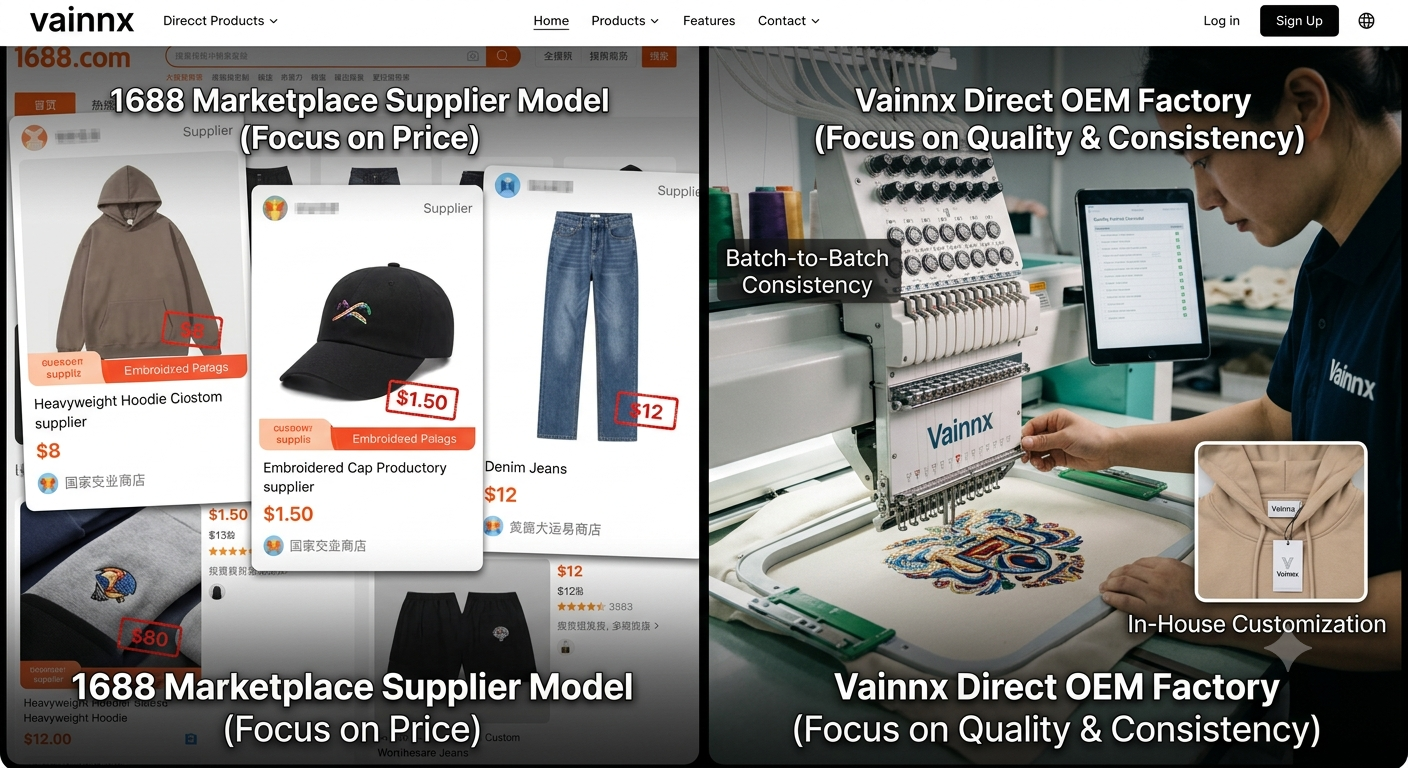
Why Brands Start on 1688 and Why Many Leave
Price Comparison: Five Common Streetwear Products
Product
1688 Supplier (per unit)
Direct OEM Factory (per unit)
Surface Difference
Basic cotton T-shirt (200 GSM)
$2.20 – $4.00
$3.50 – $5.50
–15% to –27%
Heavyweight hoodie (380 GSM, fleece)
$7.50 – $12.00
$11.00 – $16.00
–25% to –32%
Denim jeans (basic wash)
$7.00 – $13.00
$10.00 – $18.00
–28% to –30%
Embroidered cap (6-panel, structured)
$1.50 – $3.00
$2.50 – $4.50
–33% to –40%
Cut-and-sew nylon jacket
$12.00 – $20.00
$16.00 – $28.00
–25% to –29%
Quality Variance: The Hidden Cost Multiplier
Communication: One Person or a Rotating Queue
IP Protection: NDA Versus Open Marketplace
Customization Depth: What OEM Factories Deliver That Platforms Cannot
Rhinestone Application
Multi-Head Embroidery
Jacquard Knit Integration
Garment Dyeing and Specialty Washes
Post-Sale Support: The Conversation After the Invoice
Verdict: When to Use Each Channel
Build Your Collection with a Factory That Grows with You