The Streetwear Manufacturing Guide to 3D Puff Printing and Acid Wash Techniques
Introduction:
For streetwear brand owners, independent designers, and e-commerce fashion labels, the essence of streetwear has always revolved around two non-negotiable elements: substantial visual weight and distinctive tactile texture. In today’s hyper-competitive global fashion market, generic flat screen prints or standard solid-colored blanks no longer suffice to capture consumer attention on TikTok, Instagram, or high-end multi-brand boutique shelves.
To make your brand stand out, you must innovate at the intersection of fabric and advanced garment processing techniques. As a premium, high-end custom apparel manufacturer specializing in streetwear, Vainnx delivers this comprehensive, factory-floor technical guide. We will dismantle the complexities of 3D Puff Printing and Acid Wash processes, revealing how a professional streetwear clothing manufacturer orchestrates these crafts to produce high-value, market-dominating apparel.
1. The Physics and Chemistry of 3D Puff Printing in Bulk Production
What is 3D Puff Printing?
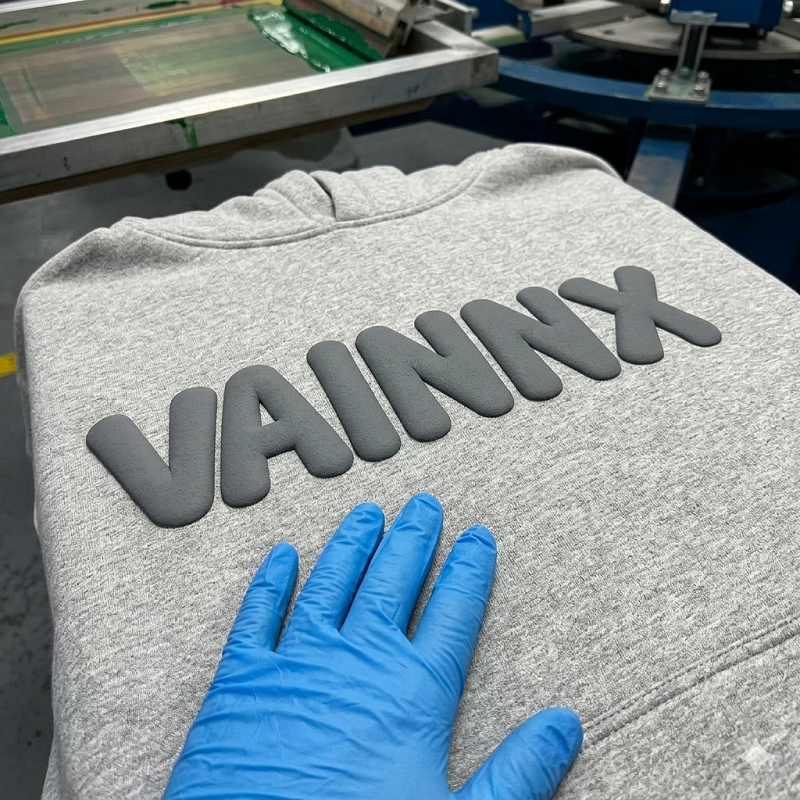
3D puff printing is a specialized screen-printing technique where a foaming agent is mixed into traditional plastisol or water-based inks. When exposed to precise high temperatures during the curing stage, a chemical reaction occurs, causing the ink to expand vertically and create a raised, three-dimensional, embossed texture on the fabric surface. Unlike standard plastisol prints or Direct-to-Garment (DTG) digital printing, puff printing offers a substantial vertical height, rounded volumetric edges, and a matte, rubberized, rubber-like elastomeric feel.
In luxury streetwear design—pioneered by iconic aesthetics like Kanye’s Yeezy line and Denim Tears—puff printing is extensively utilized for giant bold logos or typography across heavyweight hoodies and oversized tees, instantly imparting an architectural, industrial, and dystopian raw aesthetic to the garment.
Critical Manufacturing Parameters and Metrics
At Vainnx, executing puff print at scale goes far beyond basic studio setups. It requires strict industrial control over a matrix of chemical and physical variables to guarantee absolute consistency across thousands of pieces:
Ink Formulation & Ratio: The puff additive must be blended with high-tensile plastisol base inks at exact, proprietary ratios. If the puff agent percentage is too high, the internal structure becomes overly hollowed out, causing the print to collapse or split after washing. If it is too low, the three-dimensional loft fails to meet design expectations. Vainnx's standard formulation guarantees a uniform vertical height between 1.0mm and 2.5mm while maintaining a dense, structurally sound internal core.
Mesh Count Selection: Low-density screen meshes are mandatory for puff printing, typically ranging from 80 to 110 mesh counts. A mesh that is too fine blocks the highly viscous puff ink from passing through evenly, whereas a mesh that is too coarse creates jagged, blurred edges that ruin the graphic's crispness.
Squeegee Durometer & Pressure: We utilize mid-high hardness polyurethane squeegees rated at 70/75 durometer with mechanized, uniform downward pressure. This ensures an even ink deposit layer across the entire print zone, which is vital because the post-cured vertical height is entirely dependent on the pre-heated ink layer's volumetric thickness.
Flash Curing & Tunnel Temperature Profiles: This is the most critical threshold. The thermal activation and expansion window for puff ink typically falls between 145°C and 165°C (290°F to 330°F) for a duration of 20 to 30 seconds. Inconsistent heat distribution within low-tier curing tunnels causes uneven expansion across the garment—yielding high spots, deflated zones, and extensive peeling after standard consumer wash cycles.
2. Solving Brand Pain Points: How to Prevent Puff Print Cracking and Peeling
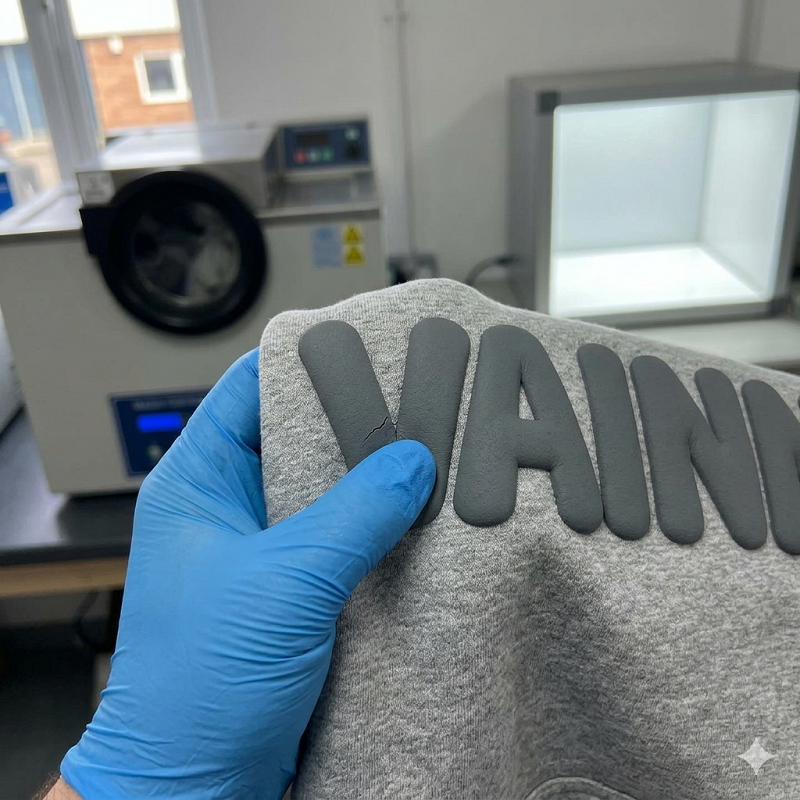
A recurring grievance our B2B sales team hears from emerging brand owners is: "My previous manufacturer produced puff-print hoodies that cracked, flaked, and peeled after just two home washes, resulting in devastating customer complaints and returns."
As an industry-leading garment supply chain partner, Vainnx asserts that puff print cracking and peeling are 100% preventable manufacturing flaws caused by poor execution. Here is how we eliminate these vulnerabilities on our production floors:
High-Elasticity Underbase Architecture
To prevent the loose surface fibers (fibers) of heavyweight knit fabrics—such as 450GSM French Terry or heavy fleece—from puncturing the puff ink layer and compromising its structural integrity, Vainnx implements a mandatory high-elongation clear base underbase. We print and flash-cure this structural base coat first. This acts as a smooth, sealed chemical foundation that anchors the fabric fibers down, allowing the upper puff ink layer to form a permanent bond with the underbase, significantly multiplying the garment's tensile strength and rub-resistance.
Precise Microprocessor-Controlled Molecular Cross-Linking
Many budget cut-make-trim (CMT) factories rush garments through shortened curing tunnels to boost daily throughput. This results in under-cured ink where the resin molecules fail to complete their chemical cross-linking phase. The print looks expanded on the outside but remains a powdery, brittle sandcastle internally. Vainnx utilizes a 15-meter industrial, multi-zone automated temperature-controlled curing conveyor tunnel. This setup ensures that every garment travels along a scientifically verified thermal curve, enabling complete, deep-core molecular cross-linking to build a robust, closed-cell honeycomb interior matrix.
Exhaustive In-House Industrial Wash-Testing Standards
Before any bulk order departs our facility, our Quality Control (QC) department subjects randomized production samples to rigorous AATCC (or ISO 6330) washing protocols consisting of 5 consecutive cycles of high-agitation machine washing and heavy-duty tumble drying. If even a microscopic hairline fracture or localized blistering is detected, the entire batch is halted, analyzed, and corrected.
3. The Industrial Science and Sequence of Streetwear Acid Washing
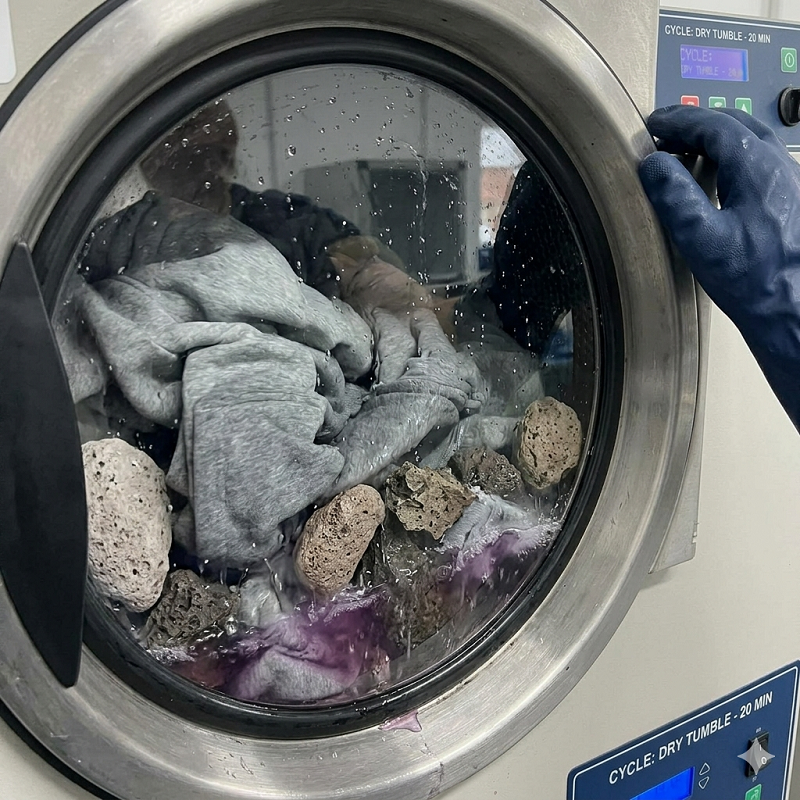
While 3D puff printing injects architectural "bones" (spatial height) into an apparel collection, Acid Washing (also known as mineral wash, snow wash, or marble wash) infuses the garment with its vintage "soul" (distressed, time-worn character).
The Chemical and Physical Dynamics
Modern industrial acid washing does not involve drowning clothes in raw acid pools. Instead, it is an advanced process of controlled, localized, non-uniform dye degradation. The process relies on porous volcanic pumice stones (Pumice Stones) that are pre-saturated with a concentrated solution of Potassium Permanganate{KMnO4}, a potent oxidizing agent. These stones are then tumbled dry with the garments in massive industrial washing cylinders.
As the stones repeatedly slam into and slide against the raised fabric surfaces—such as sewn seams, kangaroo pocket edges, shoulder lines, and hood rimming—they transfer the oxidizing agent solely to the outermost topography of the garment. This breaks down the molecular structure of the fabric dyes, resulting in organic, high-contrast marble textures, snow-speckled distressing, and worn vintage patinas.
The Vainnx Acid Wash Production Blueprint (Sequence)
1.Garment Selection & Pre-Treatment:
Dye Chemistry Validation
Garments must be constructed using fabric dyed with high-quality reactive dyes or sulfur dyes. Premium heavy knitwear, such as Vainnx's 100% Cotton 260GSM jersey or 450GSM heavy loops French Terry, serve as optimal substrates. All structural stitching is checked to withstand intense physical abrasion.
2.Pumice Stone Impregnation & Hydro-Extraction:
Moisture Factor Control
Premium multi-porous volcanic rocks are submerged in a calibrated {KMnO4} solution. They are then transferred to a centrifugal hydro-extractor to remove excess surface liquid until they are damp but absolutely non-dripping. Moisture control is everything: Overly wet stones bleed fluid, causing massive, uncontrolled bleached patches instead of crisp marble lines; overly dry stones fail to transfer the chemical entirely.
3.Dry Tumbling & Mechanical Friction:
15-30 Minute Cycle
The completely dry, finished garments are loaded alongside the chemical-carrying pumice stones into a dry industrial tumbling washer. The stones continuously crash against the fabric, scraping the outer fibers and leaving behind intricate, irregular paths of white oxidation marks along all seams and panels.
4.Chemical Neutralization & Multi-Stage Rinsing:
Terminating Oxidation
The second the tumble timer expires, the drum is flooded with cold water mixed with a precise dosing of Sodium Metabisulfite. This reducing agent immediately neutralizes the remaining Potassium Permanganate (converting toxic, brown Manganese Dioxide residues into highly soluble, colorless, harmless ions), halting the fading process instantly. This is followed by multiple clear-water overflow rinses.
5.Silicone Conditioning & Low-Heat Tumble Drying:
Hand-Feel Restoration
Aggressive physical pounding and chemical stripping leave raw cotton fibers feeling stiff and brittle. Vainnx introduces a premium bath of eco-friendly emulsified silicone softeners, allowing the relaxed cotton matrix to absorb nourishing compounds. This restores the heavy, thick, incredibly soft, and draped hand-feel expected of premium luxury streetwear before final low-temperature industrial drying.
4. Overcoming Manufacturing Dilemmas: Heavyweight Fabrics vs. Wash Tearing
In the global streetwear market, high-end positioning demands heavyweight fabrics. Modern designers almost exclusively request 400GSM, 500GSM, or even massive 600GSM loop-back French Terry or double-brushed heavy fleece. However, manipulating heavyweight knits inside an acid wash environment exposes a major supply chain pitfall: fabric degradation, structural brittleness, and localized tearing.
Why Heavyweight Garments Face Higher Tearing Risks
Potassium Permanganate is an indiscriminate oxidizer. If its concentration is uncalibrated or if neutralization is delayed by mere minutes, it attacks the cotton fibers themselves, cleaving the cellulose molecular chains and decimating the fabric’s bursting strength. Furthermore, when heavy knit garments soak up water inside industrial washers, their mass multiplies exponentially. As these water-logged, heavy garments fall from the top of massive rotating drums, the physical impact force exerted on seams is many times greater than that felt by lightweight t-shirts. If a seam or pocket edge has been chemically over-oxidized, this violent mechanical thrashing will cause the fabric to rip wide open, or fail under minimal customer stretch post-delivery.
The Vainnx Engineering Solution
To master the fine line between "extreme, high-contrast vintage distress aesthetics" and "bulletproof garment longevity," Vainnx enforces strict engineering protocols across our washing lines:
Digitalized Concentration & pH Instrumentation: We calculate {KMnO4} concentrations based on the total dry weight of the fabric load (rigidly keeping it between 1% and 3%), utilizing automated digital timers that trigger the neutralization cycle down to the exact second.
Thread Composition Upgrades: For all heavyweight garments slated for intensive acid washes, we discard standard cotton sewing threads. Instead, we mandate high-tenile poly-cotton core-spun threads and execute heavy-duty bar-tack reinforcements at all critical stress centers, including kangaroo pocket corners, crotch seams, and armpits.
Comprehensive Pre-Shrunk Fabric Mapping: Heavyweight 100% cotton fabrics undergo massive, erratic shrinkage during hot industrial washing and drying cycles. Vainnx runs all raw fabric bolts through specialized industrial steam pre-shrinking machinery prior to cutting. This ensures that the finalized, post-washed custom garment matches your tech pack's size charts with pinpoint accuracy.
5. Advanced Craft Fusion: The Vainnx Methodology for Combining Puff Print and Acid Wash
The most sought-after, high-margin streetwear collections do not settle for just printing or just washing. True premium streetwear garments often demand the simultaneous execution of 3D puff printing and heavy acid wash on a single garment.
In standard apparel manufacturing, this is widely recognized as a "high-risk failure zone." Inexperienced factories inevitably face catastrophic production failures:
Scenario A (Printing Before Washing): The high-velocity pounding of pumice stones acts like industrial sandpaper, grinding down the puff print, leaving it scuffed, blackened, discolored, or completely cracked and torn away from the substrate.
Scenario B (Washing Before Printing): Post-washed fabrics exhibit intense surface fuzz (pilling), chemical residues, and skewed fibers. This blockages screen inks from penetrating into the core yarn, causing the print to wash off entirely on the first consumer wash. Moreover, because the garment distorts slightly during washing, achieving precise multi-color registration on the printing platen becomes nearly impossible.
The Vainnx Blueprint (Our Exclusive Production Secret)
As an elite full-production-package (FPP) streetwear manufacturer, Vainnx has perfected a highly reliable, sequential methodology through thousands of sample iterations:
1.Pre-Wash Panel Cutting & Laser Alignment: We execute advanced digital nested cutting on pre-washed panels or strategically mask print zones during garment washing. To eliminate the industry-wide headache of crooked or off-center logos caused by fabric torque and twisting during heavy washes, Vainnx’s veteran pattern makers utilize advanced digital alignment marks alongside integrated laser-guided line-projectors on our screen-printing carousels, ensuring every single graphic is positioned at the absolute geometric center.
2.Proprietary Stone-Resistant Polyurethane Puff Formula: If a designer demands the highly complex aesthetic where the print itself must undergo the stone-wash process to look organically distressed, we utilize our proprietary PU Anti-Tearing Modified Puff Ink. This formulation creates an incredibly resilient, rubberized cross-linked matrix upon curing. It withstands up to 20 minutes of high-velocity volcanic stone impact without structural failure, generating only beautiful, hyper-authentic, softly eroded vintage edge-wear.
3.Strict Chemical pH De-neutralization Bathing: Before any acid-washed garment is allowed near our screen-printing presses, it must undergo an intensive conditioning bath to stabilize its surface pH to an absolute neutral value between 6.5 and 7.5. Any trace acidic or alkaline compounds left in the cotton fibers will undergo secondary thermal activation when passed under flash heaters, resulting in severe discoloration (e.g., crisp white puff prints turning an unmarketable scorched yellow, or deep black prints turning a washed-out ash gray).
6. Conclusion: Why Vainnx is Your Ultimate Strategic Streetwear Manufacturing Partner
In the highly competitive streetwear industry, creative design is your weapon, but your manufacturing facility and supply chain are your core ammunition depot. Partnering with a cutting-edge manufacturer capable of effortlessly executing flawless 3D puff prints, controlling heavy fabric dynamics, and delivering world-class acid washes ensures your artistic vision translates into premium, market-ready retail realities.
Operating from the heart of global apparel manufacturing, Vainnx is far more than a blind cut-and-sew factory—we are your dedicated brand-development and co-creation partner. Our long-term trust among over 200 international streetwear labels, boutique e-commerce brands, independent designers, and top-tier influencers stems from our foundational competitive advantages:
Low MOQs & Agile Scaling: Designed specifically to support limited drop culture and startup testing phases, we provide flexible minimum order quantities from 50 to 100 pieces per style/color, freeing your brand from the crushing weight of traditional factory inventory demands.
Rapid 3-Day Prototyping & Sampling: Backed by our specialized 10-person streetwear design, structural patterning, and fabric development squad, we turn digital tech packs into physical, high-fidelity salesman samples in as fast as 3 to 7 days, with swift 7 to 15-day bulk delivery cycles.
Rigorously Transparent 6-Stage QC Infrastructure: From initial raw material textile inspection, pre-cut shrinking calibration, first-article print validation, wash-fastness stress testing, to final mid-line and end-of-line inspections—every single garment is verified to meet premium global retail benchmarks.
End-to-End One-Stop Full Production Package (FPP): We manage the entire manufacturing cycle. Custom tech-pack layout, bespoke yarn dyeing, advanced printing/washing embellishments, woven neck labels, custom satin care tags, barcode hangtags, and branded eco-polybags are all handled seamlessly under one roof.
If your fashion brand is planning its upcoming collection featuring heavy puff-printed hoodies, mineral-washed vintage tees, or distressed industrial tracksuits, do not let substandard manufacturing compromise your vision. Contact our global commercial team today at Vainnx.com, or drop your design vector files and tech packs directly to our central inbox: info@vainnx.com. Our technical specialists will provide a comprehensive manufacturing assessment and a highly competitive wholesale B2B quotation within 24 hours!
📞 Phone: [86-15015158179]
📧 Email: [info@vainnx.com]
🌐 WhatsApp:[https://wa.me/8618025298509]
Click the link above to start designing your custom streetwear today. We can’t wait to help you express your bold style!