The Importance of a Vertical Supply Chain in Custom Streetwear Manufacturing
Introduction: The Streetwear Dilemma and the Path to Disruption
In a global fashion industry driven by distinctive aesthetics, deep-rooted subcultural resonance, fast-moving social media viral loops, and lightning-fast consumer demand, building a sustainable and successful streetwear brand is an incredibly complex endeavor. For contemporary streetwear founders, independent creative directors, and cross-border e-commerce entrepreneurs, the daily operational battlefield has shifted. It has evolved far beyond drafting vector graphics on a computer screen or curating a compelling brand narrative on social media. The ultimate commercial success of a brand is decided silently behind the scenes—specifically in the crucial bridge connecting artistic vision to premium, tangible physical garments. This bridge is the apparel manufacturing supply chain.
Many ambitious, emerging brands stumble into a structural trap during their foundational stages by aligning themselves with a fragmented, decentralized apparel manufacturing supply chain. In this traditional legacy model, the garment production journey is split across separate, disconnected operational islands. A designer must source fabric from a textile market merchant, transport those raw material rolls to an independent pattern-making studio for grading and cutting, ship the cut panels to a third-party embellishment facility for screen printing or direct-to-garment (DTG) graphics, and finally truck the pieces to an isolated cut-and-sew factory for final assembly. In the demanding realm of high-end streetwear manufacturing—where designs rely on heavily customized fabrics, complex vintage washes, and precise 3D puff prints—this decentralized approach introduces extreme friction. It inevitably yields compounding communication errors, prolonged development delays, massive bulk color variations, and a catastrophic breakdown in quality control.
Conversely, a vertical supply chain in fashion is aggressively redefining the future of custom streetwear creation. As an elite, design-centric streetwear clothing manufacturer with extensive experience serving premier global fashion labels, Vainnx presents this multi-dimensional, deep-dive industry guide. Here, we examine why an integrated, vertical infrastructure is no longer just a backend logistical alternative, but the absolute core competitive moat for modern streetwear brands aiming to establish dominance.
1. In-Depth Anatomy: What Exactly is a "Vertical Supply Chain" in Streetwear Manufacturing?
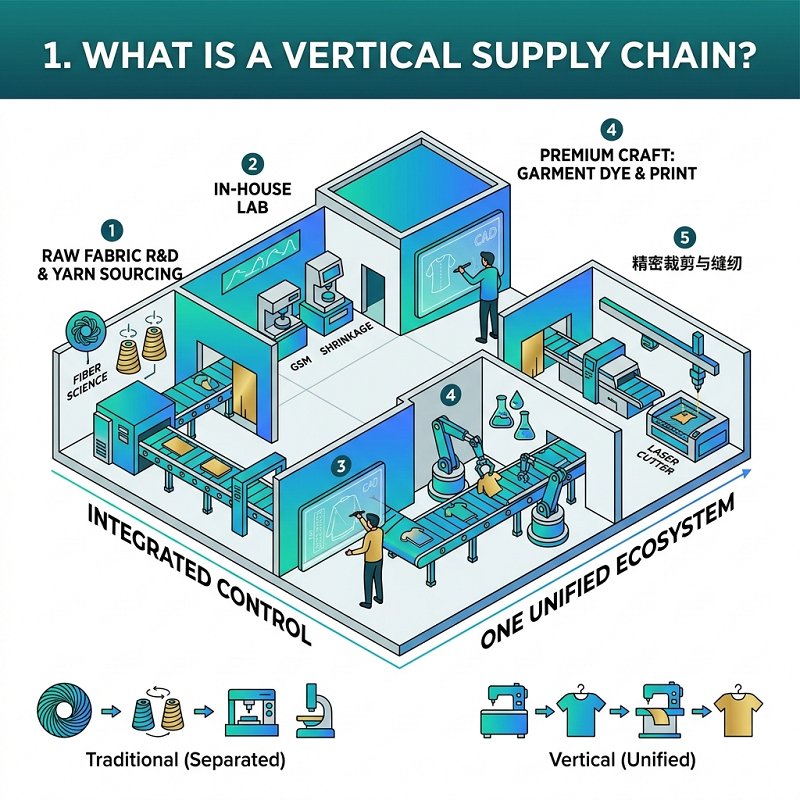
In contemporary industrial apparel manufacturing, a vertical supply chain (or vertical integration) describes an advanced operational model where a single manufacturer fully controls, commands, and executes multiple consecutive phases of the production lifecycle within its own facility. It eliminates the traditional multi-tiered subcontracting hierarchy, compressing scattered technical steps into a singular, highly synchronized, and digitally tracked manufacturing ecosystem.
A standard, state-of-the-art vertical streetwear production loop engineered and executed daily by Vainnx follows this seamless progression:
In custom streetwear manufacturing, this vertical integration represents far more than the physical conversion of raw yarn into a finished hoodie. Crucially, it represents the absolute command over aesthetic and structural integrity. The true soul of streetwear lies in its silhouette and tactile presence. Streetwear garments depend heavily on complex engineering (such as precisely balanced oversized drops, specific sleeve volumes, and custom-pitched ribbing), specialized heavy textile hand-feels (like 400GSM to 600GSM custom-knit French Terry or ultra-dense fleece), and intense multi-layered craftsmanship (such as high-density 3D puff prints layered over heavy garment acid washes).
In a traditional, fragmented manufacturing environment lacking vertical synthesis, when a design demands a combination of a complex vintage wash and a high-density puff print, independent sub-contractors frequently deflect responsibility. The laundry facility blames the print shop for using inferior ink that peels during a heavy wash, while the print shop argues that the laundry's water temperature was poorly calibrated, ruining the graphic's structure. In a vertical supply chain, all these volatile, high-risk technical variables are co-managed under one single roof by one dedicated team of cross-disciplinary experts. This end-to-end command offers brands unprecedented design security.
2. The Streetwear Paradox: Why Street Culture Demands Extreme Manufacturing Agility
To understand the immense commercial value of a vertical supply chain, we must contrast high-street fashion with mainstream fast fashion (e.g., ZARA, SHEIN) or standard blank promotional apparel. Streetwear features entirely unique manufacturing, material, and commercial dynamics:
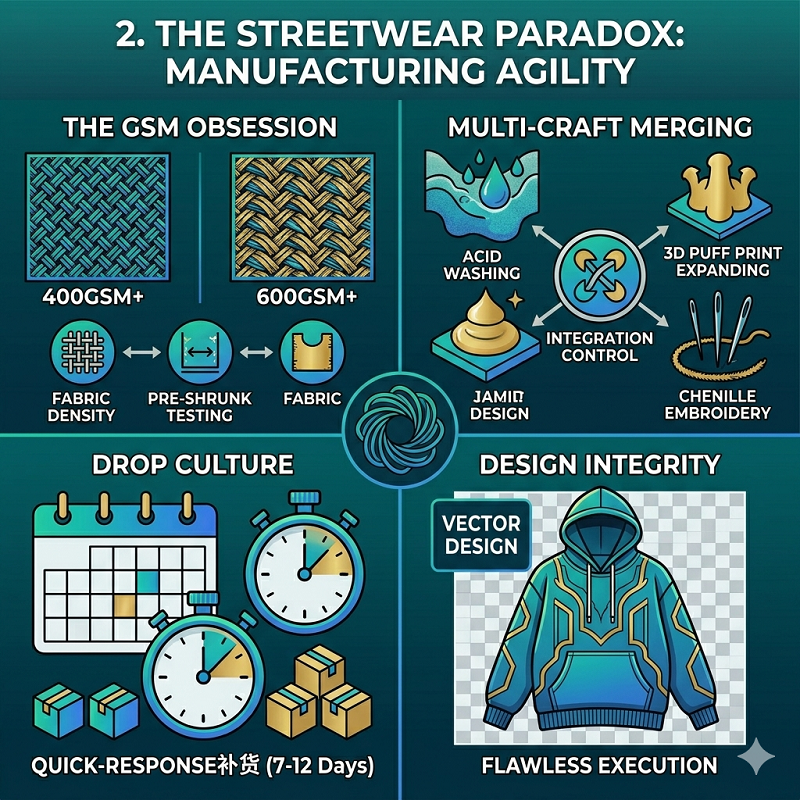
A. The Obsession with Heavyweight Fabrics & Textile Engineering
Streetwear is defined by its drape, weight, and structural rigidity. A lightweight, flimsy hoodie fails to resonate with the discerning streetwear enthusiast. Premium streetwear demands specialized, high-GSM (Grams per Square Meter) fabrics developed with exact specifications. For example:
Luxury High-Street T-Shirts: Typically require a minimum of 240GSM up to 310GSM double-ply combed cotton, paired with tightly knit 1x1 ribs to ensure collars never warp after hundreds of wash cycles.
Autumn/Winter Hoodies & Sweatshirts: Utilize 400GSM, 500GSM, or even 600GSM ultra-heavyweight French Terry or premium brushed fleece.
Standard factories lacking vertical textile R&D can only source off-the-shelf market fabrics, which frequently exhibit severe shrinkage rates exceeding 8% or rapid surface pilling. A vertical manufacturer intervenes directly at the yarn selection, knitting, and heat-setting phases. By applying specialized pre-shrunk processing and advanced silicone washes, we ensure that while the textile achieves an imposing weight and rigid structure, it retains a soft, breathable hand-feel and exceptional wash durability.
B. Hyper-Complex Surface Embellishments & Multi-Craft Merging
A signature contemporary high-street garment is often a composite of several extreme textile treatments. For instance, a vintage-vibe graphic tee might undergo: garment acid washing to achieve a snowy, marbled texture ➔ localized industrial laser distressing and fraying ➔ high-density 3D puff screen printing on the front chest ➔ 500,000-stitch premium chenille embroidery on the back panels.
Splitting these tasks across disconnected external workshops introduces massive risks of graphic misalignment, severe color variances, or structural fabric puckering caused by improper tension control across facilities. In a vertical setup, our production engineers perform "full-process routing tests" inside our own facility before bulk cutting, calculating precisely how a heavy wash's shrinkage will affect the downstream alignment of the embroidery and print screens.
C. The Agile Realities of Hype & Drop Culture
The commercial essence of modern streetwear is anchored in the "Drop Model"—highly anticipated, limited-edition releases deployed in multiple seasonal waves. Modern consumers seek exclusivity and actively avoid mass-market duplication. Consequently, brands cannot risk purchasing thousands of units upfront to sit in a warehouse; they must launch collections with minimal initial capital risk to test market sentiment.
If a particular piece goes viral on social media via an influencer endorsement and sells out immediately, the brand’s supply chain must be capable of executing an agile, quick-response restock within 7 to 12 days. For a traditional apparel broker juggling dozens of scattered sub-factories, this timeline is impossible. For a modern vertical clothing manufacturer utilizing an integrated ERP system, it is simply a standard, highly efficient production rescheduling.
3. The Top 5 Strategic Moats a Vertical Supply Chain Builds for Your Brand
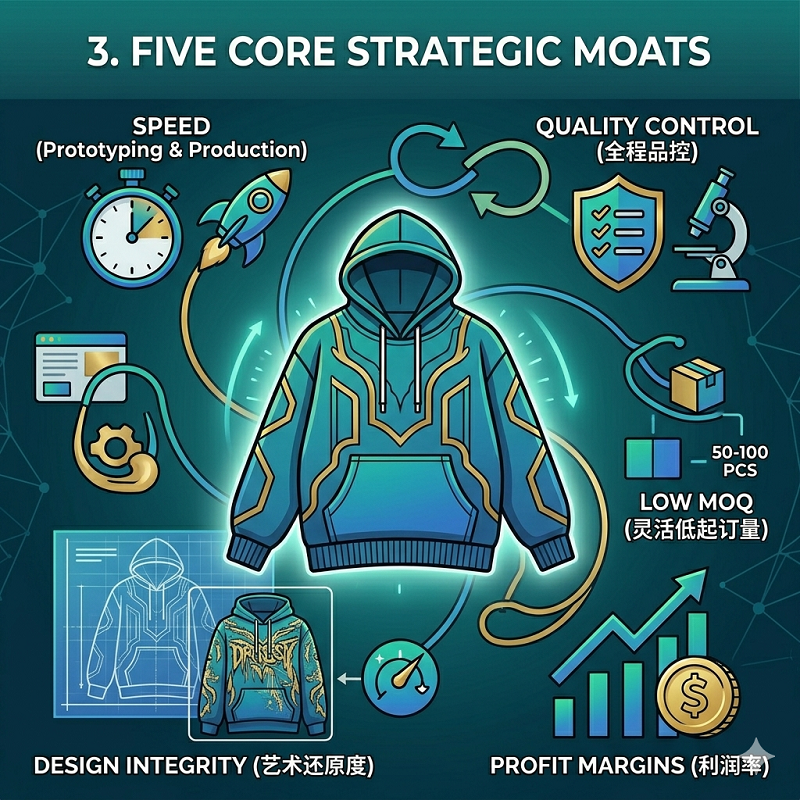
Operating as an elite high-end streetwear supplier, Vainnx’s global brand success stories consistently demonstrate that a vertical supply chain translates directly into a powerful, tangible advantage on your independent e-commerce storefront:
Advantage 1: Radical Speed-to-Market (Slashing Lead Times by over 50%)
In a fragmented manufacturing chain, significant time is squandered on administrative bottlenecks, inter-facility transit, and waiting in external production queues. A vertically integrated system compresses this timeline entirely:
3-Day Rapid Prototyping: When an e-commerce brand submits a tech pack or high-resolution design concepts online, our full-time in-house pattern masters, textile archivists, and sample craftsmen sync within an hour. Utilizing our expansive in-house raw material library and advanced CAD digital grading software, we can engineer and dispatch a flawless physical sample in as fast as 3 days.
Seamless Transition to Bulk Production: The moment the founder approves the sample, all pattern grading data, ink formulation recipes, and screen meshes are instantly deployed via our internal ERP software to the mass-production floor next door. This eliminates inter-enterprise technical miscommunications, safely compressing bulk production turnaround times to under 14 days.
Advantage 2: True Low MOQ Flexibility and Agile Hybrid Production
Legacy apparel conglomerates operate on rigid economies of scale, mandating high minimum order quantities (MOQs) of 1,000 to 3,000 units per style/color to absorb the steep setup costs of resetting sewing lines, burning screens, and mixing massive dye vats. This is an insurmountable financial wall for independent labels testing new designs.
A vertical supply chain utilizes modular production cells and rapid tooling setups to drastically lower machinery downtime. Vainnx proudly offers highly flexible low MOQs starting at 50 to 100 pieces per style. This allows independent streetwear brands to launch diverse capsule collections with minimal financial exposure, reserving capital for high-impact social media marketing.
Advantage 3: Total Elimination of Middleman Markups to Optimize Profit Margins
In a fragmented supply chain, every layer of intermediation—trading houses, independent pattern studios, middleman print brokers, third-party inspectors—adds a 15% to 25% markup to basic manufacturing costs, amplified by compounding shipping fees between facilities.
As an end-to-end vertical streetwear clothing manufacturer, Vainnx delivers direct factory pricing. By removing supply chain friction and multi-tiered broker margins, we return substantial capital back to the brand in the form of optimized Profit Margins. This gives founders the freedom to price competitively in the marketplace or reinvest the savings into superior raw textiles, driving a healthier business loop.
Advantage 4: Impeccable Design Integrity and Cultural Vibe Realization
A common frustration among international streetwear designers is: "The factory built the shirt to the dimensions requested, but completely missed the intended 'vibe' and aesthetic atmosphere." This occurs because conventional mass-production factories handle standard corporate uniforms or promotional blanks; their teams do not understand youth subcultures.
Within Vainnx’s vertical ecosystem, our multilingual account executives, engineering managers with 20 years of streetwear specialization, and artisan print makers work in close alignment. They understand "vintage grunge," "brutalist industrialism," and "Y2K pixel art." They capture the subtle nuances of your digital tech pack and execute them flawlessly across every texture of the final garment.
4. How Vainnx Leverages its Vertical Matrix to Scale Global Streetwear Labels
Strategically anchored in a world-class apparel manufacturing hub, Vainnx operates an agile vertical system engineered specifically for modern high-street and independent designer labels. Our factory infrastructure delivers unparalleled efficiency and professionalism across every touchpoint:
Comprehensive Full Production Package (FPP): We are far more than a simple cut-and-sew factory; we provide an all-inclusive OEM/ODM solution. From initial concept brainstorming and custom digital pattern grading to proprietary heavy textile knitting, premium dyeing, high-precision embellishments, custom branded hardware, main woven neck labels, bespoke packaging, and global door-to-door freight forwarding, we handle everything.
Full-Taxonomy Product Capabilities: Thanks to our diverse, modular specialized sewing lines, Vainnx manufactures a broad spectrum of high-end streetwear categories within a single facility. Whether your upcoming collection features heavyweight t-shirts, oversized hoodies, tactical cargo pants, luxury fleece tracksuits, nylon coach jackets, bomber jackets, or distressed knit sweaters, we guarantee total color-matching consistency, hardware harmony, and uniform packaging across your entire drop.
Downstream Visual Marketing Integration: Our definition of vertical integration extends past the shipping dock and into your brand's digital storefront. We understand that streetwear sales are highly visual. For our long-term brand partners, Vainnx utilizes our own facility's raw, industrial concrete architecture and brutalist spaces to provide professional lookbook photography and short-form video assets. This equips your marketing team with elite content for Instagram, TikTok, and your Shopify store the moment your collection drops.
5. Quantitative Lab Quality Metrics and Tech Pack Compliance
As a Senior Operations Executive deeply embedded in e-commerce strategy and supply chain management, I urge streetwear founders to look beyond cheap per-unit quotations. In B2B apparel production, unsustainably low prices always hide future delivery delays, bait-and-switch fabric substitutions, and massive quality defects. Instead, evaluate a partner's level of vertical integration using these four critical benchmarks:
5.1Audit Sample Speed and In-House Alteration Agility: Before executing a bulk contract, test if the facility can produce a highly accurate sample within 3 to 5 days. If a pattern correction is needed, can their in-house pattern masters modify it on-site the same day, or must they mail it back out to a third-party subcontractor?
5.2Verify Raw Greige Fabric Storage Depth: A premier streetwear manufacturer maintains immediate rolls of popular high-GSM textiles (e.g., 300g, 400g, 500g combed cotton greige loopback terry or heavy fleece) inside their own warehouse. This ensures your low MOQ project can be cut within 24 hours of ordering, rather than waiting weeks for market procurement.
5.3Confirm the On-Site Craft Ratio of Core Embellishments: Explicitly confirm via live video inspection whether the screen printing carousel, DTG machinery, embroidery bays, and industrial wash laundries are directly owned and managed inside the factory walls. Facilities with high outsourcing ratios introduce unpredictable交期交期 delivery schedules and volatile quality waves.
5.4Demand Supply Chain Transparency and Global Compliance: Does the factory welcome independent third-party inspection firms (e.g., SGS, Intertek) to audit production lines? Are their dyes and textiles backed by international safety certifications such as OEKO-TEX® Standard 100? Modern global consumers gladly pay a premium for brands with ethical, sustainable, and transparent supply chains, providing powerful storytelling material for your brand’s About Us page.
Conclusion: Partner with Vertical Power to Turn Vision into Global Hype
In the modern landscape of international streetwear commerce, your supply chain is no longer a passive administrative function—it is the ultimate competitive moat of your enterprise. Disconnected, slow-moving legacy outsourcing networks are rapidly being phased out by the market. The vertical supply chain equips your brand with unparalleled reaction speeds, total quality command, and optimized financial health.
Choosing a sophisticated, vertically integrated streetwear clothing manufacturer like Vainnx—a team that natively speaks the language of youth fashion culture, provides flexible low MOQs, and masters every step from yarn to delivery—is the most reliable, strategic, and secure pathway to converting your creative vision into an iconic street fashion brand celebrated worldwide.
📞 Phone: [86-15015158179]
📧 Email: [info@vainnx.com]
🌐 WhatsApp:[https://wa.me/8618025298509]
Click the link above to start designing your custom streetwear today. We can’t wait to help you express your bold style!