Streetwear Manufacturing Trends 2026-2027: What Brands Must Know
The streetwear manufacturing landscape is transforming at a pace that catches even seasoned brand owners off guard. Fabrics are getting heavier, embellishments are becoming more intricate, and the sustainability conversation has shifted from optional to essential. If your next collection is still built on the same production assumptions you held twelve months ago, you are already falling behind. Vainnx, a premium B2B custom streetwear manufacturer based in China serving emerging and established fashion brands worldwide, has tracked these shifts across hundreds of client projects. The data from our production floor tells a clear story: the brands winning in 2026 are those that understand not just what trends are surfacing, but how those trends translate into manufacturing decisions. This article breaks down the eight most significant streetwear manufacturing trends shaping 2026 and 2027, drawing from real production data, material science developments, and firsthand insights from brands scaling from 100 to 10,000 units per month. The most consequential shift in streetwear manufacturing right now is not a design trend — it is a fabric weight trend. Across T-shirts, hoodies, and sweats, the consumer baseline has moved decisively upward. Where 180-220gsm cotton was once the default for a premium streetwear T-shirt, brands are now specifying 280-340gsm as their starting point. For hoodies, the 400gsm threshold has become a marketing signal in its own right. This is not arbitrary. Heavyweight fabrics deliver three things that lightweight alternatives cannot: superior drape that photographs better for e-commerce, perceived quality that justifies higher retail price points, and durability that drives repeat purchases and reduces return rates. A 340gsm carded cotton T-shirt hangs differently on the body than a 200gsm ringspun — the difference is immediately visible in product photos, and it is the product photo that closes the sale. From a manufacturing perspective, the heavyweight shift creates real production challenges. Standard industrial sewing machines designed for 180-220gsm fabrics struggle with the increased thread tension required for 340gsm+ construction. Seam puckering becomes more likely. Needle breakage rates increase. Production line speed must slow by approximately 15 to 20 percent to maintain quality. Vainnx has addressed this through dedicated heavyweight production cells equipped with heavy-duty needle systems, reinforced feed dogs, and stitch-length calibration protocols specifically tuned for 280-420gsm fabrics across T-shirts, hoodies, and sweatpants. If heavyweight fabric represents the structural shift in streetwear manufacturing, embellishment represents the aesthetic shift. The demand data is unambiguous: rhinestone applications, 3D puff embroidery, and all-over jacquard knit patterns have seen demand increases of 40 to 60 percent year-over-year across Vainnx client projects between 2025 and 2026. Rhinestone work, once limited to high-end women's wear and stage costumes, has crossed fully into mainstream streetwear. Hot-fix rhinestone application — where stones are pre-coated with heat-activated adhesive and bonded to fabric using a heat press — has made the technique viable at production scale. Flat-back rhinestones applied with industrial adhesive offer an alternative path with different aesthetic properties. The critical manufacturing consideration is durability: a rhinestone hoodie that loses stones after three washes destroys brand trust. Vainnx runs wash-cycle durability testing on every embellished sample, with a maximum 5 percent stone loss threshold after 20 industrial wash cycles before a design is approved for bulk production. 3D embroidery, also called puff embroidery, layers foam beneath the stitch surface to create raised, dimensional lettering and graphics. This technique requires specialized digitization — converting artwork into machine-readable stitch files — that accounts for foam thickness, stitch angle, and compression behavior. Jacquard knitting, where patterns are woven directly into the fabric rather than printed or embroidered on top, demands entirely different equipment: computerized jacquard knitting machines that can handle pattern complexity far beyond what manual looms can achieve. Vainnx operates in-house embellishment lines covering all three techniques, eliminating the multi-vendor coordination that typically adds four to six weeks to production timelines. Sustainability in streetwear manufacturing has moved from marketing narrative to operational requirement. Consumer survey data consistently shows that Gen Z and millennial streetwear buyers rank sustainable production among their top three purchase considerations, and the behavior follows the stated preference — brands with verifiable eco-credentials are seeing higher repeat purchase rates. The manufacturing implications span every stage of production. At the fabric level, organic cotton certified to GOTS (Global Organic Textile Standard) standards, recycled polyester derived from post-consumer PET bottles, and hemp-cotton blends are replacing conventional materials. OEKO-TEX Standard 100 certification — which verifies that every component of a garment is free from harmful substances — has become a baseline expectation for export to the European Union and is rapidly gaining traction in North America. At the wash and finishing stage, traditional stone washing and acid washing consume enormous volumes of water and produce chemical effluent. Laser distressing technology achieves comparable aesthetic results with zero water consumption and no chemical discharge. Ozone washing — using ozone gas to fade and soften denim — reduces water usage by up to 60 percent compared to conventional methods. Digital pattern cutting, where computer-guided cutting tables optimize fabric layout to minimize waste, can reduce material waste by 15 to 25 percent compared to manual cutting. At the packaging level, the shift is equally pronounced. Biodegradable PLA (polylactic acid) poly bags made from corn starch, recycled paper hang tags carrying FSC (Forest Stewardship Council) certification, and recycled cardboard shipping boxes are replacing virgin plastic and non-recycled paper. Vainnx offers GOTS-certified organic cotton, OEKO-TEX certified fabrics, eco-friendly wash options including laser and ozone, and biodegradable packaging across its production lines, with flexible MOQ that makes sustainable manufacturing accessible to emerging brands rather than reserved for large-volume buyers. Key Insight: Brands that integrate sustainability at the manufacturing stage — not as a marketing afterthought — see an average 18 to 25 percent higher perceived value from consumers. The manufacturing choices you make today become the brand story your customers tell tomorrow. The Y2K aesthetic — defined by acid-washed denim, heavily distressed finishes, baggy and oversized silhouettes, and a deliberately unpolished visual language — has completed its journey from nostalgic niche to mainstream dominance. What makes this particularly relevant for manufacturing is that Y2K pieces are significantly more production-intensive than their minimalist counterparts. Acid washing requires controlled application of potassium permanganate or chlorine-based solutions to denim, followed by neutralization and rinsing — a multi-stage process that demands both chemical expertise and environmental controls. Manual distressing — achieved through hand sanding, grinding wheels, razor slashing, and patchwork application — is inherently labor-intensive: a single pair of heavily distressed jeans can require 30 to 45 minutes of skilled handwork. The silhouette shift toward baggy and oversized fits changes the entire production math. A boxy oversized T-shirt with a 74cm chest width and dropped shoulder construction uses approximately 20 to 30 percent more fabric than a regular-fit T-shirt in the same size grade. Baggy jeans with a 28cm leg opening and relaxed rise require different pattern blocks entirely — brands cannot simply size up existing slim-fit patterns and expect proportional results. Vainnx has developed dedicated Y2K pattern blocks across T-shirts, hoodies, denim, and jackets, with wash and distressing capabilities that include acid wash, enzyme wash, stone wash, hand sanding, grinding, razor distressing, and patchwork reconstruction. One of the most structurally significant trends in streetwear manufacturing is the steady decline of minimum order quantities. Where 300 to 500 pieces per style per color was the industry standard five years ago, the market has shifted decisively toward 50 to 100 pieces as the new normal — and forward-thinking manufacturers are accommodating trial orders as low as 30 pieces for new brand partnerships. Three forces are driving this change. First, the direct-to-consumer model rewards testing designs in small batches before committing to volume — a brand can drop 80 pieces, measure sell-through in 48 hours, and place a restock order based on real demand data rather than guesswork. Second, the pre-order model, where brands collect customer payments before placing production orders, naturally gravitates toward smaller batch sizes. Third, the rise of micro-brands — solo founders and two-person teams operating entirely through social media — has created a new category of buyer who simply cannot absorb 300-piece minimums. The economics of small-batch production are challenging for manufacturers. Fabric mills impose their own minimums — typically 100 to 200 meters per color per fabric type — which means small orders must either pay premiums for below-minimum fabric purchases or share fabric runs across multiple clients. Production line setup time, which includes machine configuration, thread changes, and quality checkpoint calibration, represents a fixed cost regardless of order size. Vainnx addresses these challenges through fabric-sharing programs that aggregate demand across brands using the same base fabrics, and through flexible production cells designed for rapid changeover between small-batch runs. The result is startup-friendly MOQ of 30 to 50 pieces for initial trial orders while maintaining the quality consistency that larger volume buyers require. Technology is embedding itself into the physical garment in ways that create entirely new manufacturing requirements. QR code hang tags, once a novelty, are now standard on mid-tier and premium streetwear. These codes link to authentication pages, brand stories, styling guides, care instructions in multiple languages, and sustainability provenance tracking — turning a passive garment into an active digital touchpoint. NFC (Near Field Communication) tags represent the next frontier. Sewn into care labels or embedded in branded patches, NFC chips can be scanned by any smartphone to verify authenticity, unlock exclusive content, register products for warranty or loyalty programs, and provide proof of ownership for resale platforms. The manufacturing implications are practical: NFC tags must survive industrial washing, heat pressing, and the full garment production cycle without degradation. Tag placement must account for the metal content of nearby hardware — buttons, zippers, rivets — that can interfere with NFC signal transmission. Smart packaging extends the tech integration beyond the garment itself. QR codes on poly bags and shipping boxes, scannable care instruction inserts with video links, and augmented reality hang tags that trigger brand experiences when viewed through a phone camera are all entering production workflows. Vainnx supports QR code hang tag production with variable data printing — each tag carries a unique serialized code — and NFC tag integration with placement testing to ensure reliable scanning performance after production and shipping. Trend awareness without production adaptation is just theory. The practical question for any brand owner reading this is: can my manufacturer actually execute on these trends, or are they just nodding along? At Vainnx, the answer is built into physical production infrastructure, not marketing copy. The heavyweight fabric shift required investment in heavy-duty sewing workstations with reinforced feed mechanisms, industrial-grade needles rated for 300-420gsm materials, and operator retraining on the slower, more precise sewing cadence that heavyweight construction demands. The embellishment boom meant expanding in-house rhinestone application lines — both hot-fix and flat-back adhesive — adding multi-head embroidery machines capable of 3D puff output, and maintaining jacquard knitting capacity for pattern-woven garments. Sustainability requirements drove adoption of GOTS-certified organic cotton supply chains, OEKO-TEX certified fabric sourcing, laser distressing equipment that eliminates water consumption from the wash process, and biodegradable packaging options including PLA poly bags and FSC-certified paper products. For brands, these investments translate into a straightforward value proposition: a single manufacturing partner that can produce a heavyweight 340gsm T-shirt with rhinestone embellishment, packaged in biodegradable materials with a scannable QR hang tag, starting from a trial order of 50 pieces — all without the coordination overhead, quality variance, and timeline risk of managing four separate vendors. Not every trend has equal staying power. The table below maps each trend against its projected lifecycle, based on underlying structural drivers rather than aesthetic fashion cycles — because structural trends driven by material science, production economics, and consumer behavior shift more slowly and predictably than surface-level style trends. The brands that will thrive through this period of rapid manufacturing evolution share a common behavior: they treat their manufacturer not as a vendor executing purchase orders, but as a production partner whose capabilities directly shape what is possible for the brand. The brands stuck on 200gsm blanks while their competitors ship 340gsm heavyweight collections with embellished details and sustainable packaging did not make a design mistake — they made a manufacturing partner mistake. Three actionable steps for brand owners evaluating their manufacturing readiness for 2026-2027: Vainnx has built its production infrastructure around these six trends because the data from hundreds of brand partnerships makes the direction unambiguous. The shift toward heavier fabrics, richer embellishment, verifiable sustainability, and technology-integrated garments is not a passing wave — it is the new manufacturing baseline for streetwear. Brands that align their production partnerships with this reality now will spend 2027 focused on growth, not catching up. The heavyweight fabric shift — moving from 180-220gsm to 280-400gsm across T-shirts, hoodies, and sweats — is the single most consequential trend because it affects every product category, changes production economics, and directly impacts consumer perception of quality. A brand launching with 200gsm blanks in 2026 is competing at a structural quality disadvantage. Heavyweight fabrics typically add 15 to 25 percent to raw material costs, and the slower production line speeds required for quality heavyweight construction add approximately 10 to 15 percent to labor costs per unit. The total cost increase for a 340gsm T-shirt versus a 200gsm equivalent typically ranges from 20 to 35 percent — an investment that brands recoup through higher retail pricing and lower return rates driven by superior perceived quality. Sustainable manufacturing was historically gated behind large MOQ requirements because organic and certified fabrics carried high mill minimums. This is changing rapidly. Vainnx offers GOTS-certified organic cotton and OEKO-TEX certified fabrics at MOQ as low as 50 pieces through fabric-sharing programs that aggregate demand across multiple brands, making sustainable production accessible to emerging labels. The Y2K aesthetic — acid wash, baggy silhouettes, distressed finishes — is projected to remain strong through 2027, after which it will likely evolve rather than disappear. The baggy and oversized silhouette preference shows signs of becoming a more durable shift, not just a fashion cycle, because it aligns with the broader comfort-driven consumer behavior that emerged during the pandemic era and has not meaningfully reversed.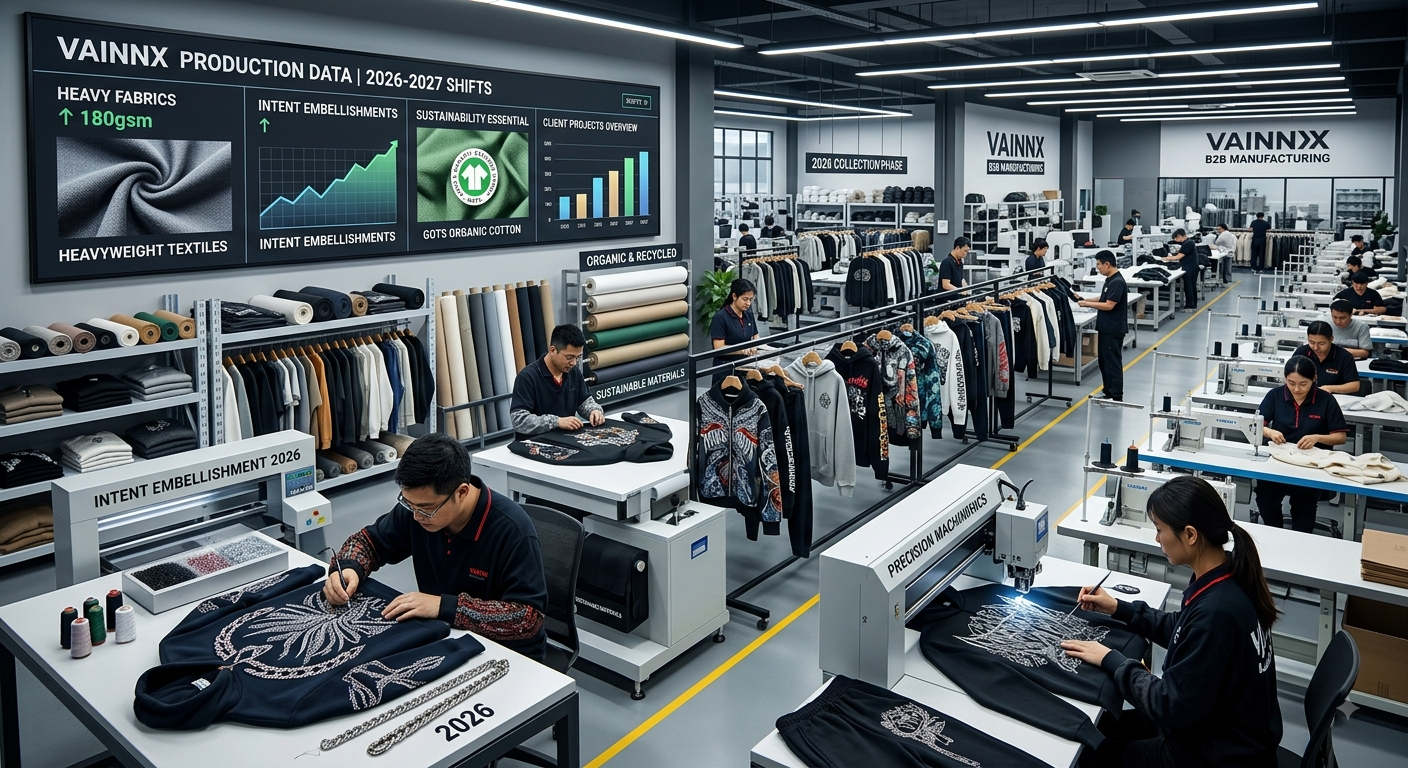
Heavyweight Revolution: Why 300-400gsm Is Becoming the Standard
The Embellishment Boom: Rhinestones, 3D Embroidery, and Jacquard Demand
The Sustainability Shift: Eco-Friendly Production Goes Mainstream
Y2K Renaissance: Acid Wash, Distressed Finishes, and Baggy Silhouettes Return
The Small Batch Economy: MOQ Decline and the Rise of Agile Production
Tech Integration: QR Hang Tags, NFC, and Smart Packaging
How Vainnx Is Adapting: Production Line Transformation for 2026-2027
Trend Lifecycle Predictions: What Stays and What Fades Through 2027
Trend
Structural Driver
Projected Lifecycle
Confidence
Heavyweight Fabrics
Material quality perception, e-commerce photography requirements
Structural shift — multi-year staying power
High
Embellishment (Rhinestone, 3D Embroidery)
Differentiation in saturated market, social media visual impact
Strong through 2027, may moderate as market saturates
Medium-High
Sustainability
Regulatory pressure, consumer demand, supply chain economics
Permanent structural shift — will only accelerate
Very High
Y2K Aesthetic
Fashion cycle recurrence, cultural nostalgia
18-24 month cycle — peaks 2026-2027, then evolves
Medium
Small Batch Economy
DTC model economics, micro-brand proliferation
Structural shift — permanent change in industry structure
Very High
Tech Integration (QR, NFC)
Authentication needs, DTC engagement strategy
Accelerating — will become baseline expectation by 2028
High
Positioning Your Brand for the 2026-2027 Manufacturing Landscape
Frequently Asked Questions About Streetwear Manufacturing Trends
What is the most important streetwear manufacturing trend for 2026?
How much more does heavyweight fabric manufacturing cost?
Can small brands access sustainable manufacturing, or is it only for large orders?
How long will the Y2K aesthetic trend last?