Step-by-Step Guide: How to Work Efficiently with an Overseas Custom Clothing Manufacturer
Introduction: The Streetwear Dilemma and the Path to Disruption
In today’s fast-paced global fashion supply chain ecosystem, launching and scaling a successful streetwear or designer clothing label depends heavily on one foundational pillar: a stable, agile, and high-performing manufacturing partner. For independent apparel designers, cross-border e-commerce brands, social media influencers, and emerging streetwear brand owners, partnering with an overseas custom clothing manufacturer is a highly strategic and forward-looking decision. By leveraging the cost efficiences, advanced craft capabilities, and massive capacities of mature overseas textile hubs, fashion brands can achieve remarkable gross profit margins and build robust defensive barriers in a hyper-competitive market.
However, cross-border collaboration is rarely a seamless journey. Extreme time zone variations, subtle cultural and linguistic nuances, and a general unfamiliarity with mass industrial apparel assembly lines often turn the factory-brand relationship into a high-risk zone. Many standalone e-commerce store operators routinely suffer from common industry pain points: multi-month sampling delays, prototypes that completely misinterpret design aesthetics, incorrect fabric克重 (GSM), and delayed bulk shipments that cause brands to miss peak retail seasons. As a premier, vertical streetwear clothing manufacturer situated in the heart of the world's apparel manufacturing epicenter, Vainnx has navigated and solved these operational friction points for over 200 trendy labels worldwide. This comprehensive execution guide breaks down every industrial checkpoint from initial concept to final bulk dispatch, helping you forge an ultra-efficient, highly synchronized partnership with your overseas clothing factory.
1. Why Partnering with an Overseas Source Clothing Manufacturer is a Brand Game-Changer
Before diving into the granular mechanics of production, brand executives must realign on a core strategic supply chain truth: Why invest time in international communication to source a direct clothing manufacturer (OEM/ODM Factory) instead of relying on local trading firms, brokers, or agents?
1. Absolute Cost Barriers and Profit Margin Optimization
In the garment trade, every intermediate layer represents a direct drain on your brand's net margins. Local agents or domestic trading firms function essentially as order brokers; they outsource your tech sheets to secondary or tertiary workshops while taking a hefty commission. Partnering directly with a direct overseas custom clothing manufacturer like Vainnx cuts out all intermediate brokers completely. This allows your brand to retain maximum gross margins, unlocking vital cash flow to funnel into high-intent Google Ads, influencer talent acquisition, and premium content marketing production.
2. Direct Technical Dialogue and Absolute Quality Control
Streetwear and luxury high-street apparel place extreme demands on technical craftsmanship. Techniques like 3D puff printing, custom heavyweight textile engineering (400GSM to 600GSM premium 100% cotton), dense loop French terry, and complex distressing (such as acid wash or sun-faded solar processes) involve highly specific chemical formulations and precise mechanical calibrations. Trading companies lack deep engineering laboratories, resulting in a distorted "broken telephone" effect when passing requirements down to workers. A vertical source clothing factory houses internal R&D, master pattern makers, and experienced dyer chemists who accept direct engineering accountability, preventing the structural degradation common in multi-tiered outsourcing networks.
3. Vertical Supply Chain Integration and Shorter Time-to-Market
A true, vertical custom clothing manufacturer integrates yarn selection, custom fabric knitting, computerized CAD pattern grading, automated cutting, high-precision screen printing, embroidery assembly, and complete post-processing (manual thread trimming, high-pressure steam pressing, strict visual auditing, and retail packaging) into a unified workspace. This seamless workflow eliminates inter-factory transportation lags and communication friction, allowing independent brands to drastically optimize their Time-to-Market and deploy quick-response restocking cycles before seasonal trend windows close.
2. Step 2: Laying the Foundation – Creating an Impeccable Technical Package (Tech Pack)
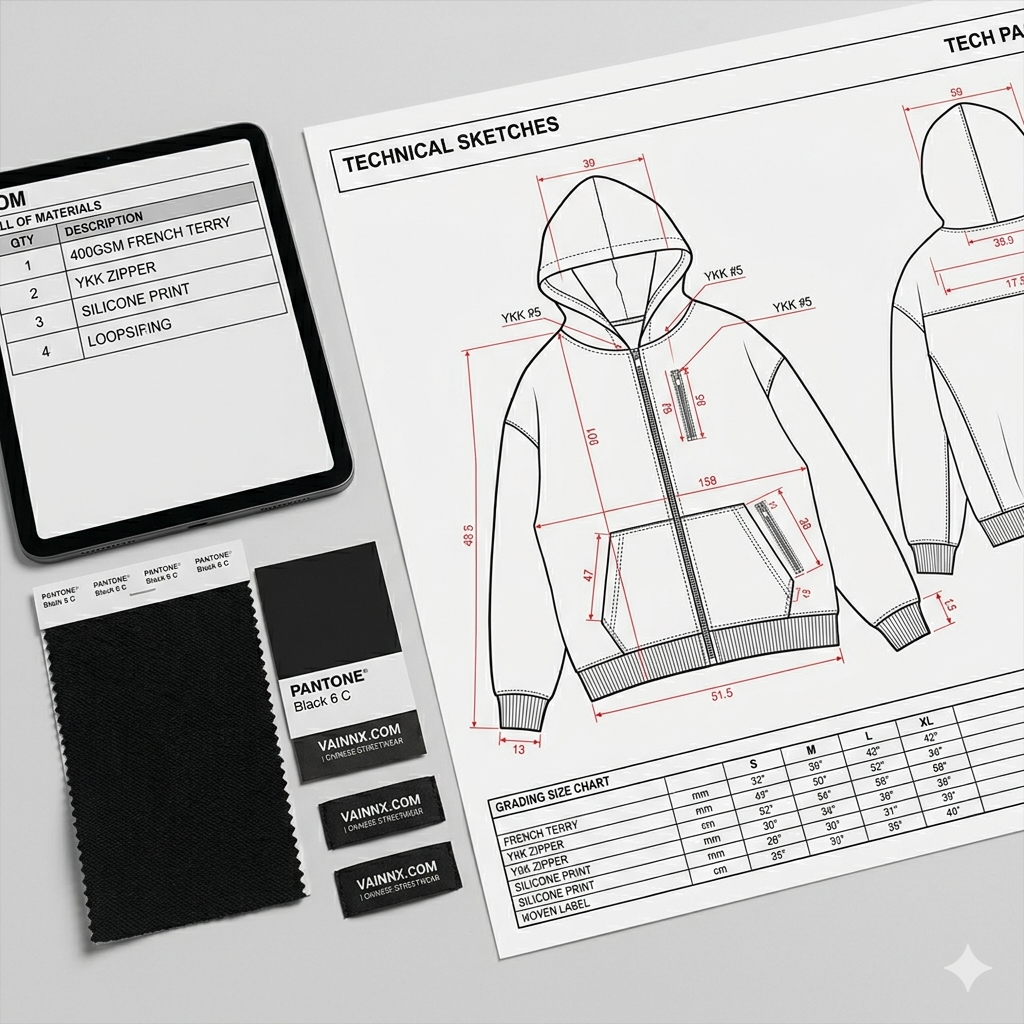
Seamless cross-border production does not begin when a contract is signed; it starts with a clean, standardized, and internationally recognized Tech Pack (Technical Package). In standard day-to-day operations, many emerging designers drop rough smartphone screenshots or artistic Pinterest mockups into an email to an overseas garment factory, asking: "How much to produce this item?"
In a professional manufacturing environment, an inquiry lacking exact industrial variables is highly inefficient. Without specified dimensions, fabric breakdown, and explicit stitching details, the apparel factory can only guess. This trial-and-error approach inevitably triggers endless rounds of sampling revisions, costing thousands of dollars and weeks of wasted time. An impeccable Tech Pack that allows overseas pattern cutters and sewing machine operators to execute flawlessly must contain these five foundational components:
1. Technical Sketches and Flat Geometry Drawings
Avoid relying on stylized promotional mockups with dramatic shadow details. Instead, provide clean, two-dimensional, flat black-and-white vector line drawings displaying both front and back views. Annotate specialized sewing treatments clearly—such as three-needle five-thread coverstitching, double-needle edge topstitching, or flatlock seams. Clearly define the exact coordinate placements for pockets, hood eyelet parameters, and zipper length dimensions. For deconstructed or multi-panel hoodies and outerwear, provide separate close-up cross-sectional illustrations.
2. Micro-Level Bill of Materials (BOM)
The BOM chart is the complete inventory registry for your garment, cataloging every element required for final assembly:
Shell Fabric Specification: Declare exact fiber blends (e.g., 100% Cotton, 80% Cotton / 20% Polyester), weave architectures (waffle knit, double-yarn combed jersey, loop-back French terry), and the vital fabric weight in Grams per Square Meter (GSM).
Trims and Hardware: Designate specific zipper brands, gauges, and pull finishes (e.g., YKK #5 Antique Brass dual-zipper sliders), button materials, drawstring cord compositions, and custom ribbing structures.
Branding Identifiers: Provide detailed guidelines for high-density woven main labels, satin care instructions, custom sizing loops, and cardstock hangtag placements.
3. Precise Sizing Specifications and Grading Rules
Never simply state "S/M/L/XL" without data metrics. Fit profiles differ fundamentally between American, European, Japanese, and Australian customer bases. You must supply an explicit chart detailing flat-laid measurements across all critical intersections (chest circumference, back body length, drop shoulder width, sleeve length, armhole depth, and collar width), alongside established scaling deltas (e.g., chest increases by 4cm per grade, body length by 2cm). For high-street oversized fits, explicitly map out the intended fabric drape tolerances to prevent the factory from defaulting to tighter, conventional slim fits.
4. Embellishment Artworks and Placement Schematics
Color cannot be evaluated accurately over computer screens due to monitor variance; always pinpoint exact color parameters using the PANTONE Matching System (PMS) color codes. Define decoration layouts using centimeters or inches relative to fixed garment baselines (such as the neck seam or shoulder joint). Most importantly, explicitly define the mechanical printing technique required: Direct-to-Garment (DTG), automated silk-screen printing, high-density 3D embroidery, raised silicone, puff ink printing, or heat transfer film.
5. Packaging and Inbound Warehouse Compliance
This ensures smooth logistics handling upon arrival in your destination country. Detail whether garments are flat-packed individually or ship on hangers. Specify whether the enclosure should be a standard clear polybag or a heavy-duty frosted zip-lock bag featuring printed suffocation warnings and custom eco-friendly badges. Clearly state carton assortments (e.g., solid size vs. mixed ratio like 2S-4M-4L-2XL per master box), outer shipping marks, and pre-applied UPC/EAN retail barcodes.
💡 Expert Factory Blueprint for Success: If you are a startup brand lacking an internal technical developer to construct a complex Tech Pack, Vainnx recommends utilizing the "Physical Reference Sample" shortcut. Source a garment from the market that represents your ideal fit, weight, and silhouette, and mail it directly to our development center. This is more effective than sending dozens of 2D images. Our master pattern makers can analyze the physical dimensions with calipers, test the material density in our laboratory, and construct a flawless 1:1 blueprint or introduce custom modifications according to your brief.
3. Step 3: Navigating the Supply Chain – Balancing Fabric Engineering and MOQs
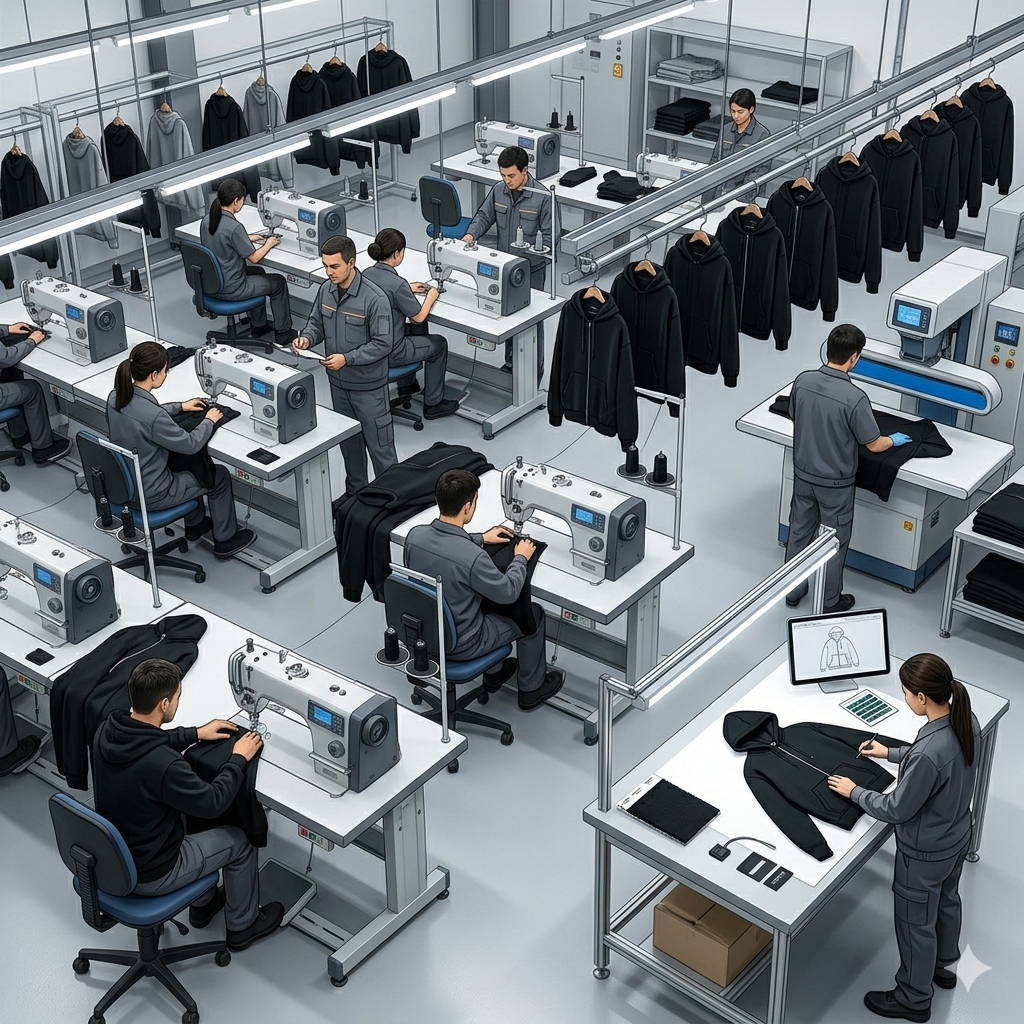
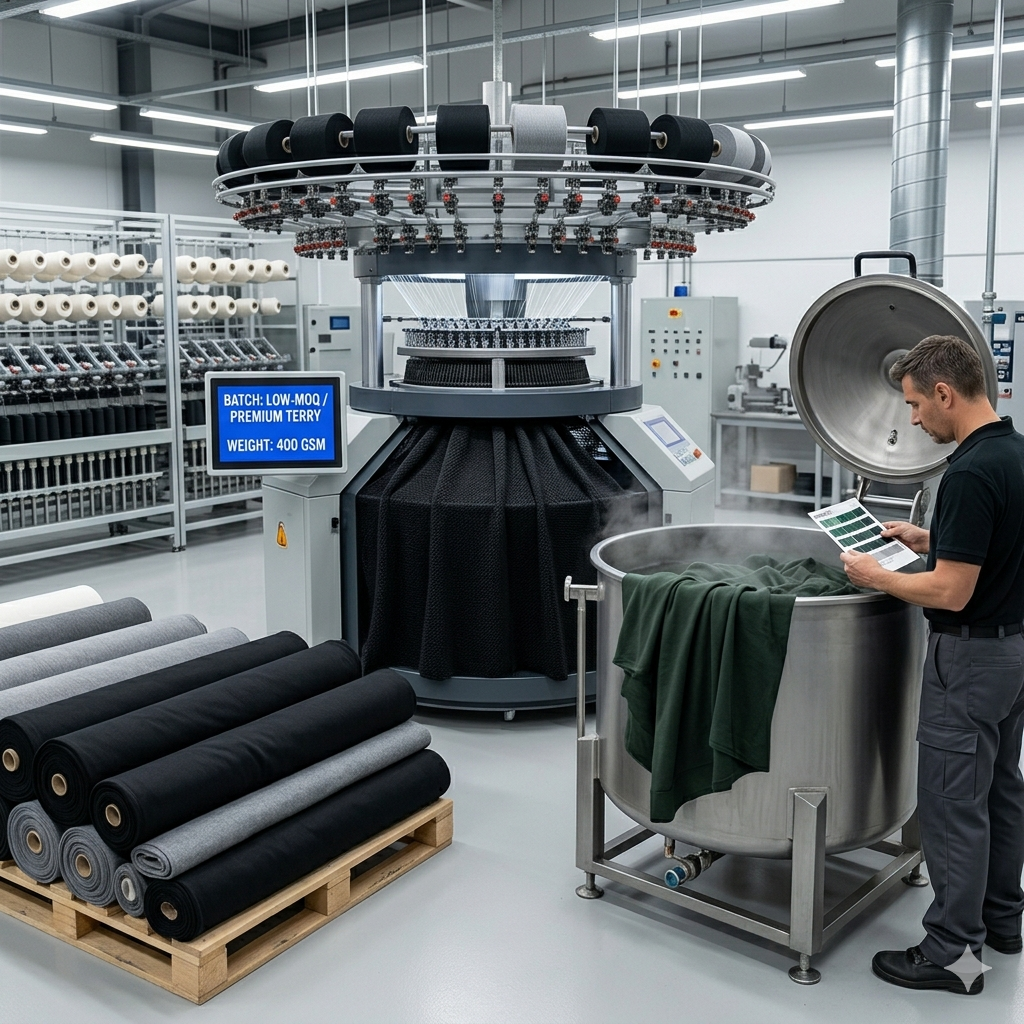
Fabric is the bone structure of streetwear. The boxy drape, structured shoulder roll, and heavy fallback profile characteristic of high-end urban apparel are achieved entirely through dense, high-GSM yarn knitting techniques. However, when emerging labels connect with an overseas clothing factory, they often face a major obstacle: Minimum Order Quantities (MOQs). Many brands wonder why custom factories require hundreds of units per colorway for specialized garments.
1. Understanding the Large-Scale Industrial Logic Behind MOQs
From an engineering standpoint, factory MOQs are not arbitrary rules designed to squeeze smaller buyers; they are determined entirely by the mechanical boundaries of upstream textile spinning machinery and heavy industrial dye vats:
Custom Dye Lot MOQs: Industrial dye vats require a minimum volumetric fabric mass to cycle the liquid pigment evenly via convection. A standard small-scale dye vat requires at least 100kg to 150kg of raw greige knit fabric to operate. For a 500GSM heavyweight fleece hoodie, 100kg of textile translates to roughly 150 to 200 physical garments. Loading a vat below its physical minimum causes uneven pigment distribution, leading to severe color shading, surface blotching, and coarse fabric textures.
Custom Knitting Loom MOQs: If a designer demands a completely proprietary knit pattern—such as an exclusive high-density waffle, dual-sided jacquards, or a specific bamboo-cotton slub ratio—setting up the industrial circular knitting machines involves substantial labor and wire-threading overhead. As a result, textile mills generally require at least 500kg of raw yarn yarn to offset machine down-time costs.
2. Vainnx’s Flexible Solutions: Achieving Premium Aesthetics at Low MOQs
To address the e-commerce realities of low-volume testing, fast-response restocking, and diverse color variations, Vainnx has developed a flexible manufacturing framework:
The Ready-Made Fabric Framework (Agile Testing Track)
Minimum Order Volume: Only 50 to 100 pieces per style/colorway.
Material Execution: Utilizes Vainnx's comprehensive, on-site inventory of premium, heavyweight core fabrics. Our warehouses maintain constant stock of dozens of trending streetwear fabrics certified under the international OEKO-TEX® environmental standard (including 320GSM double-yarn combed cotton jerseys, 420GSM luxury French terries, and 500GSM heavy loopbacks).
Strategic Advantage: Brands can bypass raw textile milling MOQs entirely, executing low-volume drops while utilizing post-processing embellishments (screen prints, dense embroidery, or garment washing) to deliver a high-end luxury feel with minimal financial risk.
The Custom-Made Production Track (Bespoke Scale Track)
Minimum Order Volume: 100 to 300 pieces per style/colorway, optimized for established brands.
Material Execution: Complete custom weaving and dyeing tailored to proprietary yarn counts, structures, and exclusive Pantone color lots.
Strategic Advantage: Provides full supply chain ownership, allowing for unique structural panel paneling, custom stitch lines, and heavy-intensity distressing wash cycles.
4. Step 4: Golden Rules for Efficient Communication During the Sampling Stage
In the fashion manufacturing cycle, sampling is the true test of an overseas custom clothing manufacturer's capabilities. It is also the phase most vulnerable to communication gaps and costly misunderstandings. Inexperienced brand owners often find themselves caught in a cycle of revising a single prototype four or five times, wasting hundreds of dollars in development fees and missing critical retail release windows.
1. Understanding the Lifecycle and Types of Industrial Samples
In a standard, professional apparel manufacturing workflow, prototypes are developed through iterative phases, each serving a distinct purpose:
Proto Sample / Fit Sample: The sole objective of this initial prototype is to verify pattern geometry, silhouette drape, ergonomic movement, and measurement accuracy. At this stage, the factory will not utilize your final bulk-dyed textile; instead, they construct the piece using "available warehouse布料" (substitute fabric) or raw greige cotton. Startups should not worry about incorrect color shades or print placements during this phase. Your focus should be entirely on fit variables: Are the sleeves too long? Is the shoulder drop natural? Is the neckline opening comfortable?
Strike-Off / Tech Sample: This phase involves executing your prints and embroidery motifs on real fabric panels or textile swatches. It serves as a focused check for Pantone color rendering, puff ink expansion height, DTG print resolution, or edge results from specialized wash treatments (like acid wash, enzyme stonewashing, or distressing), requiring direct sign-off from the brand owner.
Pre-Production Sample (PPS): The definitive benchmark before mass assembly lines begin running. The PPS must be assembled using the exact bulk-approved dyed fabric, final trims, verified embellishments, and complete branding tags. Bulk manufacturing only begins once the brand owner tests this sample and provides explicit, signed PPS Approval.
5. Step 5: Managing Bulk Production and Full-Scale Quality Assurance (QC)
Once your PPS is approved and your order moves onto mass assembly lines, your role transitions from creative designer to systematic project manager. When working with an overseas clothing manufacturer thousands of miles away, how do you maintain strict oversight without physically being on the shop floor?
1. Breaking Down the Mass Manufacturing Workflow
A high-caliber apparel factory moves your bulk order through six sequential, highly synchronized production phases:
Incoming Fabric Inspection & Analysis: Raw textiles entering our warehouse undergo a 100% audit on specialized fabric inspection machinery. Technicians verify weight per square meter, tensile strength, and run wash tests to establish precise shrinkage rates. These metrics are used to adjust our computerized CAD cutting markers.
Computerized CAD Layout & Automated Cutting: Advanced CAD software maps out pattern components (Marker Making) to minimize fabric waste. Automated fabric cutters or high-precision electric saws then cut the panels, keeping edge deviation within fractions of a millimeter.
Panel Verification & Embellishment (Panel Decorating): Before sewing begins, cut fabric lots are audited to remove any pieces with weaving defects or thread loops. Approved panels are then sent to embroidery or printing lines for 3D puff print or silk-screen applications.
Assembly Line Sewing: This stage relies on the technical skill of our machinery operators. Heavyweight streetwear textiles require specialized heavy-duty industrial sewing machines to maintain clean stitch tension. Workshop supervisors set up dedicated assembly sequences (e.g., specialized operators for neck binding, separate teams for sleeve setting) to ensure consistent stitch density across the entire batch.
Post-Processing & Finishing (Trimming & Ironing): Assembled garments move to the finishing division, where experienced operators manually trim loose threads and use high-pressure, high-temperature industrial steam irons to shape and flatten the fabric.
6-Step Quality Control & Carton Packing: At Vainnx, we implement a rigorous 6-Step QC Process (encompassing incoming fabric audits, cut panel checks, print reviews, semi-finished assembly checks, 100% finished goods inspection, and a final pre-shipment random audit). This ensures all garment measurements remain within the standard international tolerance of $\pm1\text{cm}$ before packaging.
2. Establishing Structured Weekly Progress Syncs
To eliminate production anxiety for e-commerce operators, a transparent overseas clothing manufacturer maintains clear communication channels. We recommend setting up a Weekly Visual Update system with your designated factory merchandiser:
Track Critical Project Milestones: Establish a clear calendar marking fabric delivery, print completion, assembly line setup, finishing dates, and estimated freight dispatch.
Leverage Factory Footage for Content Marketing: Have your merchandiser shoot brief 5-to-10-second smartphone video clips or high-resolution photos during key production stages (such as bulk cutting or embroidery lines running). These updates keep you informed and serve as highly engaging Behind-the-scenes (BTS) social media content for your brand's Instagram, TikTok, or YouTube channels. Modern fashion consumers value supply chain transparency, which builds strong authenticity and trust for your label.
Conclusion: Shifting from a Transactional Buyer to a Strategic R&D Partner
Throughout the history of the global fashion industry, successful apparel brands—whether established labels like Fear of God and Supreme or rapidly growing e-commerce brands like Represent—rely on long-term relationships with one or two core manufacturing partners over 5 to 10 years. Their bond goes far beyond a basic "cash-for-goods" transaction; they view their factory as an essential hardware research and development lab.
A reliable, fashion-forward overseas clothing manufacturer like Vainnx brings decades of technical expertise in pattern engineering, textile performance, and international quality compliance. When a designer shares a creative concept or an irregular panel blueprint, our engineering team works proactively to deconstruct the architecture. We identify potential assembly line challenges before cutting begins and offer practical, material-focused improvements to maximize garment quality while keeping costs efficient.
By utilizing structured Tech Packs, leveraging factory-stocked premium fabrics to manage initial MOQs, and using consolidated feedback reports during sampling, you can eliminate cross-border friction and build a highly efficient partnership with your factory.
If you are preparing to launch your next custom streetwear or high-street designer collection and are looking for a reliable, quality-focused clothing manufacturer in China, reach out to the Vainnx Team today. Backed by a sales and product planning team with 20 years of international brand experience and a modern R&D development facility, we are ready to bring your design concepts to life perfectly. Let's work together to elevate your brand's impact through an exceptional supply chain.
📞 Phone: [86-15015158179]
📧 Email: [info@vainnx.com]
🌐 WhatsApp:[https://wa.me/8618025298509]
Click the link above to start designing your custom streetwear today. We can’t wait to help you express your bold style!