Sourcing High-Quality Fabrics: What Top Custom Clothing Manufacturers Look For
Introduction:
In the modern fashion industry, particularly within the highly individualistic and high-premium universe of premium streetwear, fabric is far more than a mere canvas for graphical prints—it serves as an assertive design language and a brand's primary structural capital. The reason an iconic oversized hoodie drapes with that perfect heavy, boxy stance, or a high-end luxury streetwear tee maintains its pristine layout without warping, shrinking, or bacon-necking after a hundred intensive home wash and dry cycles, boils entirely down to the rigorous physics and chemical engineering of the textile substrate.
For global streetwear brand owners, independent creative fashion designers, crowdfunding apparel project creators, and fast-growing e-commerce clothing labels, translating a conceptual digital sketch or a sleek 3D render into a physical garment involves a critical, high-stakes bottleneck. It rarely lies within the printing mechanics alone; rather, it hinges comprehensively on whether the physical, dimensional, and chemical properties of your sourced fabric can successfully bear your brand's premium aesthetic vision. Many emerging brands suffer from the painful lesson of "flawless sample, collapsed mass production," a classic supply chain failure rooted in a lack of technical understanding of fabric properties and manufacturing constraints.
As a premium, full-service custom clothing manufacturer deeply anchored in high-end streetwear production and serving over 200 trend-setting designer brands globally, Vainnx (Dongguan Qianjiayi Garment Co., Ltd.) has formulated a meticulous, laboratory-grade protocol for textile sourcing and comprehensive quality control. In this extensive masterclass guide, we step inside the technical mind of a top-tier garment manufacturing facility to break down exactly what master apparel manufacturers look for when sourcing premium textiles—and how the right scientific fabric selection injects long-term market premium, structural luxury, and unyielding customer loyalty into your collection.
1. The Soul of Streetwear: Decoding Heavyweight Fabrics and Crucial Physical Parameters
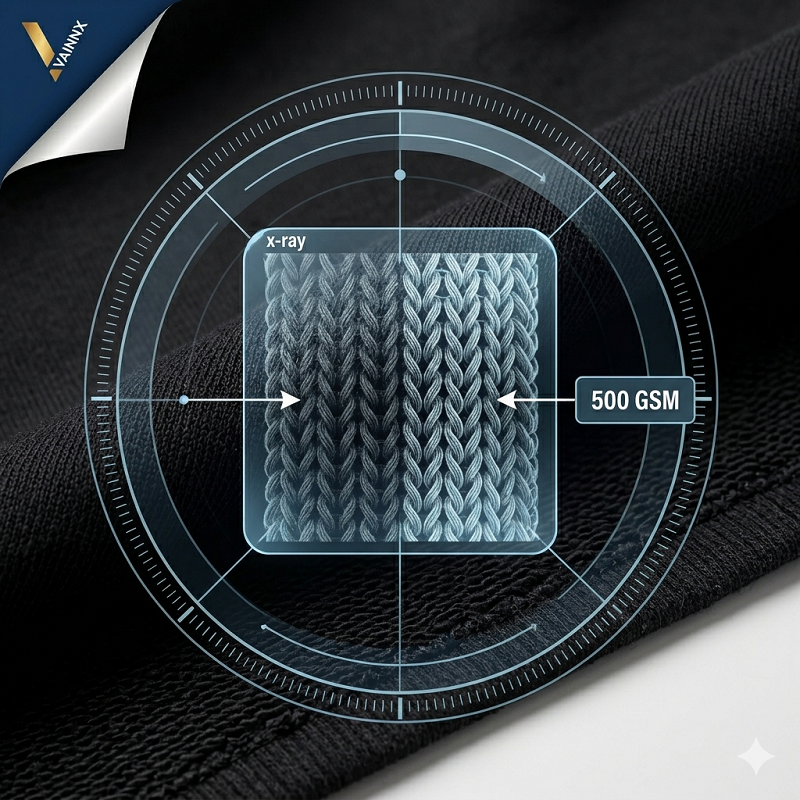
In contemporary high-street, archive fashion, and 90s vintage hip-hop aesthetics, the term "heavyweight" has become universally synonymous with premium luxury. However, from the lens of an expert clothing manufacturer, true heavyweight performance is never just about adding bulk or thickness blindly. It requires an intricate, multi-dimensional calibration of textile density, air permeability, and structural skeletal integrity. If engineered incorrectly, a heavyweight fabric becomes heavy, suffocating, stiff, and completely uncomfortable to wear.
1.1 The Golden Ratios of GSM (Grams per Square Meter) and Substrate Allocation
GSM is the definitive international metric used to quantify fabric thickness, mass density, and physical weight. Across Vainnx's automated and agile production lines, we have calculated a strict fabric weight matrix explicitly optimized for high-end streetwear tailoring layouts:
Premium Streetwear T-Shirt Fabrics: While generic fast-fashion or promotional merchandise blanks float around a flimsy 160 GSM to 180 GSM (which easily translucents and loses shape), top-tier streetwear blanks typically start at 240 GSM, 280 GSM, and scale up to a substantial 310 GSM or even 360 GSM heavy double-sided interlock fabrics for luxury minimalist drops. Sourcing this precise weight ensures the t-shirt hangs independently off the human body, completely obscuring under-contours to deliver that desired, crisp, architectural "boxy fit" profile.
Heavyweight Hoodies & Sweatshirts: Our custom manufacturing baseline begins at a solid 400 GSM to 500 GSM, and for avant-garde high-street labels, we constantly maintain specialized stocks of 550 GSM up to an ultra-heavyweight 600 GSM premium French terry or brushed fleece fabrics. This extreme weight gives hoodies an unmatched luxurious downward drape. More importantly, it allows the hood to stand rigidly upright and structured on the wearer's shoulders without collapsing and without needing cheap internal foam inserts—an unwritten industry law that instantly separates premium streetwear from commercial lounge apparel.
1.2 The Strategic Interplay of Yarn Count and Woven Density
A common pitfall for emerging streetwear designers is assuming that a higher yarn count automatically translates to a superior premium product. While that rule dictates luxury formal dress shirts or executive tailored suiting (where fine 100s or 120s double-ply combed cotton is sought after for weightless silkiness), it is an absolute technical misconception in raw, structured streetwear manufacturing.
Low Yarn Counts with Coarser Diameters (e.g., 10s, 14s, 16s): This is the master manufacturing secret to crafting heavy, rugged fabrics with that authentic vintage grain and distinct tactile grit. For instance, to produce a robust 300 GSM t-shirt, utilizing fine high-count yarns would require multi-layered weaving that makes the garment suffocatingly hot. Instead, selecting a single-ply 14s or 16s pure cotton yarn woven via tight compact spinning delivers a single-layer high-GSM textile that boasts the rugged, heavy-duty texture iconic to classic American streetwear.
High-Count Multi-Ply Plied Yarns (e.g., 21s double-ply, 32s double-ply parallel weaving): When a luxury streetwear client demands a remarkably smooth, pristine, silk-like face combined with a heavy physical weight exceeding 400 GSM, Vainnx deploys high-count multi-ply yarns twisted tightly together. This specialized method achieves an incredibly uniform, flat surface layout with minimal hairiness. This flat profile is highly advantageous for high-resolution Direct-to-Garment (DTG) digital printing or high-mesh screen printing, eliminating any edge blur caused by standing micro-fibers.
2. Microscopic Fiber Vetting and Advanced Knit Structure Analysis
Operating as a vertically integrated, high-efficiency garment manufacturer, Vainnx enforces strict raw material vetting at the spinning origin to mathematically control and eliminate future issues with surface pilling, thermal shrinkage, moisture absorption, and elasticity degradation before production begins.
2.1 The Nuances of 100% Pure Cotton: Combed Cotton vs. Open-End Spinning
Pure cotton remains the undeniable, irreplaceable king of streetwear culture. However, cotton varieties differ drastically based on the spinning engineering chosen by the apparel manufacturer to align precisely with a brand's market positioning:
Combed Cotton: This textile undergoes an intensive mechanical combing stage that systematically removes short, weak cotton fibers and micro-impurities, leaving only the longest, straightest, premium cotton filaments. Sourcing combed cotton results in an ultra-clean, lustrous surface texture with a certified pilling resistance score confidently hitting Grade 4 or higher. It is highly recommended for premium, minimalist fashion brands aiming for a sleek, contemporary, luxury urban look.
Open-End (OE) Cotton / Carded Spinning: This method bypasses the intensive combing stage and spins fibers utilizing high-speed airflow, leaving the natural micro-slubs, minor irregularities, and texturized variance of the cotton fibers completely intact. For brands pursuing an authentic 90s hip-hop vibe, a true gritty vintage thrift look, or heavy-duty utilitarian workwear aesthetics, Vainnx actively sources open-end cotton. It provides that classic, dry-touch handfeel and a rugged visual texture that beautifully enhances and gains character with age and subsequent washing.
2.2 Navigating Knit Architecture: French Terry vs. Fleece
The internal microscopic architecture of fleece and sweatshirt fabric dictates the garment’s thermal insulation, moisture management, and overall structural rigidity upon the human body. Top-tier factories analyze two completely separate structural standards:
French Terry (Loopback): Characterized by clean, uniform, fish-scale loops arranged meticulously on its reverse side. A premium manufacturer closely evaluates loop tension and ensures there is zero "grinning" (where the backing yarn bleeds through to the face). High-quality French Terry offers excellent moisture-wicking properties and built-in air circulation, making it the perfect substrate for spring/summer custom hoodies, heavyweight shorts, and tracksuits.
Fleece (Brushed Back): Created by passing premium loopback fabric through an intensive mechanical brushing machine that pulls and lofts the internal loop fibers into a soft, highly insulating nap. When Vainnx sources heavy fleece for autumn/winter lines, we run mandatory fiber-shedding and anti-static lab tests. This guarantees that when an end-consumer tries on a brand's hoodie over a white underlayer for the first time, they won't experience embarrassing lint transfer, and the interior fleece won't mat, ball up, or shed after intensive wear cycles.
3: Advanced Graphic Applications - 3D Puff Embroidery and Digital Printing
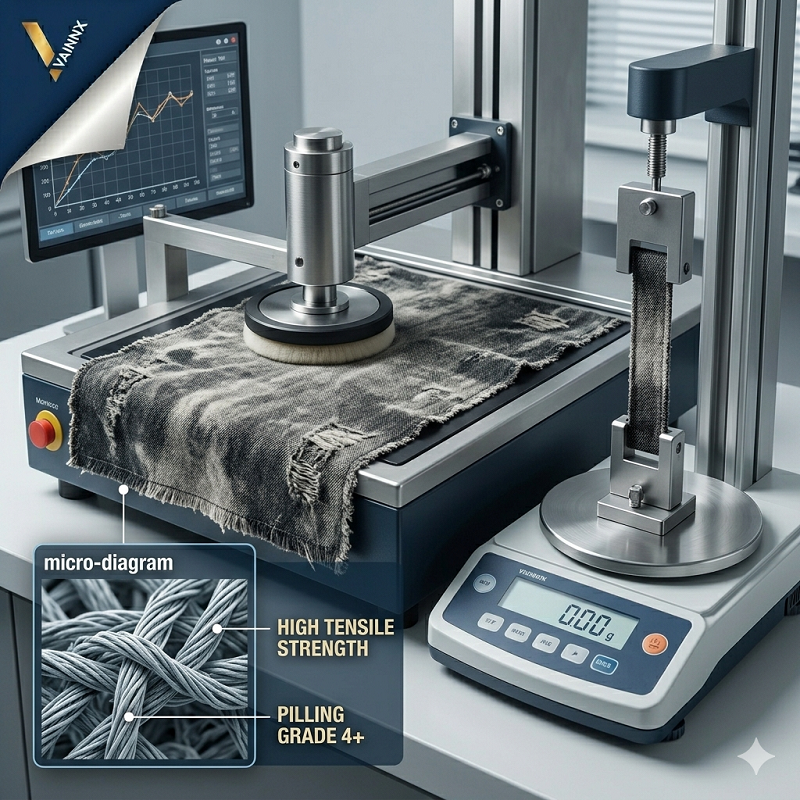
Modern streetwear aesthetics heavily rely on aggressive, structurally altering post-garment washing techniques to achieve distinct distressed visual states and unique color variations. If a manufacturer sources fabric based purely on raw handfeel without anticipating how it handles chemical oxidation and intense physical abrasion, mass bulk production will inevitably result in catastrophic defect rates. As a seasoned clothing manufacturer, Vainnx employs a proactive destructive screening mechanism for specialized washes:
3.1 Sourcing for Acid Wash, Enzyme Wash, and Snow Wash Resilience
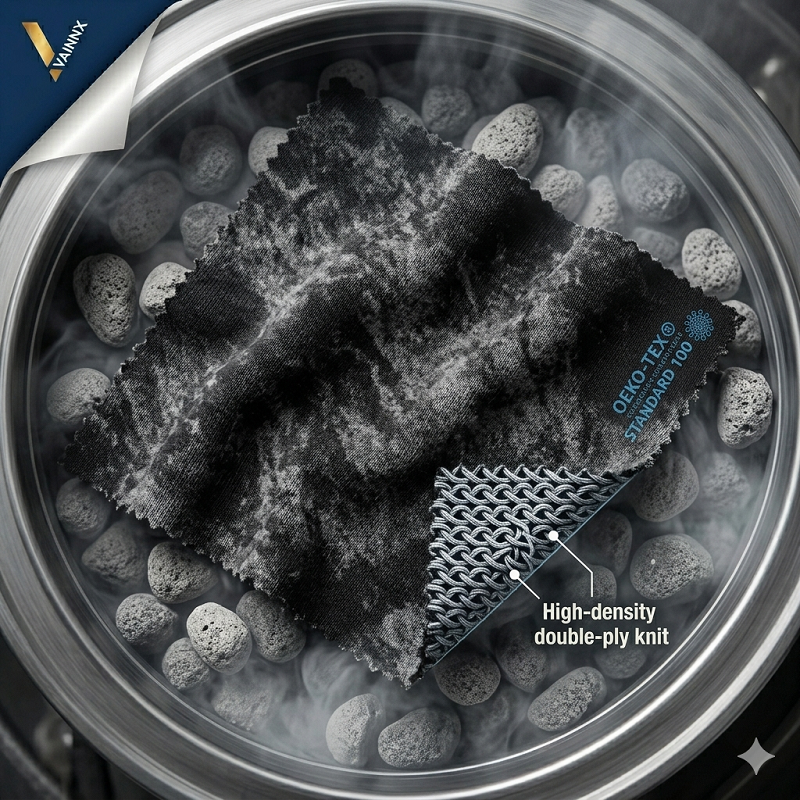
Acid washing utilizes intense oxidizing agents like potassium permanganate mixed with highly porous volcanic pumice stones inside massive industrial tumblers to strip away surface dye layers, yielding a high-contrast, industrial, mottled, and weathered finish.
The Manufacturing Focus: Sourcing for high tensile strength and bursting resistance is non-negotiable here. Extreme chemical exposure combined with heavy stone friction will cause lower-grade fabrics, or fabrics with high-synthetic compositions and loose knit density, to tear, resulting in holes along weak structural points like pocket corners, armpit seams, and hood edges. Vainnx prevents this by exclusively sourcing dense, pure cotton double-ply knits woven via compact siro spinning, ensuring the fabric retains its core skeletal strength and abrasion resistance post-treatment.
3.2 Sun-Fading and Mineral/Sulfur Garment Dyeing
Achieving a genuinely aged, vintage-thrifted, or sun-bleached look requires mineral or sulfur garment dyeing.
The Manufacturing Focus: Manufacturers must source pristine, raw greige fabric or completely untreated, desized white blanks. If a factory incorrectly purchases standard off-the-shelf dyed fabrics that have already undergone commercial fixing agents, heavy silicone treatments, or industrial softeners, the new dye molecules will fail to penetrate the core of the cotton fibers. This results in splotchy color deposit, muddy tones, and severe colorfastness failure after a single consumer wash. Vainnx prevents this by acquiring first-hand greige fabric directly from weaving mills, guaranteeing perfect color reproduction and rich tonal depths.
4: The Art of Washing - Acid Wash, Enzyme Wash, and Vintage Distressing
As international consumers demand deep supply chain transparency and ethical manufacturing practices—particularly within high-end European and North American streetwear demographics—eco-certifications have transitioned from a luxury marketing option into a critical cross-border compliance mandate.
Vainnx's Green Manufacturing Promise: Our materials library integrates sustainable fabrics certified to the world’s highest ecological standards. This not only elevates your brand’s eco-premium and narrative depth but completely insulates your business from customs compliance audits and seizure risks abroad.
When executing high-standard fabric sourcing, premium apparel factories refuse to compromise on these key certifications:
OEKO-TEX® Standard 100: The premiere global benchmark testing for harmful substances across every component of a textile (including threads, buttons, and zippers). It guarantees the fabric is completely free from toxic azo dyes, carcinogenic heavy metals, formaldehyde, and phthalates. For premium brands catering to sensitive skin or high-end retail markets, this is our baseline quality threshold.
GOTS (Global Organic Textile Standard) & GRS (Global Recycled Standard): For brands centered on circularity and eco-forward design, Vainnx tracks down and sources certified recycled polyester and 100% organic cotton directly at the spinning origin. We accompany these orders with verifiable Transaction Certificates (TC) to back up your sustainable claims transparently.
5. Quantitative Lab Quality Metrics and Tech Pack Compliance
A mature clothing manufacturer never buys fabric based on subjective finger-feel or casual visual inspection. Instead, decisions are dictated by empirical laboratory testing data. At Vainnx, before any bulk fabric shipment is released into our cutting rooms, it must pass a strict 6-point physical performance evaluation:
5.1 Dimensional Stability and Control (Shrinkage Control)
Knit cotton fabrics are inherently prone to contracting. Standard factories working with cheap blanks tolerate a massive shrinkage variance of 5%–8%, meaning a consumer’s garment shrinks an entire size profile after its first home wash.
The Vainnx Standard: Every fabric batch we source undergoes extensive industrial sanforizing and advanced pre-shrunk operations. We lock in bulk warp and weft shrinkage parameters to under ±3%. This ensures that the exact dimensions specified in your brand's custom size charts remain absolutely intact through years of consumer washing and machine drying, preserving your intended classic or oversized boxy fit.
5.2 Colorfastness Grades
Saturated, high-contrast streetwear colorways (such as midnight blacks, deep volcanic grays, and high-vis neons) are notoriously prone to color bleeding or crocking onto other garments.
The Test Threshold: A top-tier manufacturer requires that colorfastness to water, perspiration, and mechanical rubbing (both dry and wet crocking) hits a Grade 4 or higher (out of a maximum 5). This prevents disastrous dye migration, ensuring that heavy sweating during intensive skateboarding or mixing a dark hoodie with white items in a home wash won't result in color contamination.
5.3 Martindale Pilling Resistance
When a high-ticket streetwear item develops fuzzy pills on its surface from daily friction against bags or jackets, the perceived value of the brand immediately plummets.
The Control Standard: Utilizing the rigorous Martindale Method for circular track abrasion testing, Vainnx's sourced heavyweight textiles must confidently maintain a Grade 4 or better rating after surviving 2,000+ continuous friction rubs.
6. Why Partner with Vainnx for Your Custom Streetwear Manufacturing Needs?
In a highly saturated streetwear marketplace, having a vertical supply chain partner that seamlessly bridges textile R&D with flexible, agile production is your ultimate competitive weapon. Dongguan Qianjiayi Garment Co., Ltd. (Vainnx) is a manufacturer that speaks the true language of streetwear culture.
A Ten-Person Expert R&D Team & 3-Day Sample Realization: Our specialized technical pattern makers and designers don't just assemble clothes; they dissect the architecture of streetwear. Send us your design sheets, tech packs, or a reference physical garment, and we will accurately match, source, and proof the ideal textile substrate, delivering a premium sample in as fast as 3 days.
Agile Low MOQs (50–100 Pieces): To empower independent designers, startup labels, and influencers launching limited capsule drops or running quick-turn market tests, we have shattered the legacy factory paradigm of requiring thousands of units. We proudly support production scaling from 50 to 100 pieces per style/colorway, dramatically optimizing your inventory capital.
End-to-End One-Stop Manufacturing Supply Chain: From proprietary fabric development and knitting to executing highly complex garment crafts (3D puff printing, high-density screen printing, tackle twill, heavy chenille embroidery, distressing), and finalizing custom woven neck labels, care tags, branded packaging, and end-to-end global logistics tracking—we deliver rapid turnaround cycles of 7–15 days for quick-turn samples and 4 weeks for bulk orders.
Strict 6-Stage Quality Assurance System: We implement an uncompromising quality control pipeline comprising six distinct checkpoints spanning incoming fabric inspection, precision laser cutting, inline sewing monitoring, mid-production pressing, post-ironing checks, and final pre-pack garment audits. We fully welcome and accommodate any third-party inspection agencies appointed by your brand.
Fabric forms the bone structure and skin of apparel. By aligning your brand with Vainnx, you are anchoring your designs into the epicenter of China’s most advanced, premium streetwear manufacturing cluster. Let us combine unyielding textile quality with industrial craftsmanship to turn your boldest creative visions into the market's next sold-out streetwear phenomenon.
📞 Phone: [86-15015158179]
📧 Email: [info@vainnx.com]
🌐 WhatsApp:[https://wa.me/8618025298509]
Click the link above to start designing your custom streetwear today. We can’t wait to help you express your bold style!