Walk into any streetwear boutique in 2026 and one thing is immediately obvious: the racks are thick. Not thick with inventory — thick with fabric. The lightweight, tissue-thin T-shirts that dominated fast fashion for a decade are being pushed aside by garments you can feel before you even touch them. Heavyweight streetwear — defined as fabrics weighing 300gsm and above — has moved from niche obsession to industry standard. For brand owners, this shift is not just a design trend to watch. It is a fundamental recalibration of what consumers expect when they spend $60, $80, or $120 on a hoodie or T-shirt. Understanding heavyweight production — from fabric selection to factory capabilities — is now a competitive requirement, not a differentiator.
Vainnx, a premium B2B custom streetwear manufacturer based in China serving emerging and established fashion brands worldwide, has seen this shift firsthand across hundreds of client collections. The data from our production floor tells a clear story: orders specifying 300gsm+ fabrics have more than tripled since 2023. This guide breaks down everything brand owners need to know about the heavyweight revolution — what it means, why consumers are demanding it, how it changes production, and how to position your brand to win with weight.
What Defines Heavyweight Streetwear: GSM Standards by Garment Type
GSM — grams per square meter — is the universal metric for fabric weight. It measures the actual mass of the fabric, not the thickness, though the two often correlate. In streetwear, the heavyweight threshold begins at 300gsm, but what counts as "heavy" varies by garment category. Understanding these benchmarks helps brands specify fabrics correctly and avoid the common mistake of applying one weight standard across entirely different product types.
| Garment Type |
Lightweight |
Midweight |
Heavyweight |
Premium Heavyweight |
| T-Shirt |
120-180 gsm |
180-240 gsm |
240-320 gsm |
320-400 gsm |
| Hoodie |
240-300 gsm |
300-360 gsm |
360-440 gsm |
440-500 gsm |
| Sweatshirt |
220-280 gsm |
280-340 gsm |
340-420 gsm |
420-480 gsm |
| Jogger / Sweatpant |
240-300 gsm |
300-380 gsm |
380-460 gsm |
460-520 gsm |
| Denim Jean |
200-280 gsm |
280-360 gsm |
360-450 gsm |
450-510 gsm |
A 300gsm T-shirt feels dramatically different from a 300gsm hoodie because expectations differ by category. A 300gsm tee is genuinely heavy — it holds structure, resists wrinkling, and drapes with substance. A 300gsm hoodie is entry-level midweight by today's standards, where premium brands now routinely specify 400gsm and above. The key for brands: know your category baseline, then decide how far above it you want to go based on your positioning and price point.
Why Consumers Are Abandoning Lightweight: Durability, Drape, and Perceived Quality
The consumer migration toward heavyweight is not about chasing a fad. It is a rational response to three product failures that lightweight garments consistently deliver.
Durability Failure
Lightweight T-shirts at 140-160gsm typically survive 15-25 wash cycles before showing visible degradation: collar bacon-neck, seam puckering, fabric thinning, and color fading. A 300gsm heavyweight tee, by contrast, routinely lasts 50-80 washes while maintaining structural integrity. For consumers who view streetwear purchases as investments rather than disposables, this math is impossible to ignore. The cost-per-wear calculation overwhelmingly favors heavyweight construction.
Drape Failure
Lightweight fabrics cling where they should not and collapse where they should hold shape. A 160gsm T-shirt drapes like a tissue over the body — it reveals rather than sculpts. Heavyweight cotton at 300gsm+ creates intentional silhouette. The fabric holds its own architecture: shoulders sit square, the body falls clean, and the garment looks deliberate rather than accidental. This is why oversized and boxy fits — the dominant streetwear silhouettes of 2025-2026 — only work properly in heavyweight fabrics. A boxy cut in 160gsm looks sloppy; the same cut in 320gsm looks architectural.
Perceived Quality Failure
Before a customer reads your hang tag, checks your stitching, or visits your website, they touch the garment. Hand feel is the first quality signal and the hardest to fake. Lightweight fabrics communicate cost-cutting. Heavyweight fabrics communicate intention. In blind handling tests, consumers consistently rate 300gsm+ garments as 40-60% more expensive than their 180gsm equivalents, even when construction quality is otherwise identical. This perception gap translates directly to willingness-to-pay and brand loyalty.
The Data Behind the Shift: Heavyweight Market Growth 2023-2026
The heavyweight trend is not anecdotal. Search volume for "heavyweight hoodie" has grown approximately 180% between January 2023 and mid-2026. "400gsm hoodie" has moved from near-zero search volume to thousands of monthly queries globally. On the supply side, fabric mills in China's textile hubs report that orders for 300gsm+ cotton fleece and French terry now account for over 40% of streetwear-directed production, up from roughly 15% in 2022. Retail data tells the same story: brands advertising specific GSM numbers in product descriptions see 25-35% higher conversion rates than those listing only qualitative descriptors like "premium cotton" or "heavy feel." Consumers want specificity, and GSM numbers deliver it.
Vainnx production data mirrors these market signals. In Q3 2025, approximately 28% of client orders specified fabrics at or above 300gsm. By Q2 2026, that figure had risen to 62%. Brands that launched with midweight fabrics in 2024 are returning with heavyweight specifications for their 2026 collections at unprecedented rates.
Production Challenges: Why Heavyweight Fabrics Demand Different Manufacturing
Many brand owners assume that switching from 180gsm to 320gsm is as simple as selecting a different fabric roll. In practice, heavyweight production introduces distinct manufacturing challenges that factories unprepared for the shift will struggle to meet.
Machine Requirements and Needle Selection
Standard industrial sewing machines are rated for medium-weight fabrics in the 150-280gsm range. When fabric weight exceeds 300gsm — particularly with dense constructions like French terry or fleece — machines face increased resistance during feeding, higher needle deflection, and accelerated wear on feed dogs and presser feet. Factories producing heavyweight garments must use heavy-duty needle systems (typically size 16/100 to 18/110 for 300-400gsm, and 20/120 or higher for 400gsm+) and maintain aggressive needle replacement schedules. Skipping needles becomes dramatically more common when machines and needles are not specced correctly.
Thread Tension and Stitch Formation
Heavyweight fabrics resist thread penetration differently than lightweight materials. The thicker the fabric cross-section at seam points — which multiplies at collar bands, shoulder seams, and hem junctions where fabric is folded — the harder it is to achieve balanced thread tension. Over-tensioning causes puckering along seam lines. Under-tensioning creates loose stitches that fail under stress. The sweet spot narrows as fabric weight increases, requiring more skilled operators and more frequent tension calibration. At Vainnx, our production lines serving heavyweight orders are staffed with senior operators who average 8+ years of experience specifically with heavy-gauge fabrics.
Seam Construction and Reinforcement
A 400gsm hoodie places roughly 2.5 times the gravitational stress on its seams compared to a 240gsm equivalent. Shoulder seams, armhole attachments, and side seams all bear proportionally greater loads. Standard single-needle construction that passes QC on lightweight garments may fail durability testing on heavyweight versions. The solution is a combination of stitch type selection — double-needle coverstitch for hems, safety stitch (4-thread overlock + 2-thread chainstitch) for main seams, and bar-tack reinforcement at all stress points — plus seam allowance optimization. Heavyweight garments typically require 1.2cm minimum seam allowance versus 0.8-1.0cm for lightweight equivalents.
Cost Implications: The Real Economics of Going Heavy
The shift to heavyweight changes cost structure across the entire supply chain. Brand owners who do not model these costs accurately will either under-price their products or face margin erosion.
| Cost Factor |
Lightweight (180gsm Tee) |
Heavyweight (320gsm Tee) |
Delta |
| Fabric Cost per Garment |
$1.80 - $2.50 |
$3.20 - $4.50 |
+75-80% |
| Labor (Cut & Sew) |
$2.00 - $3.00 |
$2.80 - $4.00 |
+30-40% |
| Per-Unit Shipping Weight |
~220g finished |
~380g finished |
+73% |
| Bulk Shipping (per 1000 units) |
~220kg |
~380kg |
+73% |
| Total Landed Cost (est.) |
$5.00 - $7.50 |
$7.50 - $12.00 |
+50-60% |
The landed cost increase of 50-60% is significant, but it creates retail pricing opportunities that more than compensate. Heavyweight tees routinely retail at $55-85 versus $30-45 for lightweight equivalents. The gross margin percentage often improves because consumers perceive and accept the value proposition: they are buying a fundamentally different product category. A brand selling a 320gsm T-shirt at $68 with a $10 landed cost earns a 70% margin on landed cost; the same brand selling a 180gsm tee at $35 with a $6 landed cost earns only 56%. The math favors heavyweight at every step of the value chain — provided the brand communicates the value clearly.
Best Fabrics for Heavyweight Streetwear: A Material-by-Material Guide
Not all heavyweight fabrics are created equal. Each material brings distinct properties that affect hand feel, drape, printability, durability, and cost. Choosing the right fabric for each garment type is one of the most consequential decisions a brand owner makes.
100% Cotton — Heavyweight Jersey
The workhorse of heavyweight streetwear. At 280-400gsm, carded or combed cotton jersey delivers the crisp structure and clean drape that define the premium T-shirt category. Combed cotton at 320gsm strikes the ideal balance for most brands: substantial hand feel without excessive stiffness, strong print surface for screen printing and DTG, and excellent wash performance. Open-end cotton at similar weights offers a rougher texture that works well for vintage-inspired or workwear-adjacent aesthetics. Ring-spun cotton provides the smoothest surface and best print clarity at the high end.
French Terry
French terry is the foundation of premium heavyweight hoodies and sweatshirts. Distinguished by its looped back (unbrushed) interior, French terry at 360-440gsm offers breathability with substance. The unbrushed loops create a structured drape that holds shape through wear while remaining more wearable in moderate temperatures than fleece. Three-end French terry — woven with three yarns for density — at 400gsm+ is the current gold standard for luxury streetwear hoodies. The fabric face takes screen printing and embroidery exceptionally well, making it versatile for branded collections.
Fleece / Brushed-Back Terry
When French terry's looped back is brushed, it becomes fleece — the soft, insulating interior that consumers associate with cozy, premium hoodies. Heavyweight fleece at 380-480gsm delivers maximum warmth and the plush hand feel that drives winter collection sales. The trade-off: brushing reduces tensile strength slightly and the brushed surface can pill over time if fiber quality is not managed. For brands targeting the premium cold-weather segment, a 440gsm cotton-polyester blend fleece (80/20 or 85/15) provides the best balance of softness, durability, and cost.
Sherpa and Double-Face Fabrics
At the extreme end of the heavyweight spectrum, sherpa-lined and double-face constructions push garment weights past 500gsm. Sherpa — a high-pile polyester or poly-cotton knit that mimics shearling — is typically used as a lining fabric bonded to a woven or knit shell. Full sherpa hoodies and jackets have become statement pieces in the luxury streetwear segment, with brands using them to anchor winter drops. Manufacturing complexity is high: the bonding process requires specialized equipment, and seam bulk at attachment points demands careful pattern engineering to avoid uncomfortable ridges.
Vainnx Heavyweight Production Capabilities: 280-420gsm Across Categories
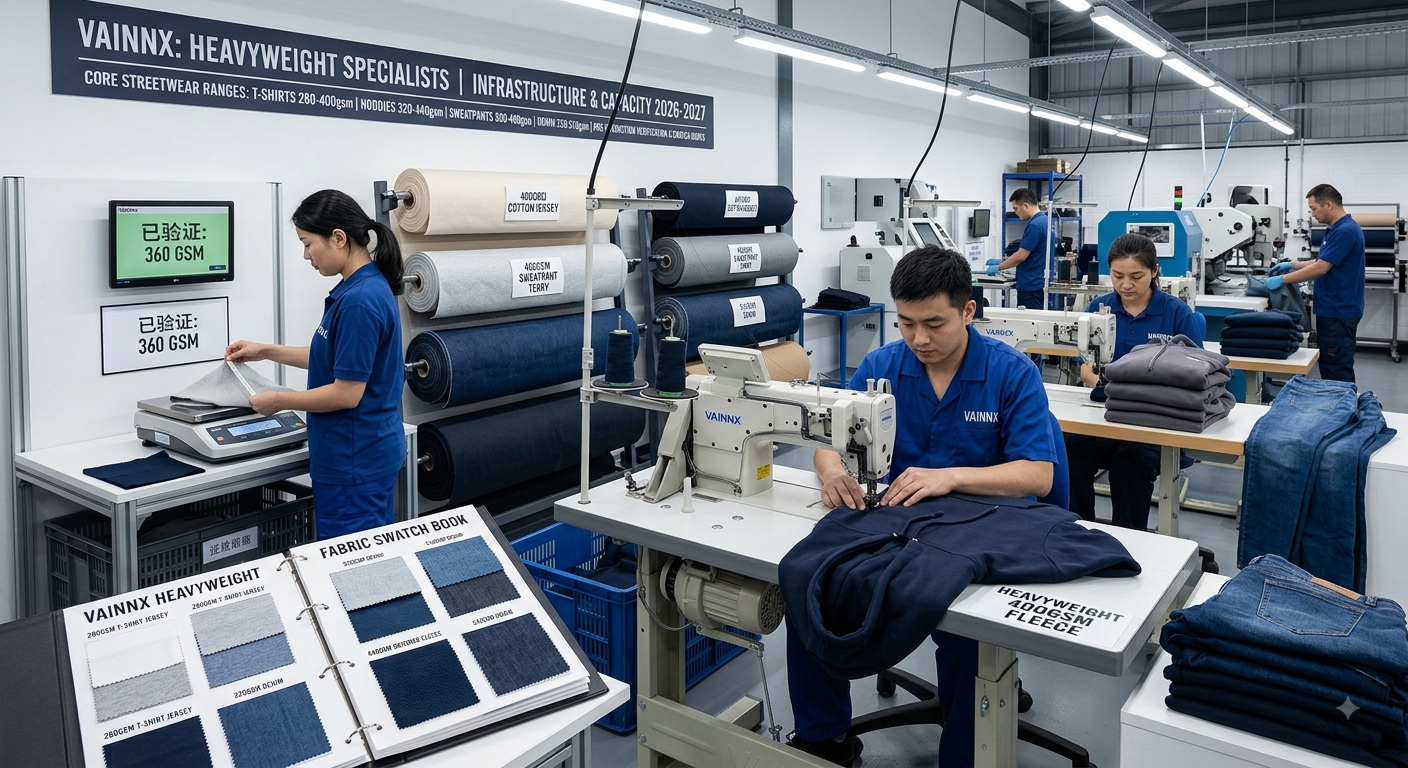
Vainnx has invested systematically in heavyweight production infrastructure to meet the demand shift described throughout this guide. Our factory lines are equipped for the full heavyweight spectrum across every core streetwear category: T-shirts from 280gsm to 400gsm, hoodies and sweatshirts from 320gsm to 440gsm, sweatpants and joggers from 300gsm to 460gsm, and denim from 320gsm to 510gsm. This range allows brands to specify exactly the weight profile that matches their positioning without switching manufacturers between product categories.
Our in-house fabric sourcing team maintains relationships with mills specializing in heavyweight cotton jersey, three-end French terry, brushed-back fleece, and bonded sherpa constructions. Every fabric lot undergoes pre-production GSM verification — we measure, not assume — so the 400gsm hoodie you spec is the 400gsm hoodie your customer receives. For brands developing their first heavyweight collection, Vainnx provides fabric swatch books with GSM-labeled samples across the full weight range, eliminating the guesswork from remote material selection.
Brands Winning with Heavyweight: Who Is Setting the Standard
Several brands have built their entire market position on heavyweight construction, proving that fabric weight is not merely a technical specification but a brand identity.
Fear of God Essentials established the template that much of the current heavyweight market follows. Their core fleece program at approximately 400-440gsm demonstrated that consumers would pay $90-110 for a hoodie when the fabric weight and hand feel justified the price. The brand's consistent specification of heavyweight French terry and brushed fleece created a sensory experience — the "Essentials feel" — that became inseparable from the brand itself. Competitors who tried to replicate the aesthetic with lighter fabrics found that consumers noticed the difference immediately, even when design elements were similar.
Represent, the British luxury streetwear label, has pushed heavyweight even further with garments exceeding 450gsm in their core hoodie program. Their "Owners Club" and "247" lines explicitly market GSM as a selling point, educating consumers to associate higher numbers with higher quality. Cole Buxton has built one of the most distinctive heavyweight aesthetics in the market, using 400gsm+ cotton with garment-dyed finishes that create a worn-in luxury feel. Yeezy Gap Engineered by Balenciaga brought heavyweight construction to the mass market, with pieces in the 350-420gsm range demonstrating that heavyweight demand extends far beyond the enthusiast niche.
The pattern across all successful heavyweight brands is consistent: they do not merely use heavy fabric; they make weight central to the brand story. GSM numbers appear in product descriptions, marketing materials, and social content. Weight becomes a badge of quality that customers learn to look for.
Marketing Heavyweight: How to Position Weight as Your Brand's Advantage
Producing heavyweight garments is only half the equation. Communicating that value to customers in a way that drives purchase decisions requires deliberate strategy. The brands winning the heavyweight market follow several consistent principles that emerging labels can adopt immediately.
Specify GSM in Every Product Description
Vague descriptors like "heavy cotton" or "premium fabric" no longer differentiate. Consumers educated by the brands above now actively search for specific GSM numbers. Including "320gsm heavyweight cotton" or "400gsm French terry" in product titles and descriptions signals competence and builds trust. It also improves search visibility for the growing number of consumers who use GSM as a search filter. Make fabric weight a first-class product attribute alongside size, color, and fit.
Show the Difference Visually
Side-by-side comparison content — a 180gsm tee next to a 320gsm tee, held up to light, draped over a form, or folded — communicates weight more effectively than any copy. The visual contrast between a translucent lightweight fabric and an opaque heavyweight fabric is visceral. Brands should invest in product photography and short-form video content that makes fabric weight tangible for online shoppers who cannot touch the garment before purchase.
Price with Confidence
Heavyweight garments cost more to produce and should cost more at retail. Brands that under-price heavyweight products relative to their material quality train customers to undervalue the construction. The brands cited above price heavyweight hoodies between $85 and $180 — and they sell. If your 400gsm hoodie is priced at $49, consumers will assume it is not actually 400gsm, or that corners were cut elsewhere. Price communicates quality as loudly as product descriptions do.
Heavyweight Trend Lifecycle: Is This the New Normal?
Every trend cycle raises the same question: is this a peak or a plateau? The evidence for heavyweight streetwear points strongly toward plateau — a permanent structural shift in consumer expectations rather than a cyclical fashion moment.
Several factors support this view. First, the heavyweight trend is driven by tactile product quality, not visual novelty. Visual trends cycle because novelty fades; tactile quality creates baseline expectations that do not revert. Once a consumer experiences a 400gsm hoodie, a 280gsm hoodie feels insufficient — not because it is unfashionable, but because it feels worse. This is the same dynamic that drove mattress thickness, smartphone build materials, and automobile interior quality: sensory upgrades create permanent new floors, not temporary new ceilings.
Second, the trend spans multiple consumer segments simultaneously. Heavyweight demand is strong in luxury streetwear at $100+ price points, in mid-market direct-to-consumer brands at $50-80, and increasingly in mass-market channels where retailers are introducing "premium heavy" sub-lines. When a trend operates across the full price spectrum, it indicates a genuine consumer preference shift rather than a niche enthusiast movement.
Third, the supply side is adapting structurally. Fabric mills are expanding heavyweight production capacity, machine manufacturers are developing new heavy-gauge equipment, and factories like Vainnx are building dedicated heavyweight production lines. These capital investments only make economic sense if demand is expected to be sustained. The industry is betting on heavyweight as the new baseline, not a passing wave.
Common Mistakes Brands Make When Transitioning to Heavyweight
Brands moving from lightweight or midweight to heavyweight production encounter predictable pitfalls. Awareness of these before placing an order saves time, money, and product quality.
Mistake 1: Applying Lightweight Patterns to Heavyweight Fabrics
A pattern graded for 180gsm jersey will not produce the same fit in 320gsm jersey. Heavyweight fabrics have less drape and more structure, which means the same pattern produces a boxier, stiffer garment. Patterns must be adjusted for fabric weight, with modifications to ease allowances, seam placements, and hem depths. Vainnx maintains separate pattern blocks for heavyweight and lightweight fabric families specifically to address this issue.
Mistake 2: Ignoring Print Cure Adjustments
Screen printing on heavyweight fabrics requires longer dwell times in the curing oven because the thicker fabric mass absorbs more heat before reaching the required cure temperature at the ink layer. Under-cured prints on heavyweight garments are among the most common QC failures we see from brands switching factories or fabrics without adjusting their print specifications.
Mistake 3: Underestimating Shipping Cost Impact
As shown in the cost comparison table above, heavyweight garments increase shipping weight by 70% or more. Brands that calculate freight costs based on previous lightweight shipments routinely under-budget for their first heavyweight order. The solution is to request weight estimates from your manufacturer during the sampling phase and model total landed cost — not just FOB cost — before setting retail prices.
Mistake 4: Specifying Weight Without Context
A spec sheet that reads "400gsm cotton hoodie" without specifying fabric construction leaves too much to interpretation. 400gsm French terry, 400gsm brushed fleece, and 400gsm jersey are fundamentally different fabrics with different hand feels, drape characteristics, and production requirements. Always specify both GSM and fabric construction type, and request physical swatches before confirming bulk production.
How to Start Your First Heavyweight Collection with Vainnx
Transitioning to heavyweight production does not require a complete brand overhaul. Vainnx supports brands at every stage of the heavyweight journey, from first sample to scaled production.
Start by requesting our heavyweight fabric swatch book, which includes labeled GSM samples across cotton jersey, French terry, brushed fleece, and sherpa constructions from 280gsm to 480gsm. Review the swatches against your design vision and target price point. Our fabric sourcing team can also source custom weights and blends if your collection requires specifications outside our standard range.
Begin with a small-batch sample order — Vainnx supports heavyweight sampling at MOQs as low as 30-50 pieces, allowing brands to test fabric weights, fits, and customer response before committing to bulk production. Once samples are approved, our production team manages the full cut-and-sew process with the machine specifications, needle selections, thread tension calibrations, and seam reinforcement protocols described throughout this guide. Every order includes pre-shipment QC inspection with AQL 2.5 sampling, including GSM verification on finished garments.
For brands ready to discuss their first heavyweight collection, Vainnx offers complimentary consultation on fabric selection, cost modeling, and production planning. Contact our team to start the conversation or browse our product categories to see the full range of heavyweight options available.
Frequently Asked Questions About Heavyweight Streetwear Production
What is the ideal GSM for a heavyweight T-shirt?
280-320gsm represents the sweet spot for most streetwear T-shirts. At 280gsm, the garment has clear substance over standard tees without feeling stiff. At 320gsm, the T-shirt holds architectural shape and drapes with intention. Above 350gsm, T-shirts begin to feel more like light sweatshirts than tees, which works for statement pieces but reduces everyday wearability. The best choice depends on your brand positioning and target retail price.
Does heavyweight fabric work for summer collections?
Yes, with the right fabric selection. Heavyweight does not always mean hot. French terry at 320-360gsm with its unbrushed loopback interior breathes significantly better than brushed fleece at the same weight. For summer heavyweight pieces, French terry and heavyweight cotton jersey are the preferred constructions. Many brands successfully sell year-round heavyweight T-shirts by marketing the weight as a quality signal rather than a warmth feature.
What is the minimum order quantity for heavyweight garments?
At Vainnx, heavyweight sampling starts at 30-50 pieces per style. Bulk production MOQs begin at 50-100 pieces per style depending on fabric and construction complexity. These MOQs are designed to be accessible for emerging and mid-size brands testing heavyweight for the first time.
How does heavyweight fabric affect print quality?
Heavyweight fabrics generally improve print outcomes. The denser, more stable surface provides a better substrate for screen printing with less ink bleed and sharper edge definition. For DTG printing, heavyweight cotton jersey at 300gsm+ produces consistently better results than lightweight alternatives because the fabric does not shift or stretch during the printing process. The main consideration is cure time adjustment as noted in the common mistakes section above.
Can Vainnx match a heavyweight fabric sample I provide?
Yes. Vainnx offers fabric matching as a standard service. Send us your reference swatch — a physical sample, not a photo — and our sourcing team will identify or develop a match in terms of weight, fiber composition, construction, and hand feel. We provide matched swatches for your approval before proceeding to sampling or production.
The Bottom Line: Weight Is the New Quality Signal
The heavyweight streetwear movement is the rare fashion trend that aligns consumer interest, product quality, and brand economics simultaneously. Consumers get garments that last longer, look better, and feel more substantial. Brands get higher perceived value, stronger margins, and a defensible quality position that cannot be replicated with design alone. The production complexity is real, but for brands working with a manufacturer equipped for heavyweight — like Vainnx — it is managed complexity, not barrier to entry.
If your brand's 2026-2027 collection plan does not include heavyweight fabric specifications, you are not just behind a trend. You are leaving money, customer loyalty, and competitive positioning on the table. The brands that will own the next phase of streetwear are the ones that understand: weight is not just a spec. It is a strategy.