From Tech Pack to Bulk Production: The Step-by-Step Apparel Manufacturing Process
Introduction: Unveiling the Backbone of the Streetwear Supply Chain
In today's hyper-competitive global fashion marketplace, launching a successful streetwear brand requires much more than avant-garde graphic concepts and viral marketing campaigns; it demands a solid, dependable, and highly professional supply chain infrastructure. Many emerging fashion designers encounter a massive, frustrating bottleneck: how to perfectly translate a 2D digital design on a laptop screen into a heavyweight, meticulously crafted garment hanging on a premium retail rack.
The answer lies deep within a rigorous, highly standardized apparel manufacturing process. For contemporary streetwear brands that obsess over premium craftsmanship, even the smallest oversight in the production chain—whether it is an inaccurate fabric weight, a subtle color variance during acid washing, or premature cracking on a screen print—can utterly destroy brand reputation overnight. As a premier, experienced streetwear apparel manufacturer, VAINNX (https://www.vainnx.com/) has long been dedicated to breaking down the information barriers that traditionally separate independent brands from high-tech manufacturing facilities.
This comprehensive, insider's guide pulls back the curtain on the modern garment factory floor to provide a full-spectrum breakdown of the entire journey: from the initial clothing tech pack to the final bulk apparel production. By mastering these industrial-grade production phases, you will learn how to communicate efficiently with clothing suppliers, eradicate costly administrative overhead, and guarantee that your seasonal collections deploy flawlessly into the global retail market.
Phase 1: The Tech Pack—The Structural Blueprint of Apparel Manufacturing
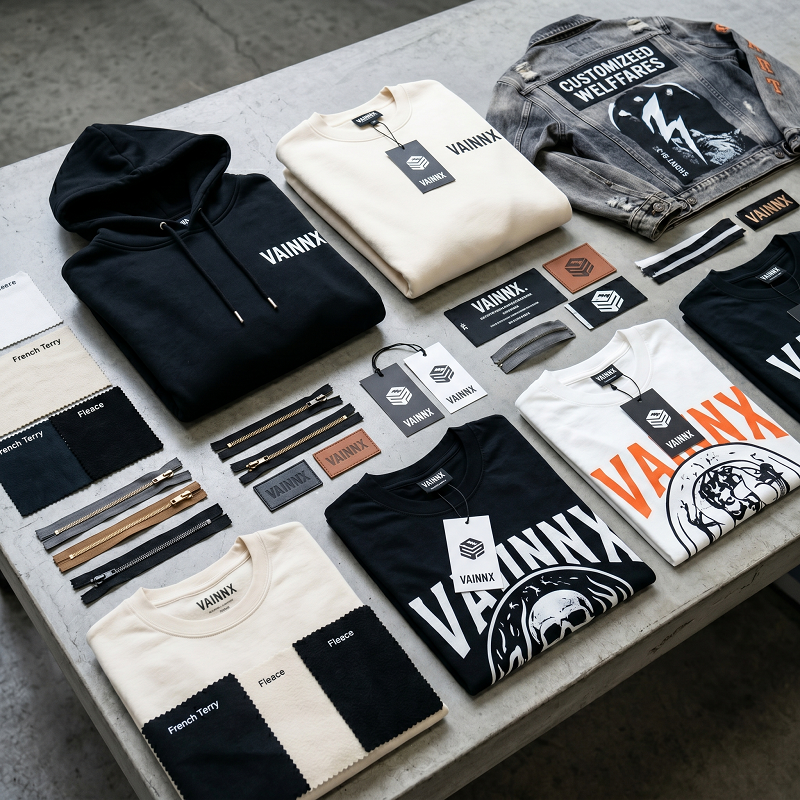
In the modern apparel manufacturing industry, running a production line without a comprehensive tech pack is an absolute impossibility. A tech pack serves as the literal "architectural blueprint" for a garment, functioning as the primary universal language spoken between fashion designers and apparel factories.
1. What Exactly is a Tech Pack, and What Crucial Elements Must It Contain?
A complete, factory-ready tech pack is vastly more complex than a simple fashion illustration or a stylistic mood board. It is an exhaustive, multi-page technical dossier that must include the following cornerstone components:
Technical Flat Sketches (CADs): Highly detailed, two-dimensional line drawings illustrating the exact front, back, and side views of the garment. These drawings must explicitly map out every structural detail, including topstitching lines, zipper paths, pocket alignments, and drawstring placements.
Bill of Materials (BOM): The financial and physical heart of manufacturing. The BOM explicitly itemizes every single material required to construct one unit of the garment. This includes the primary shell fabric (e.g., 400GSM ultra-heavyweight combed cotton), secondary trims (such as heavy-duty YKK metal zippers, high-density elastic ribbing), heavy-duty sewing threads, woven main labels, care labels, hangtags, and custom polybags.
Measurement Specification & Grading Rules: A precise matrix charting all critical physical dimensions (chest width, body length, shoulder-to-shoulder, sleeve length, armhole depth, neck drop) for the baseline sample size (typically an international Medium or Large). It must also specify the geometric grading increments for smaller (S, XS) and larger (XL, XXL, 3XL) sizes, establishing strict industrial tolerances (generally restricted to ±1cm).
Colorway Matrix & Graphic Placements: Absolute color specifications verified via international Pantone Textile Codes (TCX/TPX), coupled with pinpoint mathematical coordinates determining the exact dimensions, spacing, and placement of screen prints, embroideries, or specialized 3D puff printing on the fabric panels.
2. Why Low-Quality Tech Packs Cause Catastrophic Production Failures
As an established, high-capacity clothing manufacturer, our factory regularly reviews ambiguous design submissions that inevitably lead to severe production bottlenecks. For instance, when a designer submits only a highly stylized lifestyle photograph featuring dramatic lighting rather than a flattened technical schematic, the pattern maker is forced to blindly guess the structural layout. This guesswork routinely yields initial prototypes with distorted armholes or incorrect crop lengths, wasting expensive raw textiles and causing brands to miss critical seasonal drop windows. A precise, highly specific tech pack ensures absolute factory compliance, eliminates costly human error, and serves as your primary defense against mass-production budget overruns.
Phase 2: Fabric Sourcing & Custom Textile Development
The true soul of high-end streetwear resides entirely within the physical hand-feel, structural drape, and advanced finishing treatments of its fabrics. The visual slouchiness and tactile premium texture characteristic of modern luxury streetwear are governed entirely by the rigorous selection of raw yarn and structural knitting methods.
1. Critical Sourcing Metrics for Luxury Streetwear Textiles
Within the comprehensive supply chain ecosystem at VAINNX, we routinely guide independent streetwear brands through deep custom textile engineering. Authentic streetwear demands specialized heavyweight fabrics that maintain rigid architectural silhouettes:
Heavyweight Knit Textiles: Standard fast-fashion t-shirts utilize cheap 140GSM jersey, whereas luxury streetwear tees demand robust 260GSM to 300GSM double-yarn combed cotton. Similarly, premium streetwear hoodies and heavy sweatpants require 400GSM, 500GSM, or even massive 600GSM custom-knit French Terry or brushed fleece. These heavyweight materials are essential for supporting the boxy, oversized drop-shoulder silhouettes that dominate high-street fashion trends.
Hardware and Trim Customization: Streetwear outerwear and hardware must withstand intense, long-term physical wear. Consequently, we source heavy-gauge, custom-branded metal zippers (such as No. 8 or No. 10 asymmetrical metal tracks). All auxiliary hardware, including metal eyelets and drawstring aglets, must undergo anti-oxidation processing, distressed vintage brushing, or matte sandblasting to match industrial, brutalist design aesthetics.
2. Lab Dips, Color Matching, and Performance Testing
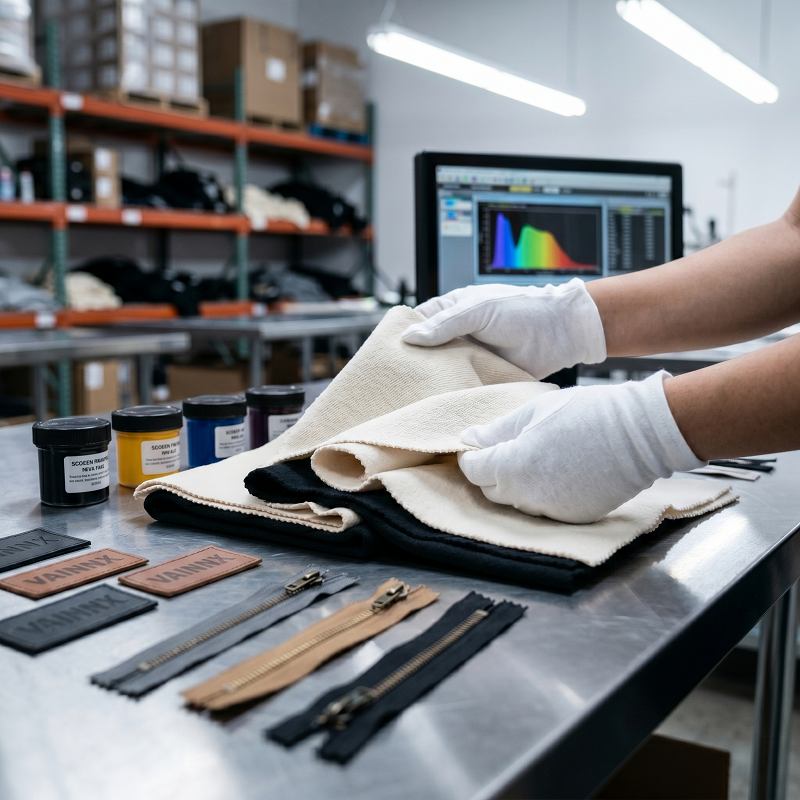
Once a specific textile formulation is finalized, the unbleached greige fabric is dispatched to the dye house for precision color sampling—a critical industrial milestone known as Lab Dips.
The dye technician utilizes the precise Pantone Codes provided in the tech pack to formulate three distinct chemical dye variations (labeled A, B, and C). These small fabric swatches are evaluated under standardized spectrophotometer lighting cabinets (using D65 artificial daylight and TL84 retail lighting) against the master reference swatch.
Massive commercial dye vats are only activated after the brand owner provides explicit, signed approval for a specific lab dip code.
Concurrently, a truly professional apparel manufacturer subjects the textile to comprehensive physical laboratory testing, including dimensional stability tests (ensuring heavyweight fleece does not shrink by two full sizes after the consumer's first home wash cycle) and colorfastness to crocking (preventing dark dyes from bleeding onto light-colored surfaces).
Phase 3: Digitized Pattern Making & Industrial Size Grading
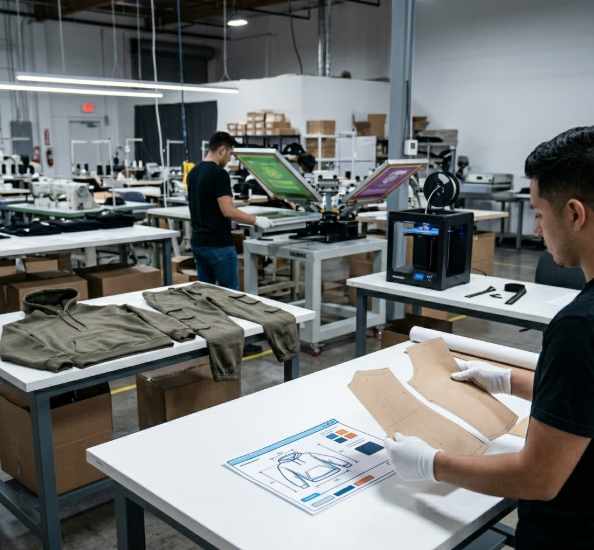
Following the finalization of the tech pack and the sourcing of raw textiles, the production workflow transitions to the most technically demanding artisan in the garment factory: the Pattern Maker. This phase involves translating flat 2D measurements into dynamic, 3D structural forms.
1. CAD Pattern Engineering and 3D Virtual Prototype Simulation
Modern, top-tier clothing manufacturers have completely replaced manual cardboard pattern drafting with sophisticated Computer-Aided Design (CAD) systems.
The pattern engineer uses CAD software to plot the exact geometric boundaries of every individual panel—including the front bodice, back bodice, sleeves, hood panels, and patch pockets—incorporating precise seam allowances based on the fabric's physical behavior.
To master complex streetwear structures (such as extreme drop-shoulders, batwing sleeves, or multi-paneled 3D cargo trousers), VAINNX employs cutting-edge 3D virtual prototyping software. This allows us to digitally assemble the 2D CAD patterns onto virtual fit models, simulating fabric drape, tension, and wrinkling. This eliminates up to 80% of structural fit anomalies before a single pair of shears ever touches real fabric.
2. Industrial Grading and Tolerance Management
Size grading is the mathematical process of scaling the validated baseline master pattern outward to generate larger sizes or inward to generate smaller sizes across the entire retail range.
Grading rules for streetwear diverge sharply from traditional tailored menswear. Tailored garments scale incrementally to maintain a close-to-body fit, whereas streetwear grading must preserve a highly specific oversized proportion. For instance, as a hoodie scales up to XXL, the overall body length may increase conservatively, but the shoulder width and armhole circumference must scale exponentially to retain that signature, slouchy high-street drape.
Every grading node across the CAD file must be calculated down to the millimeter. If the mathematical model behind the grading profile is flawed, the mass production run will suffer from catastrophic scaling issues—resulting in an M size that fits perfectly, while the XXL size completely loses its artistic silhouette and fits like an unformed, boxy sack.
Phase 4: Sample Prototyping & Pre-Production Sample Validation
Before a clothing manufacturer activates hundreds of industrial sewing machines for mass production, the collection must clear several iterative stages of physical prototyping. This sample review cycle is the most critical safeguard a professional clothing factory provides to insulate apparel brands from manufacturing risks.
1. The Three-Tier Sampling Development Protocol
A mature, enterprise-grade apparel development cycle consists of three separate, non-negotiable physical prototyping stages:
①Proto Sample (Development Sample): This initial physical garment is constructed primarily to assess structural fit, silhouette, and pattern accuracy. At this early stage, factory technicians bypass expensive custom dyes and bespoke graphics, opting instead to use readily available substitution fabrics of an equivalent weight. The focus is entirely on verifying body proportions, sleeve pitch, and overall drape.
②Size Set Sample: This run is executed to validate the wearability and visual balance of every single size within the planned grading scale (S, M, L, XL, XXL). The factory produces a complete set of physical sizes, which are thoroughly tested on live, professionally proportioned fit models. This ensures that the aesthetic integrity of the garment does not degrade or distort at the extreme ends of the sizing spectrum.
③Pre-Production Sample (PPS): The absolute "supreme judge" of the entire manufacturing process. The PPS must be a 100% flawless replica of the final retail product, utilizing the exact bulk-production dyed fabric, custom hardware, verified screen prints, woven branding labels, care tags, and commercial packaging. Crucially, the PPS must be assembled directly on the primary mass-production line by the actual line operators. Once the brand director signs off on the PPS, it becomes the legally binding quality benchmark for the entire bulk production run.
2. The Pre-Production (PP) Alignment Conference
Immediately following the formal approval of the PPS, the apparel factory convenes a mandatory, closed-door Pre-Production Meeting. This alignment involves the manufacturing director, the chief quality control (QC) manager, the workshop line supervisor, and the raw materials procurement lead. The team reviews every line of the tech pack alongside the approved PPS to dissect potential operational hazards. For instance, if a 600GSM ultra-heavy fleece presents a risk of skipped stitches when crossing a four-layer seam overlap, the supervisor will mandate a transition to heavy-duty size 14 industrial needles and pre-program specific sewing machine tensions to guarantee flawless execution across thousands of units.
Phase 5: Comprehensive Quality Control & Final Garment Finishing
The moment a garment completes its final sewing assembly, it is still classified as a "semi-finished commodity." To pass global retail customs and clear premium boutique inspection benchmarks, it must navigate a highly rigorous post-production finishing and quality assurance protocol.
1. The Eight-Step Closed-Loop Quality Assurance Protocol
VAINNX operates a meticulous, multi-stage finishing workflow to guarantee that every single garment dispatched to international buyers arrives as a functional piece of art:
①Initial Cleaning and Thread Trimming: Dedicated operators utilize high-suction trimming devices to remove all visible structural thread remnants longer than 2mm from both the exterior and interior surfaces.
②High-Pressure Steam Forming & Pressing: Garments are mounted onto specialized pneumatic form finishers and ironed using industrial-grade, high-pressure dry steam irons to erase structural wrinkles induced during sewing and stabilize the heavy cotton fibers.
③100% Final Visual Inspection: Every single unit passes through high-lumen, color-corrected inspection stations where veteran QC officers perform an exhaustive, multi-point manual scan of the exterior face, interior lining, underarm junctions, pocket linings, and graphic print matrices, rejecting any piece showcasing minimal oil spots, skipped stitches, color shading, or graphic micro-cracking.
④Mathematical Measurement Auditing: QC leads randomly pull a 10% statistical sample from every finished sub-batch, deploying soft precision tape measures to audit 12 core dimensions against the approved PPS. Every metric must align perfectly within the strict allowed industrial tolerance window.
⑤Automated Needle Detection & Ferrous Metal Scanning: This represents a vital, non-negotiable safety redline for premium international retail distribution. Prior to final packing, 100% of finished garments must pass through an automated, high-sensitivity electromagnetic conveyor needle detector. If the system detects a micro-fragment of a broken sewing needle embedded deep within the heavy seams, an alarm triggers, the conveyor reverses, and the garment is permanently quarantined and destroyed. This completely eliminates any liability risk or physical hazard to the end consumer.
⑥Trims, Branding, and Barcode Verification: Inspectors verify that the main labels, care readouts, and size tabs are aligned correctly, while scanning the external hangtag barcodes (UPC/EAN strings) to ensure perfect integration with the buyer's global logistics and warehouse management systems.
⑦Precision Folding & Specialized Single-Unit Packaging: Garments are folded according to precise retail dimensions and sealed inside custom-branded, high-thickness frosted zipper polybags embedded with anti-moisture desiccant packets to prevent any atmospheric degradation during transit.
⑧Heavy-Duty Export Master Carton Packing: Packed units are systematically arranged into five-layer, ultra-rigid double-wall corrugated export master cartons. Cartons are fully wrapped in industrial waterproof stretch film, reinforced with heavy-duty poly strapping to ensure they survive long-haul cross-border ocean freight or air transit without structural collapse or moisture infiltration.
Conclusion: Aligning with a Master Apparel Manufacturer to Solidify Your Brand’s Legacy
From the geometric engineering of the initial clothing tech pack to the complex logistics of final bulk apparel production, high-end garment manufacturing is a highly precise, detail-driven marathon that leaves absolutely no room for operational amateurism. As demonstrated throughout this comprehensive guide, every single phase of production requires deep industrial heritage, advanced heavy equipment arrays, and unyielding quality management systems.
For any ambitious streetwear brand eyeing global expansion, your creative leadership should not be squandered on micromanaging factory floors, chasing down missing threads, or fixing off-center prints. Partnering with an experienced, authoritative streetwear apparel manufacturer that fundamentally understands heavy textiles, advanced streetwear aesthetics, and industrial quality control is the single fastest mechanism to scale your fashion footprint globally.
At VAINNX, we provide brands with state-of-the-art production facilities spanning thousands of square meters, a robust global textile sourcing network, and an elite team of master artisans who live and breathe authentic streetwear culture. Whether you are an independent designer launching your premier capsule collection utilizing our flexible Minimum Order Quantities (MOQs), or an established global label requiring consistent, high-capacity bulk manufacturing outputs across hundreds of thousands of units, we possess the infrastructure to seamlessly transform your wildest concepts into premium apparel realities.
Are you ready to deploy your next viral seasonal collection? Visit our official digital hub at VAINNX (https://www.vainnx.com/) today to connect directly with an executive account manager. Dispatch your tech pack to our engineering desk, and let us embark on an extraordinary manufacturing partnership from creative inspiration to flawless mass production!
📞 Phone: [86-15015158179]
📧 Email: [info@vainnx.com]
🌐 WhatsApp:[https://wa.me/8618025298509]
Click the link above to start designing your custom streetwear today. We can’t wait to help you express your bold style!